December 15th, 2025
Pre-Launch Validation Checklist for Startup Founders
Validate before you build: prove the problem, find early adopters, test pricing and landing pages, then decide to build, pivot, or stop.
Warren Day
Launching a startup without proper validation is risky. Here’s why: 20% of startups fail in their first year, and 75% of venture-backed startups don’t succeed. Why? Many founders skip the critical step of testing their idea before investing time and money.
What is validation? It’s the process of confirming that your target market has a problem, that your solution solves it, and that people are willing to pay for it. This guide provides a step-by-step checklist to help you validate your idea, minimize risk, and make informed decisions.
Key Steps:
- Define the Problem and Solution: Clearly outline the problem you’re solving and your proposed solution. Avoid vague ideas.
- Identify Your Audience: Focus on those most affected by the problem (early adopters) and understand their needs.
- Test Demand: Conduct interviews, surveys, and create landing pages to measure interest and willingness to pay.
- Set Validation Goals: Use measurable benchmarks like email signups, pre-orders, or conversion rates to track progress.
- Decide Next Steps: Based on feedback, decide whether to move forward, pivot, or stop.
This process ensures you’re building something people actually want, reducing the chances of failure. Validation isn’t a one-time step - it’s ongoing and helps guide your decisions at every stage.
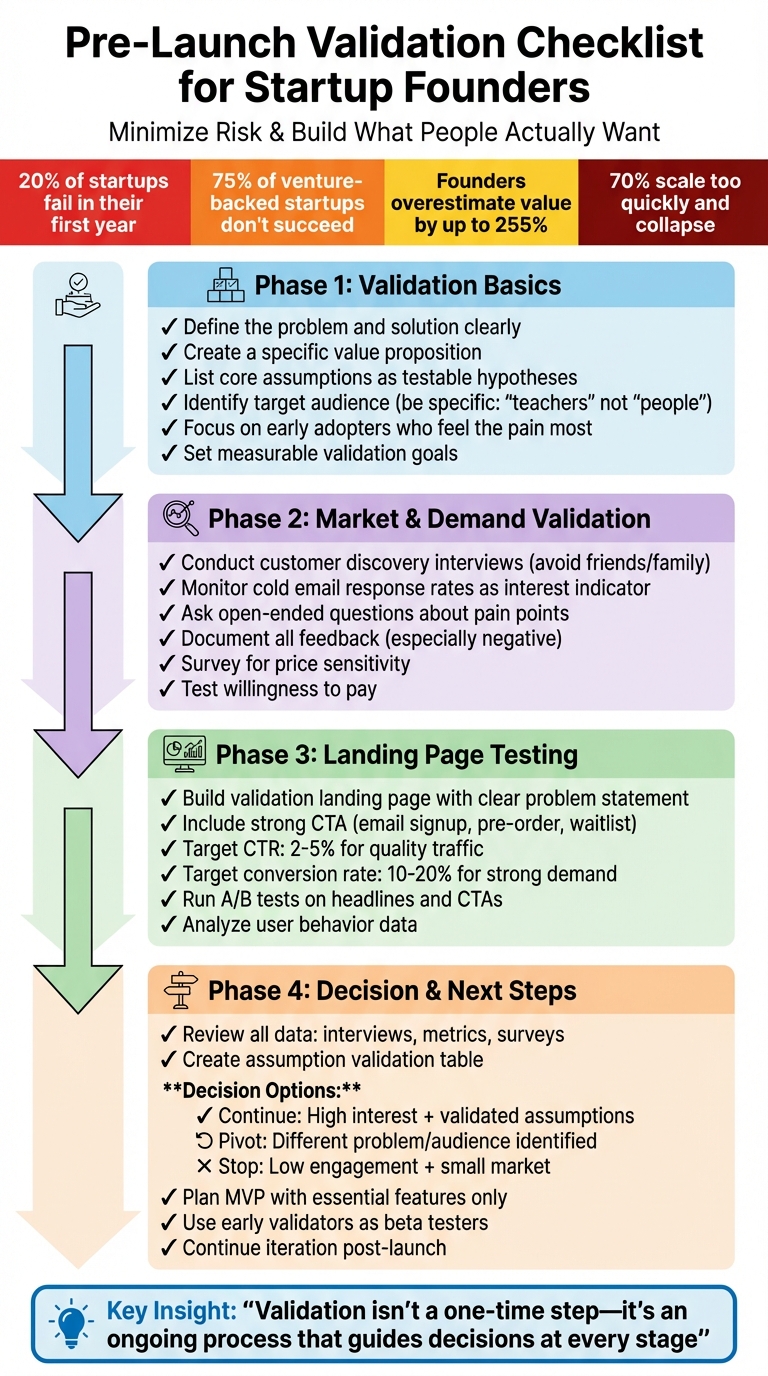
Startup Validation Checklist: 4-Step Process to Validate Your Business Idea
5 STEPS to Validate Your Product Idea FAST in 2025 - BEFORE Your Create or Launch ANYTHING
Validation Basics Checklist
Before diving into testing, it’s crucial to establish a solid foundation. This starts with clearly defining the problem you’re addressing, identifying who faces that problem, and outlining the assumptions behind your proposed solution. Without this groundwork, your efforts could easily miss the mark. Once the foundation is in place, focus on detailing the specifics of the challenge and the solution you’re offering.
Define Your Problem, Solution, and Assumptions
Start by documenting your problem in clear, specific terms. Avoid vague statements and instead describe a real-world scenario that highlights the inefficiency your product aims to fix. The key is to deliver genuine value to your target audience.
Craft a concise value proposition that clearly explains how your solution improves outcomes for your customers. Keep it straightforward and focused. As Matt Lerner, Co-founder and CEO of SYSTM, puts it: “Winning messages that resonated with all prospects aren’t watered down. Find a message that’s quite specific but still has broad appeal.” Resist the urge to make your solution all things to all people.
Next, list your core assumptions and establish measurable criteria for success. Turn each assumption into a testable hypothesis. This step can help you steer clear of overestimating your idea’s appeal - a common pitfall for founders, who have been known to overestimate value by as much as 255%.
Identify Your Target Audience and Early Adopters
Define your target customer with precision. Use specific terms like “teachers,” “front-end software developers,” or “restaurant managers,” rather than relying on vague descriptors. Build a detailed profile by considering their daily frustrations, current spending habits, and broader goals. This level of understanding allows you to create a clear customer archetype with identifiable needs and motivations.
Once you’ve defined your audience, zero in on those most affected by the problem - your early adopters. These are the people who feel the pain most acutely and are most likely to pay for a solution. Webb Brown and Ajay Tripathy, Co-founders of Kubecost, stress the importance of these early conversations: “When talking to potential customers, they should express keen interest. They should be engaged in the conversation and ready to pull out their wallets on the spot to pay for your solution. There should be no space for doubt when it comes to validating your problem or solution through customer conversations.”
Finally, set measurable validation goals to track your progress. Define what success looks like, whether it’s the number of customer interviews, email signups on a validation landing page, or conversion rates from test ads. These concrete benchmarks will help you make objective decisions about whether to move forward, pivot, or stop altogether. By following these steps, you’ll lay a strong groundwork for testing market demand.
Market and Demand Validation Checklist
Once you've identified your problem and target audience, the next step is to confirm there's real demand for your idea. This involves engaging with potential customers and gathering evidence that they’re not just interested but willing to pay.
Conduct Customer Discovery Interviews
After defining your audience, direct interviews are a great way to test your assumptions. Reach out to potential customers who fit your target profile through cold emails. It's best to avoid interviewing friends or family - they're likely to give you biased feedback. Ryan Glasgow, a product manager turned founder, shared this insight from his own experience:
"One of the key learnings I had early on is to never involve people who you personally know in the customer development process."
Pay attention to cold email response rates - they can be an early indicator of interest. If response rates are low, it might suggest your value proposition isn’t resonating. During the interviews, focus on open-ended questions that allow customers to explain their pain points in their own words.
Be sure to document everything you learn. UX expert Jeanette Mellinger offers this advice:
"When you're asking for feedback, don't only listen for the things that sound good. Make space for the things you don't want to hear - those are the ones that's what will make your product better."
Measure Demand and Price Sensitivity
Once you’ve gathered qualitative insights, it’s time to back them up with quantitative data. A simple survey can help you test different price points and understand how much customers are willing to pay. Ask direct questions about their budget and which features they find valuable enough to justify specific price ranges.
The strongest signal of demand? When someone tries to buy your solution. Create a validation landing page with a clear call-to-action, such as pre-ordering or joining a waitlist. A pre-order conversion rate between 10% and 20% is a good benchmark for strong demand. If you're collecting email signups, track the conversion rate and follow up with a survey to gauge budgets and timelines for purchasing.
sbb-itb-9a9c51d
Landing Page and Message Testing Checklist
Once you've confirmed there's demand in the market, the next step is turning that insight into a landing page that puts your message to the test. Think of your landing page as more than just a marketing tool - it's a way to validate your assumptions by capturing real user responses before committing major resources to product development.
Build a Validation Landing Page
Start with a headline that clearly addresses the problem you're solving, followed by a subheadline that explains how your solution works.
Your call-to-action (CTA) should encourage users to take a step that signals commitment. This could be signing up with their email, completing a survey, or even going through a mock checkout process. Tools like LaunchSignal’s landing page templates can help streamline this with built-in features.
Test and Analyze Your Landing Page
Pay attention to both how visitors find your page (acquisition) and how they respond once they’re there (conversion). A click-through rate (CTR) in the range of 2–5% generally indicates you're attracting quality traffic.
To refine your message, run A/B tests on key elements like headlines, value propositions, and CTAs. Make sure to gather enough traffic to achieve statistically meaningful results. Use this data to adjust your landing page based on how users interact with it.
Make Your Decision and Plan Next Steps
Review Results and Decide: Pivot, Continue, or Stop
Start by pulling together all the data you’ve gathered - interview notes, landing page metrics, survey responses, and engagement stats. Look for recurring themes in customer feedback, especially around pricing, features, or alternatives. One of the strongest indicators of success is whether customers show genuine excitement and a willingness to pay for your solution.
To make sense of your findings, create a simple table. List each assumption you made about customer needs, product features, and market demand, then note whether each was validated. If most of your assumptions hold true and customer interest is high, it’s a good sign to move forward. On the other hand, if feedback suggests your idea misses the mark or points to a different problem or audience, consider pivoting. And if the market opportunity seems small and customers aren’t engaged, it might be time to step back. As Ryan Glasgow, a former PM turned founder, wisely puts it:
"A great outcome for any startup, product or new feature that you're working on is that you determine in the very beginning, or as soon as possible, that it's not worth spending time on."
Keep in mind that validation doesn’t stop here - it’s a continuous process that should guide your decisions well beyond the launch phase. With over 75% of venture-backed startups failing and 70% scaling too quickly only to collapse, these insights can help you avoid common mistakes.
Plan Your MVP or Prototype
Once your decision is clear, it’s time to focus on building a prototype. If you decide to move forward, start with an MVP (Minimum Viable Product) - the smallest set of features that solves the validated problem and that customers are willing to pay for. Resist the urge to include every feature you’ve envisioned; instead, zero in on the essentials.
Begin with basic designs using tools like Figma or Adobe XD, or create a working prototype quickly with no-code platforms like Bubble or Webflow. Before launching, set clear metrics to measure success - track sign-ups, user engagement, and conversion rates to gauge how people are interacting with your product.
Reach out to the individuals who participated in your validation process; they can be your first beta testers. Use tools like LaunchSignal’s analytics dashboard to monitor early user behavior and gather actionable data. Keep refining your product based on this feedback. Remember, the process doesn’t end with launch - an active feedback loop and ongoing iteration are key to building something customers truly value.
Conclusion: Your Pre-Launch Validation Checklist
Validation is your safeguard against spending months on a product that misses the mark. By focusing on what your customers actually need, you can avoid costly missteps and build something that truly connects with your audience.
This checklist has walked you through the critical steps - from identifying the core problem to testing demand and making data-driven decisions. These steps empower you to confidently decide whether to move forward, pivot, or hit pause on development.
What’s great about this process is that it’s not about failure - it’s about learning quickly and conserving your resources for ideas that genuinely resonate with your target market.
FAQs
What’s the best way to find early adopters for my startup?
To connect with early adopters, zero in on specific niche groups within your target audience who stand to gain the most from your product. Begin by conducting surveys or interviews to uncover their needs and challenges. Offer prototypes or minimum viable products (MVPs) to collect feedback and fine-tune your solution based on their input.
Consider providing exclusive perks like early access or discounts to motivate these users to try your product and spread the word. Building authentic relationships with early adopters not only helps you gather essential insights but also turns them into enthusiastic advocates for your brand.
What mistakes should I avoid when validating my startup idea?
When you're working to validate your startup idea, steering clear of common missteps can make all the difference. One major error? Relying solely on personal assumptions without backing them up with real data. Assumptions might feel intuitive, but without evidence, they can lead to decisions that don’t align with your audience's actual needs.
Skipping customer interviews is another trap. Without talking to potential users, it’s easy to misjudge what they truly want or need. A product built in isolation often misses the mark.
Then there’s the mistake of ignoring feedback from early users. That feedback is pure gold - it helps you refine and improve your idea. Overlooking it can mean missing out on critical adjustments that could make or break your product.
Finally, beware of scaling too early. Jumping into growth before validating your concept can waste time, money, and energy. Instead, focus on iterative testing - adjust, test again, and let user insights shape your next move.
How can I tell if I should pivot or stop based on validation results?
When reviewing your validation results, zero in on critical factors like customer feedback, engagement metrics, and whether your initial assumptions hold true. If the data points to consistently low interest, unresolved issues, or a mismatch between user needs and your solution, it might be time to rethink your approach - whether that means pivoting or even pausing the project altogether.
Pay attention to recurring patterns across different validation stages. Signals like poor user engagement, lack of demand, or repeated feedback that uncovers major flaws shouldn’t be ignored. These are clear indicators that a shift in strategy or a thorough reevaluation is needed. Let the data guide your decisions, and focus on aligning your product with what the market truly needs to reduce potential risks.
Start validating ideas in minutes not days
Create high-converting landing pages. Test with real users. Get purchase signals. Know what to build next.
Visit LaunchSignal