December 26th, 2025
Email Signups vs. Fake Checkouts: Which Validates Better?
Compare email signups and fake checkouts for product validation—how each measures interest, purchase intent, setup complexity, and when to use them.
Warren Day
When testing whether your product idea resonates with customers, two popular methods stand out: email signups and fake checkouts. Both are designed to gauge interest, but they serve different purposes and provide distinct insights. Here’s the quick breakdown:
- Email signups: Simple and cost-effective. They measure general interest by collecting contact details from people who want updates about your product. Great for building an audience but may not indicate willingness to pay.
- Fake checkouts: Simulate the buying process to assess purchase intent. Users add items to a cart and proceed to checkout, but no actual transaction occurs. This method offers stronger signals of intent but requires more effort and risks frustrating users.
Quick Comparison
| Factor | Email Signups | Fake Checkouts |
|---|---|---|
| Commitment Level | Low: Reflects curiosity | Medium: Indicates purchase intent |
| Data Collected | Emails for follow-ups | Behavioral data (cart activity, drop-offs) |
| Setup Complexity | Simple: Landing page + form | Moderate: Simulated checkout flow |
| Best For | Gauging early interest | Testing pricing and purchase intent |
Key Insight: Start with email signups to measure interest quickly, then use fake checkouts to confirm if people are willing to pay. Both methods work best when combined, offering a clear path from curiosity to commitment.
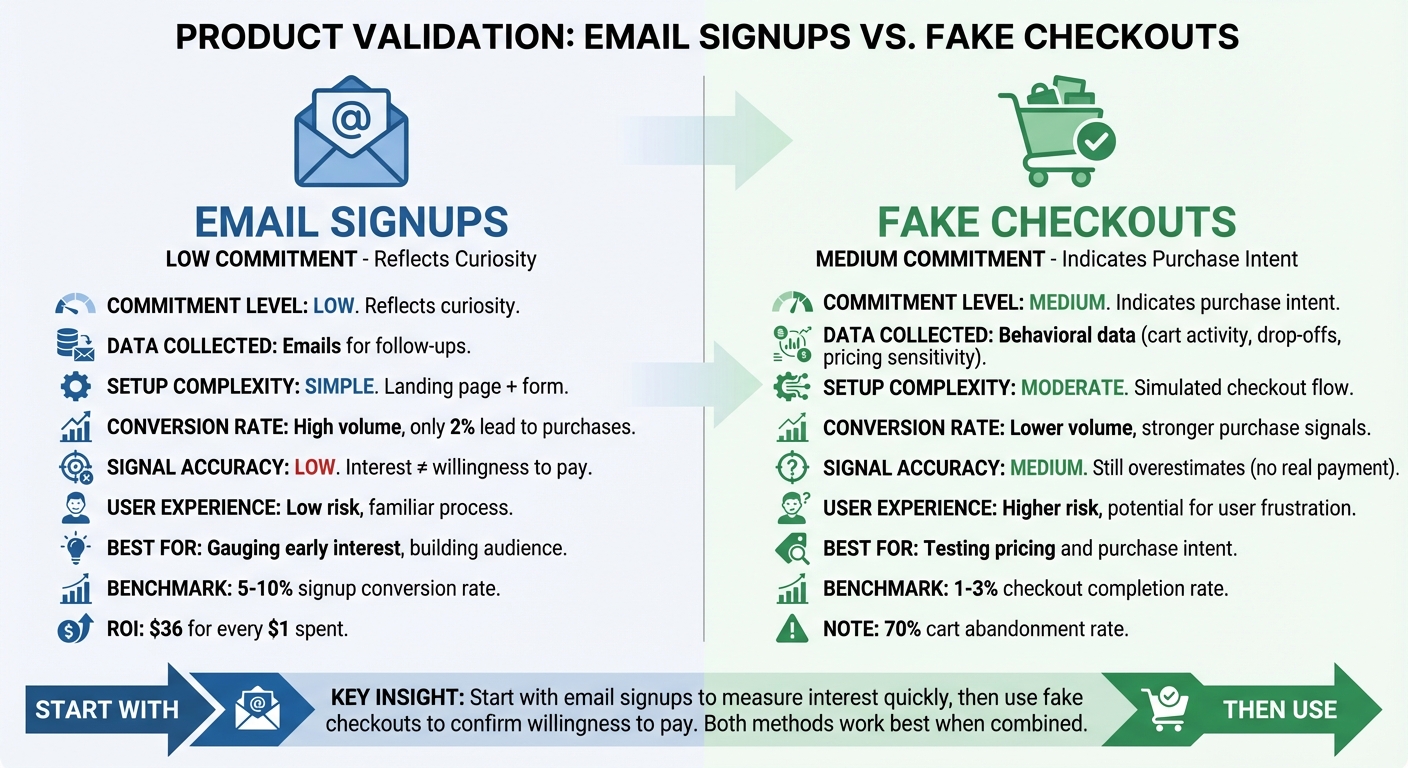
Email Signups vs Fake Checkouts: Complete Validation Method Comparison
How Email Signups Work for Product Validation
How Email Signups Function
Email signups are a simple way to gauge customer interest by offering updates, early access, or exclusive perks in exchange for contact information. Typically, a landing page introduces your product idea, often using visuals or videos to capture attention. When users provide their email addresses, it’s a clear sign of genuine curiosity or interest.
To drive signups, strategies like waitlists, update notifications, or lead magnets (e.g., early bird discounts) offer compelling incentives. As Userpilot explains, "Product idea validation is a process during which product teams test and tweak the product concept to ensure it satisfies a real market need".
The number of signups you gather can reveal the level of market demand. Beyond that, your email list becomes a valuable resource for conducting interviews, focus groups, or recruiting beta testers.
Main Benefits of Email Signups
Email signups provide an affordable way to test product interest. With a well-designed landing page and targeted ads, you can launch a campaign in just a few days - no finished product required.
Subscribers to your mailing list often show higher engagement. On average, they spend 80% more time on brand websites and are twice as likely to make a purchase. This makes email signups a powerful tool for building an audience of engaged prospects who could convert into paying customers down the line.
Common Problems and Limitations
While email signups are effective, they’re not without challenges. One major issue is data quality - over 20% of email addresses become invalid each year, and about 28% of an email list can expire within just 12 months. Fake entries and typos can also inflate your numbers without providing real validation.
Using a double opt-in process can help address this issue. It requires users to confirm their email address via a verification link, ensuring higher-quality signups. However, roughly 20% of people fail to complete this step. Those who do, though, are more likely to be genuinely interested. As MarketingExperiments notes, "The more prospects want what you're selling, the more likely they'll do what you ask". This underscores the importance of crafting a strong value proposition to convince users to take that extra step.
Another challenge is maintaining proper email list hygiene. High bounce rates and spam complaints can harm your sender reputation. Regularly cleaning your list and using real-time validation tools can prevent bad data from clogging your system. Additionally, about 70% of customers are more likely to interact with personalized messages, making it crucial to prioritize quality over quantity when collecting email addresses.
This method lays the groundwork for more advanced validation techniques, like simulated purchase flows, which will be covered next.
How Fake Checkouts Work for Product Validation
How Fake Checkouts Function
Fake checkouts replicate the buying process by using familiar UI elements like add-to-cart buttons, checkout forms, and payment screens. However, instead of processing payments, the flow stops with a message such as "Coming Soon" or "Want to be notified about the launch?" This message explains that the feature isn't live yet and often prompts users to provide their email for updates. These simulations also track critical engagement metrics, including clicks and drop-off rates, offering valuable insights into how many users might complete a real purchase.
Main Benefits of Fake Checkouts
Simulated checkouts provide a stronger indicator of user intent compared to email signups. Actions like adding items to a cart and filling out forms demonstrate a higher level of interest, acting as a clear signal of genuine demand.
"Each design is a proposed business solution; a hypothesis. Your goal is to validate the proposed solution as efficiently as possible by using customer feedback." – Jeff Gothelf, Author and Organizational Designer
Common Problems and Limitations
One major downside of fake checkouts is the risk of frustrating users. When users discover they can’t complete a purchase, they might feel deceived, which can harm trust and damage your brand’s reputation before your product even launches. To address this, transparency about the feature's pre-launch status is essential.
Another challenge is the effort required from users, which often leads to higher drop-off rates compared to email signups. While this filters for more committed users, it also results in fewer overall conversions. For these reasons, fake checkout tests should be conducted over a limited timeframe - typically a few weeks to a few months - to avoid prolonged user confusion. These considerations can help you decide whether fake checkouts or email signups are the better choice for validating your product.
Email Signups vs. Fake Checkouts: Direct Comparison
Comparison Table: Metrics and Factors
Now that we’ve covered how each method operates, let’s break them down side by side. Here's a comparison of the key metrics and factors that matter most when it comes to validation:
| Factor | Email Signups | Fake Checkouts |
|---|---|---|
| Commitment Level | Low - reflects general interest or curiosity | Medium - indicates intent to purchase and willingness to engage in the buying process |
| Data Collected | Email addresses and validation details (e.g., format, domain, mailbox existence) | Click behavior, checkout progression, drop-off points, and pricing sensitivity |
| Conversion Rate | High volume of signups, but only about 2% lead to actual purchases | Lower volume due to higher effort, but offers clearer signals of purchase intent |
| Setup Complexity | Simple - usually involves a basic signup form with email verification | Moderate - requires creating a simulated checkout flow with multiple steps |
| User Experience | Low risk - users are accustomed to sharing their email for updates | Higher risk - users may feel misled if the process isn’t clearly communicated |
| Signal Accuracy | Low - interest doesn’t necessarily translate to willingness to pay | Medium - tends to overestimate conversion since no actual payment is processed |
| Best For | Gauging early interest and building an audience | Testing pricing, purchase intent, and identifying checkout friction points |
Advantages and Disadvantages of Each Method
Email signups provide a quick and easy way to validate initial interest while keeping user friction low. This makes it possible to collect a large number of contacts in a short time. But as Daphne Tideman from RevenueCat points out:
"Clicks might feel like progress, but they aren’t the same as paying customers (same for email sign-ups, sadly). Interest and commitment are not equal. I’ve seen founders get hyped about big pre-launch email lists, only to watch 2% convert. Painful."
On the other hand, fake checkouts dig deeper into user behavior by simulating a purchase process. This method gives a clearer picture of pricing strategies and potential sticking points in the checkout flow. However, it does come with its own challenges, like lower overall conversion rates and potential trust issues if users feel misled. Tideman also highlights:
"Just remember: this method [fake door testing] will still overestimate actual conversion rates, because no one’s entered a real payment form yet. You haven’t put a ring on it (or in this case, you haven’t got their credit card information)."
Neither method is a perfect predictor of actual sales. Email signups are great for capturing broad interest, while fake checkouts help filter for more serious buyers. The right choice depends on your product validation stage and what kind of insights you’re looking to gain about your audience.
sbb-itb-9a9c51d
How To Validate Your Product (From Ideas To Delivery)
Choosing the Right Method for Your Product
When deciding how to validate your product idea, consider your startup's stage and the type of data you need. Email signups are a great starting point for gauging general interest with minimal commitment. This method works especially well for B2C products or content platforms where you're still figuring out your target audience. Aiming for a 5–10% signup conversion rate can help you measure initial interest effectively. Once you’ve confirmed there’s interest, it’s time to shift gears and focus on direct purchase signals.
For testing purchase intent, fake checkouts are a powerful tool. They’re particularly useful for SaaS products, high-ticket items, or e-commerce businesses where pricing sensitivity matters. If you’ve already established interest and need to determine whether people are willing to pay, this approach can provide clarity. A 1–3% checkout completion rate is a good benchmark to confirm demand. As Nimi Kular, Co-founder of Jaswant's Kitchen, wisely notes:
"Market evaluation, surveys, and feedback from friends and family can point you in the right direction, but money is the only thing that can validate a product."
Each method has its strengths. Email signups are ideal for campaigns targeting a broad audience, while fake checkouts signal a deeper level of commitment. For B2C products with lower price points, email signups allow you to build and nurture a larger audience over time. On the other hand, SaaS products and high-value items benefit from the stronger purchase intent signals that fake checkouts provide. It’s worth noting that email marketing offers a strong return, with an average ROI of $36 for every $1 spent.
That said, keep in mind that 70% of e-commerce users abandon their cart, meaning fake checkouts might still overestimate your actual conversion rate. However, they remain a more reliable measure of purchase intent compared to email signups, which typically convert only about 2% of signups into actual purchases.
Once you’ve set your conversion benchmarks and identified the best method for your product, fine-tune your validation tools. For email signups, use real-time email verification to ensure accuracy. When designing fake checkouts, focus on simplicity and trustworthiness - after all, 19% of online shoppers abandon their cart because they don’t trust the site with their credit card. Tools like LaunchSignal can help you quickly create validation pages for both email capture and fake checkouts, no coding required.
Conclusion
Both approaches bring unique strengths to the table when it comes to validating a product idea. Email signups are a quick way to measure interest and start building an early audience, but they need real-time verification to ensure the data is reliable. On the other hand, fake checkouts offer a deeper look into user commitment by tracking how far they go in the buying process. That said, with nearly 70% of online shopping carts being abandoned, the conversion rates you see might not fully translate to actual sales.
A smart strategy is to combine these methods: start with email signups to gauge general interest, then move on to fake checkouts to understand pricing and buying behavior. This step-by-step approach gives you a well-rounded view of your product's potential.
For an easier way to put this into action, tools like LaunchSignal can help. It lets you create validation pages for both email collection and fake checkouts - no coding required. You can track all your metrics in one place, test multiple ideas at the same time, and use pre-designed templates to focus on conversions. Plus, with built-in analytics, you can export the data and confidently decide which product ideas are worth pursuing.
FAQs
What are the advantages of using both email signups and fake checkouts to validate a product idea?
To get a clearer picture of your product's potential, combining email signups and fake checkouts is a smart approach. Email signups reveal genuine interest and show that people are curious enough to stay in the loop. Meanwhile, fake checkouts go a step further by testing whether customers are ready to take action and make a purchase.
Using both methods together minimizes the chances of misleading results. This dual approach gives you deeper insights into your audience's behavior and helps you make smarter, data-backed decisions before committing to full-scale development.
How can businesses collect accurate and reliable data from email signups?
To gather precise and trustworthy data from email signups, businesses can leverage real-time email validation tools. These tools help catch typos, identify disposable email addresses, and filter out invalid entries before they make it into your system. Adding verification measures like CAPTCHA or social logins can further block automated bots or fake signups. Additionally, keeping an eye out for unusual activity - like multiple signups in quick succession from the same IP address - can help identify suspicious behavior.
It's also important to routinely clean and validate your email list. This not only keeps your data accurate but also minimizes costs tied to outdated or low-quality contacts. Taking these steps ensures your signup data remains reliable and actionable.
What are the potential risks of using fake checkouts, and how can they be avoided?
Using fake checkouts to test product ideas can backfire if not handled carefully. Risks include harming your brand’s reputation, potential legal trouble, and eroding customer trust. These problems often occur when users feel misled or when disclaimers are unclear or missing.
To reduce these risks, it’s crucial to be upfront with your audience. Clearly explain the purpose of the fake checkout and ensure it aligns with legal and privacy standards. Keep an eye on user feedback and behavior to catch any red flags early. Most importantly, steer clear of tactics that might come across as dishonest or manipulative. Transparency and ethical practices go a long way in maintaining trust.
Start validating ideas in minutes not days
Create high-converting landing pages. Test with real users. Get purchase signals. Know what to build next.
Visit LaunchSignal