December 12th, 2025
How to Validate a Product Idea in 48 Hours
Five-step method to test product-market fit in 48 hours using a landing page, single CTA, small ad tests, and real-time analytics.
Warren Day
Most products fail because they’re built without testing if people actually want them. Instead of spending months and thousands of dollars on an unproven idea, you can validate your product concept in just 48 hours. Here’s how:
- Set clear goals: Define the problem, audience, and your success criteria. Focus on testing one key assumption, like whether people will pay for your solution.
- Build a simple funnel: Create a landing page with a single call-to-action, like “Join the Waitlist” or “Pre-Order Now.” Add a questionnaire or fake checkout to gauge interest.
- Launch quickly: Use tools like LaunchSignal to create and publish your page in hours. Share it in relevant online communities or run small, targeted ad campaigns.
- Track and adjust: Monitor metrics like sign-ups and engagement. Make real-time tweaks to your messaging or pricing based on user behavior.
- Analyze results: Compare your data to your success benchmarks. Decide whether to move forward, pivot, or scrap the idea.
This method saves time, money, and effort by showing whether your idea has real potential before you fully commit.
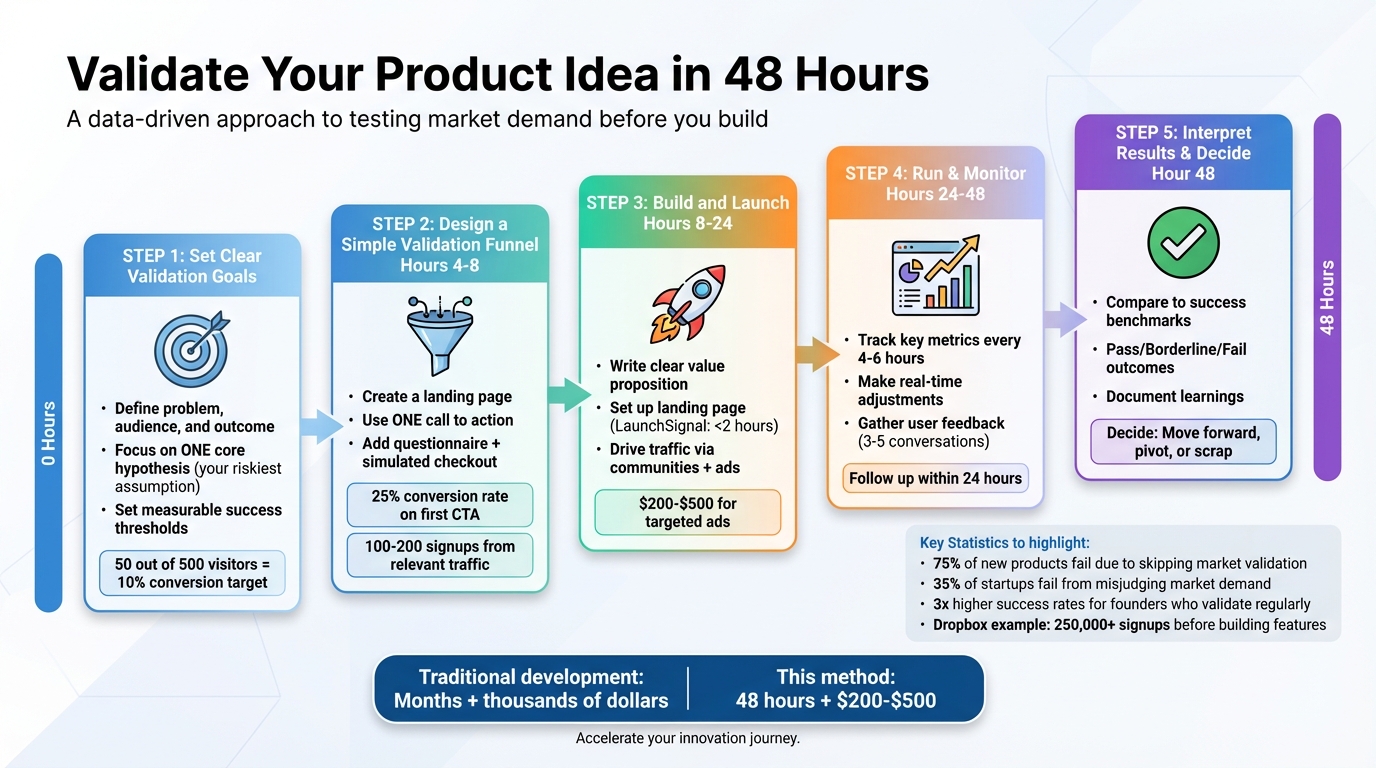
5-Step Product Validation Process in 48 Hours
How to Validate Your Startup Idea for $50 (Same Method That Built a $100M Brand)
Step 1: Set Clear Validation Goals
Before you dive into testing, make sure you know exactly what you're aiming to validate. Without clear goals, you risk wasting valuable time and effort. Product validation helps you confirm things like problem-solution fit, willingness to pay, and whether there's scalable demand for your idea. Start by defining these elements as precisely as possible.
Define the Problem, Audience, and Outcome
Pinpoint the problem you're solving, who it's for, and what success looks like. Use a structured approach like this: "I believe [specific group of people] struggle with [specific problem], and [my solution] will help them [achieve specific outcome] by [unique method/approach]".
Avoid broad, vague statements like "busy professionals need better productivity tools." Instead, aim for clarity and specificity. For example: "I believe remote software developers struggle with tracking billable hours across multiple clients, and my automated time-tracking app will help them capture 100% of billable time by running silently in the background and categorizing work by project."
"Bootstrapped startup founders have trouble getting UX feedback because they have no reliable sources to turn to." - Grace Ng, Co-Founder of Javelin
This example from Grace Ng is highly specific. She identifies exactly who the audience is and what their pain point involves.
Focus on One Core Hypothesis
During your testing phase, concentrate on your riskiest assumption - the one you’re most uncertain about or lack data on. Trying to validate multiple aspects, like pricing, features, and audience fit, all at once will muddy your results. Grace Ng stresses the importance of narrowing your focus: identify which assumption is the most critical to test.
For instance, if you're unsure whether customers are willing to pay for your product, center your test entirely around that. Leave other aspects, like feature preferences, for later.
"Mistakes include testing the wrong aspect of your business, asking the wrong questions, and neglecting to define a criterion for success." - Grace Ng, Co-Founder of Javelin
Set Measurable Success Thresholds
Establish clear, measurable criteria for success before you begin. This helps you decide whether to move forward or pivot based on the results. Grace Ng, for example, set a specific benchmark: 6 out of 10 people she interviewed needed to confirm that UX feedback was a significant problem. She reached this threshold in just three hours.
Frame your success criteria in concrete terms, like this: "I expect X number of people out of Y participants to exhibit behavior Z". For example, "I expect 50 out of 500 landing page visitors to provide their email address" sets a clear 10% conversion target. Without a predefined threshold, it's easy to misinterpret results - either overestimating interest or dismissing real demand.
Once you've established these goals, you're ready to design a simple validation funnel to test your assumptions directly. The next step is creating a lean funnel to bring your hypotheses to life.
Step 2: Design a Simple Validation Funnel
Once you've set clear validation goals, the next step is to create a funnel that captures essential user feedback. This funnel should be easy to set up and provide a direct path from initial interest to measurable engagement. At its core, your funnel needs three key elements: a landing page, a single call to action, and tools to gauge genuine interest. Let’s break these down.
Create a Landing Page
Your landing page is the heart of your validation process. It’s where you present your product idea, explain the problem it solves, and outline who benefits from it. This is also where you prompt visitors to take an action that signals genuine interest.
Take Dropbox as an example. They validated their file-sharing concept by building a simple landing page with a sign-up form and a short video explaining their idea. They shared it with their target audience and received over 250,000 signups before developing major product features. This approach proved there was demand without requiring months of development, directly testing whether users wanted a simpler file-sharing solution.
For quick setup, tools like LaunchSignal offer ready-made landing page templates. These templates don’t require coding or design expertise, allowing you to create a polished page in minutes - perfect when you’re working under a tight 48-hour timeframe.
Use One Call to Action
Keep it simple by focusing on a single, clear call to action (CTA). Whether it’s “Join the Waitlist,” “Get Early Access,” or “Reserve Your Spot,” sticking to one CTA ensures your message stays focused and your data remains clean. Avoid cluttering your page with multiple CTAs, as that can muddy the results.
"To validate your idea you really need both acquisition and activation data." - Scott McLeod
Aim for a conversion rate of at least 25% on your first CTA. Combine this with 100–200 signups from relevant traffic, and you’ll have a solid indicator that your idea is resonating. Use this as your baseline metric during your 48-hour test.
Add a Questionnaire and Simulated Checkout
Beyond capturing email addresses, include a short questionnaire to dive deeper into your users' needs and preferences. Ask straightforward questions like, “What frustrates you most about [problem]?” or “What features would matter most to you?” These responses can provide actionable insights.
To test whether users are willing to pay, consider adding a simulated checkout. For example, include a payment button or a “Pre-Order Now” option that doesn’t process actual transactions. Waksé, a wax brand, used this strategy to validate a new product, securing over 8,000 preorders by October and projecting over $1 million in revenue in their first year. By getting users to show financial commitment, they directly confirmed that people were ready to pay for their solution.
"Don't just ask if people like your idea - ask if they'll pay for it." - Life Intelligence Group
LaunchSignal can simplify this process by offering tools like email capture, questionnaires, and simulated checkouts. These features make it easy to collect meaningful feedback and test your idea efficiently.
Step 3: Build and Launch the Validation Funnel
With your goals and funnel design in place, it’s time to roll up your sleeves and bring your validation funnel to life. The key here? Speed without sacrificing clarity. Your mission is to get your validation page live and in front of real users within the first 24 hours of your 48-hour window.
Write a Clear Message
Start by creating a value proposition that clearly explains what problem your product solves and who it’s for. Think of it as answering these essential questions: Who, What, When, Why, and How.
Your headline should cut straight to the point. For instance, “Get personalized meal plans in 5 minutes” is far more effective than something vague like “Revolutionary nutrition technology.” Pair this with two or three short, benefit-driven statements that address your audience’s pain points. If you’re testing pricing, don’t shy away from including a clear price point. Experimenting with different angles and messaging will help you uncover what resonates most with real buyers.
And don’t overlook the “promise” - the specific benefit your product delivers. This is your chance to stand out and grab attention.
Once your message is ready, use LaunchSignal to transform it into a polished landing page.
Set Up the Landing Page with LaunchSignal
LaunchSignal makes creating a professional validation page quick and easy - no coding required. Start by selecting a template that aligns with your product type. Then, customize the key elements: your headline, benefit statements, and call-to-action button.
Take it a step further by including a short questionnaire (three to five questions) to gather insights about user frustrations and feature preferences. To test financial commitment, enable LaunchSignal’s fake checkout feature, which complements your earlier funnel design.
Don’t forget to activate real-time analytics. These tools will let you track page views, conversion rates, and responses to your questionnaire. With LaunchSignal, you can have a fully functional funnel up and running in less than two hours.
Once your page is live, the next task is driving high-quality traffic to validate your assumptions.
Drive Traffic to the Funnel
Start by sharing your landing page link in online communities where your target audience already spends time. This could include subreddits, Facebook groups, LinkedIn communities, or niche forums. When posting, briefly explain your product idea and ask for honest feedback. On platforms like Twitter, LinkedIn, or Instagram, try creating a short video or post that introduces your concept and includes the link to your page.
You can also run a small, highly targeted ad campaign on Facebook or Google Ads with a budget of $200–$500. This small investment can reveal whether your idea has market potential while potentially saving you tens of thousands of dollars compared to launching without testing demand. Target US-based audiences that match your ideal customer profile, and monitor engagement metrics like clicks, sign-ups, and questionnaire completions as indicators of interest.
"Most successful founders test three to five ideas before finding a winner, and those who validate regularly have three times higher success rates than those who bet everything on a single untested concept."
sbb-itb-9a9c51d
Step 4: Run and Monitor the 48-Hour Experiment
Now that your funnel is live, it's time to put your assumptions to the test. The next 48 hours aren't for sitting back - they're for actively observing user behavior, making adjustments on the fly, and gathering insights to see if your product genuinely addresses a problem people are willing to pay to solve.
Track Key Metrics
Instead of relying on what users say they'll do, focus on what they actually do. Tools like LaunchSignal's analytics dashboard can give you real-time data on crucial metrics such as page views, email sign-ups, fake checkout initiations, and questionnaire completions.
Check your dashboard every 4–6 hours. For example, if 100 visitors only lead to a handful of sign-ups or checkout attempts, it might mean your messaging isn't resonating. Use these insights to fine-tune your approach without delay.
Make Real-Time Adjustments
Pay attention to early trends and act quickly. If you see low conversion rates or high abandonment, tweak your messaging or pricing immediately. Be sure to document every change so you can compare results effectively. Dan Wu, JD/PhD, Lead Innovation Advisor at HeyJoyful, emphasizes the importance of real-time experimentation:
"Consider revising copy in real time to see if impacts conversion. To increase learning speed, simultaneously test your copy with other easy channels, such as ad traffic and social media."
For example, if users are clicking through but abandoning at checkout, try sharpening your headline to make the problem you're solving crystal clear or adjust your pricing. Document everything to track what works and what doesn't.
Gather User Feedback
Analytics tell you what's happening, but conversations reveal the reasons behind it. After a user completes a questionnaire or signs up, follow up within 24 hours with an email asking three specific questions: "What is your biggest headache with [the problem]?", "How much does this problem cost you per month?", and "Would you pay $X per month to fix it?"
For users who initiate the fake checkout process, schedule a quick 15-minute call to dive deeper into their objections and pricing concerns. Even just three to five meaningful conversations can uncover valuable insights that could reshape your strategy.
Step 5: Interpret Results and Decide Next Steps
Now that you’ve gathered real-time data, it’s time to make sense of it. The goal is to decide whether your product idea is worth pursuing or if it’s time to move on. Look back at the conversion rates and feedback you’ve been tracking, and compare them to the success benchmarks you set in Step 1. These initial thresholds are critical - they help you evaluate objectively and steer clear of confirmation bias.
Define Pass, Borderline, and Fail Outcomes
Create a straightforward system to evaluate your results based on the metrics that matter most. Real interest is reflected when people are willing to spend money - or at least show genuine intent, like completing a fake checkout or providing detailed feedback. For example, if your benchmark for success was a 10% conversion rate from landing page visits to email sign-ups and you hit 12%, that’s a clear pass. An 8% conversion might fall into the “borderline” category, while anything under 5% could indicate a fail.
Mistakes in interpretation can be costly. Building a product no one wants wastes months and thousands of dollars - 35% of startups fail because they misjudged market demand. On the flip side, giving up on a good idea too soon means missing potential opportunities. Balance these risks based on your resources. If you’re working with limited funds, aim for precision to avoid chasing the wrong idea. If you have more flexibility, you can afford to take a chance on borderline results.
Compare Multiple Ideas with Analytics
Tools like LaunchSignal’s analytics dashboard make it easier to compare how different ideas perform. For instance, if Idea A brought in 200 visits and 25 sign-ups (12.5% conversion), while Idea B had 180 visits and only 10 sign-ups (5.5% conversion), it’s clear that Idea A has stronger market interest.
But don’t just focus on numbers - look at the bigger picture. Did one idea attract users who spent more time engaging with your page? Did another spark more detailed feedback or questions? These qualitative insights can be just as important as the raw data when deciding which idea to pursue.
Document Learnings for Future Tests
Keep a detailed record of all your findings - track which headlines, pricing strategies, and page elements worked best, where users dropped off, and any unexpected feedback you received. These notes will be invaluable for refining your approach. For example, record key user reactions, objections, and any patterns that emerge.
Take a page from Marshall Hargrave’s playbook. In June 2025, he validated five startup ideas in just 48 hours. This saved him from making three costly mistakes and helped him uncover two profitable opportunities. His secret? Systematic documentation that improved his validation process over time. This process can be repeated - each time you refine it, you’ll get better at identifying promising ideas. If your results suggest a pivot, use what you’ve learned to adjust your strategy and start again with a stronger foundation. Every insight you gather now will make your next validation sprint more effective.
Conclusion
Testing a product idea in just 48 hours isn’t about cutting corners - it’s about making smart, data-driven decisions quickly. By sticking to these five steps, you can gauge market interest without sinking months of effort or thousands of dollars into something that might not resonate with your audience. Compare that to traditional development, which often consumes far more resources than a streamlined $200–$500 test.
Quick validation can save both time and money. Considering that nearly 75% of new product launches fail because they skip testing market demand first, this method becomes a no-brainer. As serial entrepreneur Marshall Hargrave aptly states:
"Validate everything first, build nothing until validation succeeds".
This approach lays the foundation for a smarter, data-backed product roadmap. Tools like LaunchSignal make it even easier, offering pre-built landing page templates, user engagement tools, and real-time analytics. For just $99 as a lifetime deal, you can test three ideas with up to 10,000 monthly page views. It’s a simple way to confirm demand before committing significant resources.
FAQs
What’s the best way to test if people are interested in my product idea?
To see if your product idea sparks interest, start with a basic landing page. Make sure it has a clear headline, a brief description, and a compelling call-to-action - whether that's signing up, pre-ordering, or something similar. Share this page with online communities or groups that align with your target audience. Another option is to run budget-friendly ad campaigns to bring in traffic and track how people engage with the page. Pay attention to metrics like clicks, sign-ups, or pre-orders - these numbers can give you valuable insight into whether your idea connects with your audience.
What mistakes should I avoid when validating a product idea in 48 hours?
When trying to validate a product idea in just 48 hours, it’s easy to fall into traps that waste time or lead to unreliable conclusions. Start by focusing on what matters most - key aspects of your idea that directly show market interest. For example, test for demand or willingness to pay, rather than getting sidetracked by details that don’t impact the core concept.
It’s also crucial to ask the right questions. Avoid vague or leading questions in surveys or interviews, as these can distort the feedback you receive. Instead, craft clear, unbiased questions that help you uncover honest and actionable insights.
Another common misstep? Jumping into validation without defining what success looks like. Set measurable goals upfront so you can clearly evaluate whether your efforts are working. And remember, actions speak louder than words - track behaviors like sign-ups or purchases instead of relying solely on opinions.
Finally, keep it simple. Resist the temptation to overcomplicate your tests or start building out a full product before confirming demand. By staying focused and streamlined, you’ll make the most of your 48-hour window and gather the insights you need to move forward confidently.
What should I do if my product idea gets mixed or unclear results?
If your results are all over the place or hard to interpret, think of it as a chance to fine-tune your strategy. Prioritize measurable actions like sign-ups, pre-orders, or survey completions instead of relying on subjective feedback. If interest seems weak or inconsistent, it might be time to rethink your messaging, revisit your target audience, or even reconsider aspects of the product itself.
To get clearer insights, try experimenting with different ad creatives, making adjustments to your landing page, or conducting more interviews. The aim is to determine if there’s real market demand before taking the next steps.
Start validating ideas in minutes not days
Create high-converting landing pages. Test with real users. Get purchase signals. Know what to build next.
Visit LaunchSignal