March 15th, 2026
Benchmarking Metrics for Landing Pages
Compare conversion benchmarks, engagement and form-abandonment rates, and use intent-driven tests to optimize landing pages and validate product ideas.
Warren Day
Want to know if your landing page is performing well? Metrics like conversion rates, engagement, and form abandonment tell the story. Here's the quick takeaway:
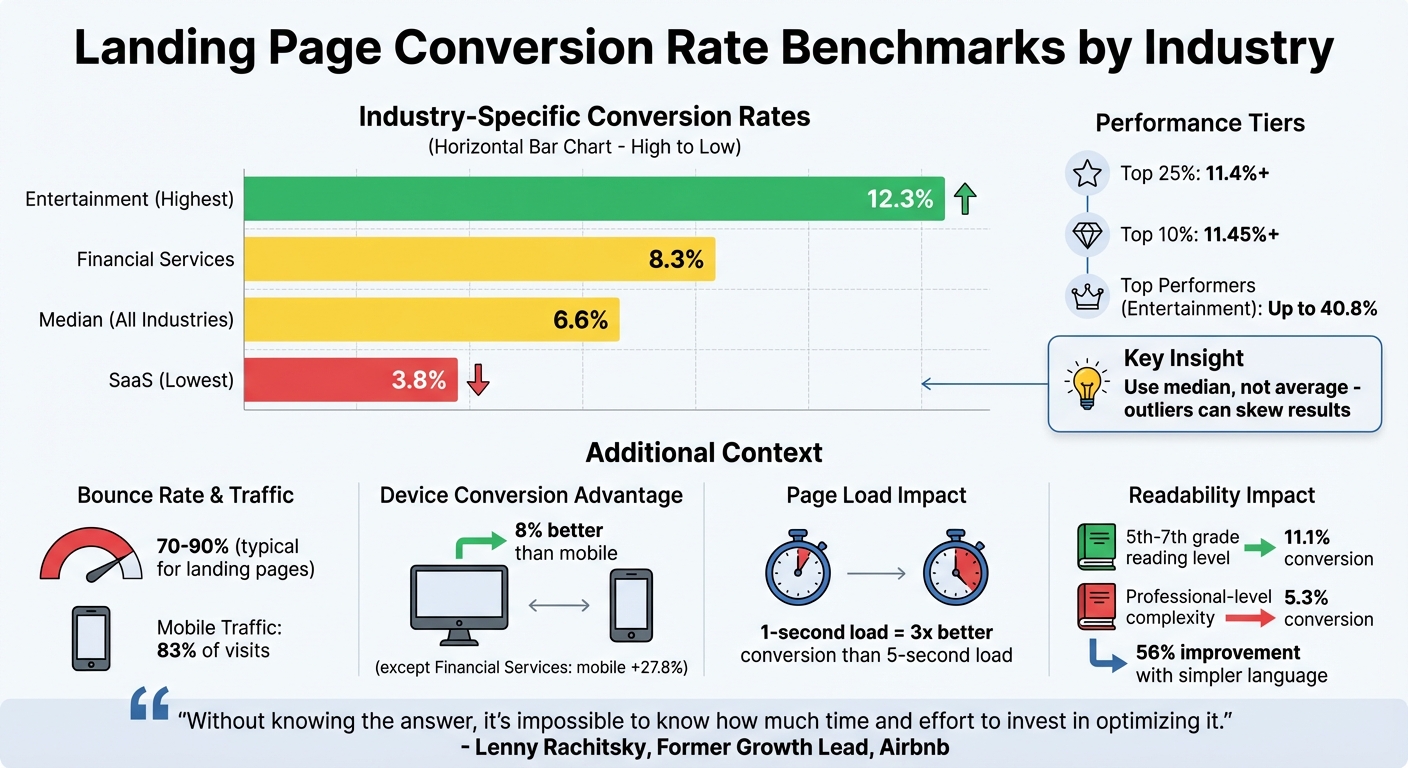
- Conversion Rate: Median is 6.6%, but it varies by industry (e.g., SaaS: 3.8%, Entertainment: 12.3%).
- Engagement: Pages with simple language (5th–7th grade level) convert 56% better.
- Form Abandonment: Long or confusing forms lead to drop-offs - simplify to boost results.
Tools like LaunchSignal focus on intent-driven actions (like mock checkouts) to help you test product ideas. Pair these insights with industry benchmarks to optimize your page and validate your product-market fit.
Landing Page Conversion Rate Benchmarks by Industry
1. LaunchSignal

LaunchSignal focuses on metrics that matter for determining product-market fit. Instead of getting distracted by vanity metrics, this platform zeroes in on behaviors that show real purchase intent. These include actions like filling out questionnaires, interacting with mock checkout flows, and sharing email addresses. Let’s break down how LaunchSignal evaluates these signals through its key metrics.
Conversion Rate
Conversion tracking on LaunchSignal goes beyond the basics. It captures meaningful actions like completing questionnaires and engaging with fake checkouts vs. email signups to determine which validates interest more effectively. For instance, if a visitor fills out a survey about their pain points or tests a mock checkout to explore pricing, it’s logged as a conversion. Plus, with support for tracking multiple conversion types across three active validation pages, you can directly compare which product ideas spark the strongest interest.
Engagement Metrics
LaunchSignal’s dashboard provides a detailed look at visitor engagement. It tracks things like time spent on your page, interaction patterns, and click-through rates on important elements. These insights help you gauge how effectively your page holds attention. Interestingly, research shows that readability plays a big role in conversions - pages written at a 5th to 7th-grade reading level convert at 11.1%, compared to just 5.3% for more complex, professional-level copy.
Form Abandonment
Understanding where users drop off is crucial, and LaunchSignal makes it easy to track abandonment rates in both questionnaires and fake checkouts. High drop-off rates often highlight friction points, such as overly long forms or confusing pricing details. Studies show that simplifying forms can significantly boost conversion rates. LaunchSignal helps you pinpoint exactly where users hesitate, giving you the chance to address these issues during the validation stage - before you dive into full-scale development.
2. Industry Standard Metrics
Industry benchmarks are essential for understanding whether your landing page is hitting the mark. Without a clear reference, a 5% conversion rate might seem incredible - or underwhelming - depending on your industry’s standards. Let’s dive into the key metrics that shape landing page performance.
Conversion Rate
The median conversion rate across industries is about 6.6%, but this varies significantly by sector. For instance, financial services pages often hit a median of 8.3%, while SaaS pages hover around 3.8%. High-performing pages in the top 25% generally start at 11.4%, with some entertainment pages soaring to as much as 40.8%.
"Say you're tasked with improving your landing page performance, and it's currently converting at 5%. Is that good? Is that terrible? Without knowing the answer, it's impossible to know how much time and effort to invest in optimizing it."
– Lenny Rachitsky, Growth Advisor & Former Growth Lead, Airbnb
When benchmarking, it’s smarter to rely on the median conversion rate instead of the average. Averages can be misleading since outliers - those few pages with unusually high or low results - can skew the numbers.
Bounce Rate
Landing pages tend to have bounce rates between 70% and 90%. A "bounce" happens when someone visits your page but leaves without interacting further. While general websites aim for bounce rates of 50% or less, landing pages naturally see higher rates because their design focuses on single actions.
Mobile traffic dominates landing page visits, making up about 83% of total visits. However, mobile users are more likely to bounce if the page isn’t optimized for smaller screens. Interestingly, desktop traffic typically converts 8% better than mobile, though in financial services, mobile can outperform desktop by as much as 27.8%. Speed also matters - a page that loads in just 1 second converts three times better than one that takes 5 seconds.
Engagement Metrics
Metrics like time on page and click-through rates reveal how well your message resonates. Over time, attention spans have shrunk significantly - from 2.5 minutes in 2004 to just 47 seconds in 2024. Simpler content also performs better. Pages written at a 5th- to 7th-grade reading level convert 56% better than those with more complex language. Using difficult words can lead to a 24.3% drop in conversions.
Form Abandonment
When visitors abandon forms partway through, it signals friction. High abandonment rates can stem from forms that are too long, lack trust signals, or have technical glitches. Simplifying forms, splitting them into steps, and tracking where users drop off can help identify and fix these issues.
sbb-itb-9a9c51d
Pros and Cons
When it comes to validating product ideas, balancing traditional industry benchmarks with LaunchSignal's intent-focused approach can make all the difference. Let’s break it down.
Industry benchmarks, like those detailed in Unbounce's 2024 report, provide a solid foundation for comparison. Drawing on data from 464 million unique visitors and 57 million conversions, these benchmarks help you determine if your conversion rate - say, 6.6% - measures up to broader standards. They’re great for statistical reliability and setting a baseline for performance.
On the other hand, LaunchSignal takes a more focused, user-driven approach, capturing real signals through tools like email surveys, questionnaires, and even fake checkouts. This method dives deeper into the "why" behind user behavior, which is often more valuable than simply knowing how you stack up against an industry median. Plus, LaunchSignal allows you to test multiple ideas at once and quickly export data for faster decision-making. However, its Lifetime plan does come with some constraints - only 3 active validation pages and a cap of 10,000 monthly page views, which might limit scalability during larger-scale testing.
Here’s how the two approaches compare:
| Metric | Industry Benchmarks | LaunchSignal Approach |
|---|---|---|
| Conversion Rate | Median 6.6%; top 10% exceed 11.45% | Focuses on user intent via fake checkouts and questionnaires |
| Bounce Rate | 60%–90%; often requires custom tracking | Prioritizes engagement signals over traditional bounce rates |
| Engagement Metrics | Avg. time on page (B2B: 1m 30s) with scroll tracking | Tracks email captures and questionnaire completions |
| Form Abandonment | Requires custom GA4 event setups | Built-in tools highlight drop-off points in multi-step flows |
While industry benchmarks often require additional configurations - like setting up custom GA4 events to track behaviors such as form abandonment - LaunchSignal simplifies this with built-in analytics. Its dashboard prioritizes actionable insights, focusing on real user signals rather than sheer data volume. This can be a game-changer when you’re still in the early stages of product development and need to validate ideas quickly.
But it’s not all smooth sailing. Relying solely on industry benchmarks can sometimes lead to misinterpretation. For instance, a high bounce rate might seem alarming but could simply mean users found what they needed and left. LaunchSignal avoids this pitfall by emphasizing intent-driven actions that offer clearer indicators of genuine interest. That said, the lack of standardized medians for these intent-driven metrics makes direct comparisons tricky. These nuances highlight how each approach serves different purposes in early-stage product validation.
Conclusion
When evaluating landing page performance for product validation, the median conversion rate of 6.6% across industries provides a solid starting point. But here's the catch: industry context matters - a lot. For example, a 5% conversion rate might be impressive in SaaS, where the median is just 3.8%, but it would fall short in the entertainment sector, which boasts a median of 12.3%. Without this context, it’s tough to gauge how much effort should go into optimization.
Taking this a step further, user intent metrics add a layer of depth that industry medians alone can’t provide. For early-stage validation, tools like LaunchSignal’s intent-driven features - think fake checkouts, questionnaires, and email captures - offer insights into user behavior that go beyond just hitting a percentage. While benchmarks help you understand where you stand, these tools explain why users are engaging (or not). This becomes especially valuable when you’re juggling multiple product ideas and need actionable insights rather than surface-level stats. This is crucial when you need to validate a product idea quickly before investing significant resources.
The best approach blends both strategies. Use industry benchmarks to set practical goals - hitting the 75th percentile at 11.4%+ is a strong indicator of solid performance. At the same time, leverage tools like LaunchSignal to dig into user intent and iterate quickly. Together, these methods provide a clear path to faster product-market fit while keeping your performance grounded in the bigger picture.
And remember: simplicity is key. Landing pages written at a 5th to 7th-grade reading level convert at 11.1%, a whopping 56% higher than those with more complex language. The takeaway? Follow landing page best practices to reduce friction, keep your message laser-focused, and capture genuine interest before diving into full-scale product development.
FAQs
What are the best ways to boost my landing page's conversion rate?
To boost your landing page's conversion rate, focus on making it clear, fast, and engaging. Start by examining key metrics like conversion rate, bounce rate, and average time on page to understand where you currently stand. From there, fine-tune your page using these actionable tips:
- Create a clear headline and value proposition: Your headline should immediately highlight the biggest benefit and address a specific challenge your audience is trying to solve. Make it concise and impactful.
- Highlight a single, standout call-to-action (CTA): Use a button that grabs attention with a contrasting color and action-driven text like “Sign up now” or “Get started today.”
- Prioritize speed and mobile optimization: Compress images, leverage a content delivery network (CDN), and ensure your design works seamlessly on mobile devices to reduce load times.
- Add social proof elements: Incorporate testimonials, trust badges, or user reviews to establish credibility and ease doubts.
- Continuously test and refine: Use A/B testing to experiment with different headlines, CTAs, and design elements. This helps you discover what resonates most with your audience.
For a quicker way to implement these strategies, tools like LaunchSignal can simplify the process. They allow you to build high-performing pages, monitor real-time analytics, and test new ideas side-by-side. With consistent improvements and tracking, you can aim to outperform the industry average conversion rate of 6.6%.
Why is readability important for landing page success?
Readability matters because it helps visitors grasp your message quickly and act on it. When your landing page copy is clear and straightforward, it keeps users engaged and can lead to higher conversion rates.
Using plain language, short sentences, and a reading level that suits your audience makes your content easier to understand. This simplicity not only makes the experience smoother but also builds trust, prompting visitors to take actions like signing up or making a purchase.
Why is tracking form abandonment on landing pages important?
Tracking form abandonment helps pinpoint the exact moments where users lose interest or stop filling out your forms. This information can help you refine the user experience. By identifying these trouble spots, you can simplify the process, reduce obstacles, and encourage more users to complete the form - leading to higher conversion rates.
With this data, you can make smarter tweaks, like cutting down unnecessary fields, making instructions clearer, or enhancing the page layout. These adjustments can make the form-filling experience smoother and more intuitive for users.
Start validating ideas in minutes not days
Create high-converting landing pages. Test with real users. Get purchase signals. Know what to build next.
Visit LaunchSignal