December 28th, 2025
The Complete Guide to Idea Validation for Entrepreneurs
A practical 2–4 week, low-cost process to test startup ideas using interviews, landing pages, pre-sales, and metrics to confirm real market demand.
Warren Day
Nearly 90% of startups fail, and 42% of those failures happen because there’s no market need for the product. Idea validation is the process of ensuring your business idea solves a real problem and has paying customers before you invest time and money into development. This guide breaks down how to test your concept in 2–4 weeks for as little as $0–$500, saving you from costly mistakes.
Key Takeaways:
- Why Validate? Avoid wasting months and tens of thousands of dollars on ideas no one wants.
- Validation Process: Focus on three criteria - feasibility (can you build it?), desirability (do people want it?), and viability (will they pay for it?).
- Tools & Techniques: Use customer interviews, landing pages, keyword research, and pre-sales to gather real data.
- Metrics to Watch: Conversion rates, pre-orders, and customer pain scores are critical indicators of success.
Validation ensures you’re solving a real problem for a real audience, minimizing risk and increasing your chances of success. Let’s dive into how to do it effectively.
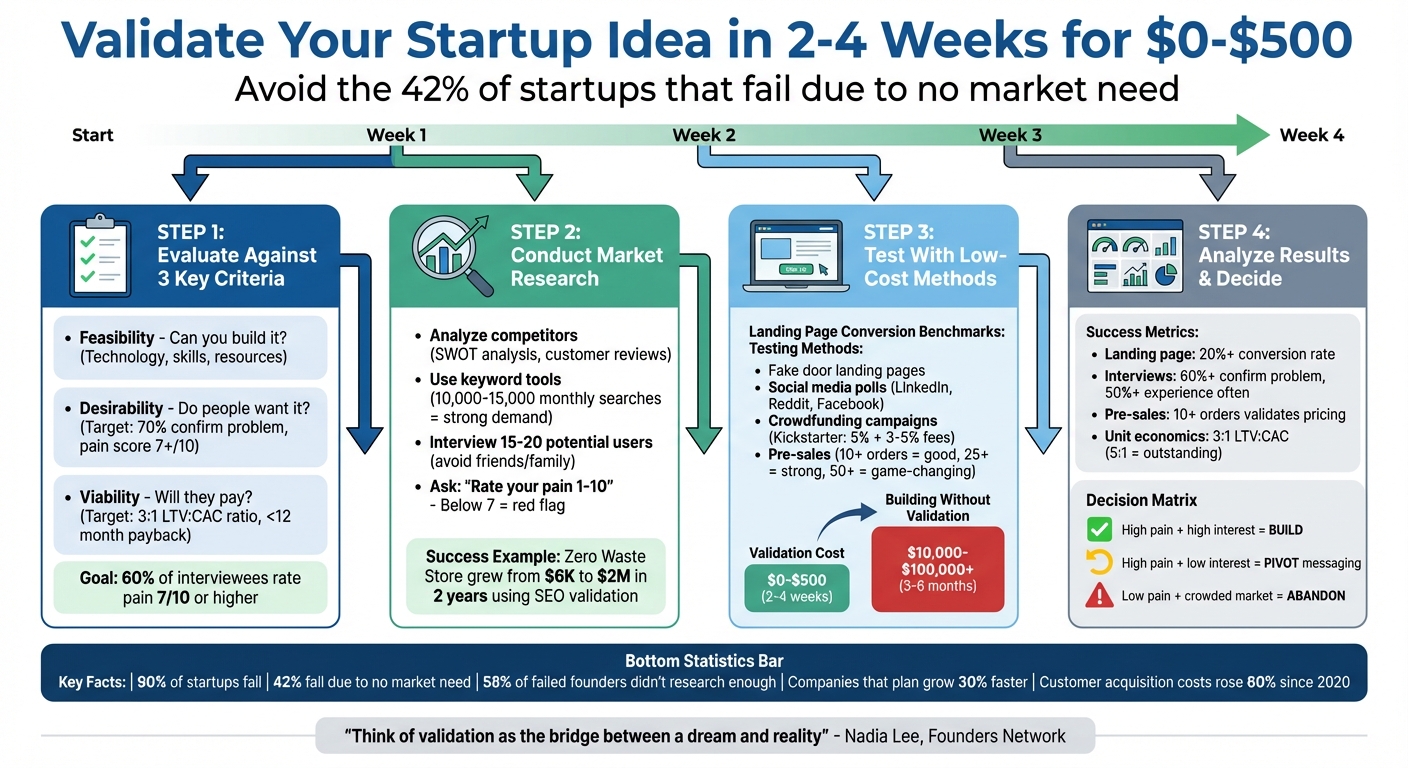
Complete Idea Validation Process for Entrepreneurs in 4 Steps
The Basics of Idea Validation
Idea validation is all about determining whether your startup concept has legs - whether it's realistic and if there's a paying audience for what you're offering. It’s not about proving your idea is flawless. Instead, it’s a way to test your assumptions before you sink time and money into development.
What Happens When You Skip Validation
Skipping validation can be a costly mistake - both financially and emotionally. Entrepreneurs who dive straight into building often spend months (and a lot of money) on products that don’t survive their first year.
The real issue isn’t just the wasted money. It’s the risk of solving a problem that either doesn’t exist or isn’t important enough for people to pay for. Take Color, for example - a photo-sharing app that raised $41 million before its 2011 launch but shut down just a year later. The team built a sophisticated tool for proximity-based photo sharing, but they hadn’t confirmed if users even cared about that feature. Then there’s Juicero, which raised $120 million for a $400 juice machine, only to shut down in 2017 after users realized they could just squeeze the juice packets by hand.
Beyond the financial hit, failed launches can derail careers and take a heavy emotional toll. And with customer acquisition costs rising by 60% since 2020, the stakes for a poorly validated launch are even higher in today’s market.
These risks underscore why it’s so important to evaluate your idea against some key criteria.
The 3 Key Validation Criteria
For an idea to succeed, it needs to meet three essential tests: feasibility, desirability, and viability. These aren’t optional - they’re the foundation of a sustainable business.
Feasibility asks: Can you actually build this? This is where you assess if you have the technology, skills, and resources to make your idea a reality. For instance, if you’re planning to create a complex AI platform but lack a technical co-founder and have a tight budget, feasibility might be your first obstacle.
Desirability asks: Do people really want this? This is about verifying that your idea addresses a genuine, high-priority problem for a specific audience. During customer interviews, ask participants to rate their pain point on a scale of 1 to 10. If most people score it 7 or higher, you’re likely solving a problem worth tackling. Many founders mistakenly validate that their product addresses a problem but fail to realize it’s a minor inconvenience rather than something users are eager to fix.
Viability asks: Will people pay for this? This focuses on whether your solution can generate revenue and if your business model can scale. A great example is Airbnb. In October 2007, founders Brian Chesky and Joe Gebbia tested viability by offering a bed-and-breakfast service with just three airbeds during a sold-out conference in San Francisco. Their experiment proved people were willing to pay to stay in someone else’s home, validating their idea without even building a platform.
"Building is secondary to delivering value to your target market... You're nothing until you have customers who want your product." – Gagan Biyani, Co-founder and CEO, Maven
Now that you know what to evaluate, let’s talk about how to set clear, actionable goals for each of these criteria.
How to Set Clear Validation Goals
Vague goals won’t get you anywhere. To validate effectively, you need specific, measurable targets for each criterion. Start by listing all the assumptions your business model depends on. Then, prioritize the riskiest ones - those that are most likely to fail and would have the biggest consequences if they did.
Turn these assumptions into testable statements with clear predictions and minimum success thresholds. For example: “At least 60% of interviewees will rate this pain point a 7/10”. For problem validation, aim for at least 15 interviews where 70% of participants confirm the issue and give it a pain score of 7 or higher. If you’re testing interest with a landing page, here’s a rule of thumb: a 5% conversion rate signals mild interest, 10% is solid, and 20% or more shows strong validation.
Baremetrics provides a great example of turning validation into action. They tested their analytics tool for Stripe by pre-selling annual subscriptions before writing any code. They raised $30,000 in pre-sales, which funded the development of their MVP. This approach validated both their pricing and the demand for their product.
For financial viability, aim for benchmarks like a 3:1 lifetime value (LTV) to customer acquisition cost (CAC) ratio and a CAC payback period of under 12 months. These numbers give you a clear framework to measure success, transforming validation into a practical decision-making tool. These metrics will also guide your market research efforts, which we’ll dive into in the next section.
How to Conduct Market Research for Validation
Market research doesn’t have to drain your wallet or eat up all your time. The goal is straightforward: ensure there’s actual demand for what you’re planning to offer. You’re looking for signs that people are actively searching for solutions, competitors are making money, and potential customers are grappling with real pain points that your idea could address. Once you’ve identified this, dive into competitor analysis to spot gaps in the market.
These methods ensure your idea aligns with real-world demand by addressing both desirability and viability.
Analyzing Competitors to Find Demand
Start by taking a close look at your competitors - not to mimic them but to see where they’re falling short. If they’re making money, that’s a good sign the market is viable. Your job is to uncover the gaps they’re leaving behind.
Check out customer feedback on platforms like Google, Amazon, or G2. Look for recurring complaints, such as poor customer support or missing features, as these could be opportunities to stand out. A SWOT analysis (Strengths, Weaknesses, Opportunities, Threats) can also help you map out where you might have an edge.
Don’t overlook brand visibility. How often is a competitor’s brand mentioned compared to others? This can show who’s dominating the conversation and where there might be room for a new player. Monitor customer sentiment - positive or negative - as it can highlight areas where a better solution is needed.
In 2024, Popl, a digital business card company, found its niche by analyzing early user feedback. Co-founder Nick Eischens noticed that business professionals were the most engaged and willing to pay for premium features. This insight, gathered through competitor analysis and customer interviews, led Popl to shift its focus entirely toward professionals.
After gathering insights from competitors, use quantitative data like keyword trends to further validate market interest.
Using Keyword Tools and Sales Data
Keyword research tools like Google Keyword Planner and Google Trends can quickly reveal whether there’s demand. High search volumes paired with strong sales data are solid indicators of a proven market.
Take the example of JJ Follano, co-founder of Zero Waste Store. Back in 2018, he used SEO tools to assess demand and found that the term "zero waste store" was being searched 10,000 to 15,000 times a month. This discovery led him to rebrand his business to align with the search term, which helped it grow from $6,000 in annual sales to $2 million in just two years.
Sales data from platforms like Amazon can also be a goldmine. Look at bestseller rankings, customer reviews, and pricing trends to confirm that there’s real demand for your product or service.
Once you’ve gathered these metrics, speaking directly to potential users will deepen your understanding of the market.
How to Interview Potential Users
Talking to potential customers is one of the most effective ways to gain meaningful insights - if you do it right. Avoid interviewing friends or family, as they’re likely to give you overly supportive feedback. Instead, reach out to unbiased individuals through LinkedIn, industry forums, or even cold emails. If someone responds to a cold message about a problem, it’s a strong indicator that the issue resonates with them.
Focus your interviews on understanding pain points rather than pitching your idea. Ask about their biggest challenges instead of leading with, "Would you use this?" If they don’t bring up the problem you’re addressing, that’s a red flag. You can also ask them to rate their pain on a scale of 1 to 10. If most people rate it below a 7, you might be solving a minor annoyance rather than a pressing issue.
For instance, Mary Gui, founder of Sock Candy, conducted 30-minute Zoom interviews with early customers. By combining these conversations with Shopify Analytics, she discovered that her "sheer" sock styles were performing far better than her "cotton" ones. This feedback prompted her to pivot the brand to focus exclusively on high-fashion sheer socks.
To gauge genuine interest, wrap up interviews by asking if participants would join a waitlist or be open to a follow-up chat. As Webb Brown and Ajay Tripathy, founders of Kubecost, explain:
"When talking to potential customers, their eyes should light up. They should be engaged in the conversation and ready to pull out their wallets on the spot to pay for your solution".
Low-Cost Methods for Testing Your Idea
After completing your market research and interviews, it’s time to see if potential customers are willing to take action. The goal here is straightforward: gather real evidence of interest without sinking a ton of money or time into building a product. Essentially, you’re looking for proof that people outside your personal circle - strangers, not just friends and family - are genuinely intrigued by your idea.
One effective strategy is the "fake door" method. This involves creating a landing page with a clear call to action, like "Sign Up" or "Pre-Order Now", even if the product doesn’t exist yet. Then, track how many visitors actually click through. For instance, in December 2016, entrepreneur Ryan Robinson tested the waters for a California hiking guide idea. He spent less than $500 over 30 days and saw 12 pre-sales, $108 in revenue, and 565 email sign-ups. This gave him solid evidence of demand before investing in a full website or final product. It’s a practical way to get real-world feedback and build on the insights from your earlier market research.
Social media can also be a powerful, budget-friendly testing ground. Dive into LinkedIn groups, Facebook communities, or Reddit threads where your target audience hangs out. Use these spaces to ask questions, run polls, or even test different messaging and pricing options through social ads. A/B testing on platforms like Facebook Ads can help you figure out which approach resonates more. Tools like PickFu also let you gather feedback from specific demographics without breaking the bank.
Another option to validate your idea is crowdfunding. Platforms like Kickstarter not only help you gauge demand but also allow you to secure pre-orders before manufacturing anything. Keep in mind, Kickstarter takes a 5% platform fee, plus 3–5% in payment processing fees, but only if your campaign is successfully funded. As Nate Nordstrom, founder of Easy Board, advises:
"Sell before you build. Make it cheap for the early adopters, but get your cash flowing in the right direction".
To ensure you’re making informed decisions, track the right metrics. Pay attention to pre-sales, email list growth, and click-through rates on your landing page. Compare your customer acquisition cost (CAC) to how much customers are willing to pay. If your CAC is too high, it’s a sign to pivot quickly. Keep in mind that 35% of startups fail because there’s no market need for their product. By focusing on these key metrics, you can confirm your idea’s market fit and lay the groundwork for moving forward with confidence.
sbb-itb-9a9c51d
Using LaunchSignal Landing Pages to Validate Ideas
Testing your concept with dedicated landing pages is a key step in validating your idea.
How to Create Landing Pages with LaunchSignal
LaunchSignal makes it easy to create validation landing pages, even if you don’t have coding or design experience. Start by defining your validation goals and setting a clear, testable hypothesis. For example, you might aim to determine if "over 50% of targeted professionals will express interest". This helps establish a measurable benchmark.
Next, pick a template and craft a focused value proposition. Rather than listing every possible feature, zero in on the main problem your solution addresses and how it stands apart. LaunchSignal’s templates are designed to collect actionable user data through email sign-ups, questionnaires, and simulated checkouts. These tools let you gather insights without spending weeks on custom-built pages. Plus, the templates work seamlessly with LaunchSignal’s tracking features, saving you time and effort.
LaunchSignal Features That Help You Validate
LaunchSignal tracks two important types of data: acquisition (traffic) and activation (visitor conversions). By automatically monitoring both, the platform gives you a complete picture of user engagement.
One standout feature is the fake checkout tool, which helps gauge purchase intent. Instead of just asking for email sign-ups, this simulated checkout flow provides stronger signals about whether users are ready to commit. Integrated questionnaires add another layer of insight, uncovering what users are truly interested in. All this data is compiled in an easy-to-use analytics dashboard, which allows you to compare results across multiple ideas using A/B testing.
How to Analyze Metrics and Make Decisions
Once you've collected data, the next step is to interpret it and make decisions based on your findings.
Focus on three main metrics: conversion rate, engagement depth, and retention rate. Conversion rate measures how many visitors complete your primary call-to-action. For instance, if 1,000 people visit your page but only 10 sign up (a 1% conversion rate), it might signal that your value proposition needs work or your audience isn't the right fit. Engagement depth shows how much users interact with your page's key features, while retention rate tracks whether users stay engaged after their initial visit.
Compare these metrics to your hypothesis. If the data doesn’t align with your expectations - like low engagement when you predicted high interest - it might be time to tweak your messaging, pivot your approach, or test a completely different idea. With LaunchSignal, you can also export your data for deeper analysis, giving you the tools to make well-informed decisions about your next steps.
What to Do with Your Validation Results
How to Define Success Metrics
Once you’ve collected your data, it’s time to set clear benchmarks to decide if your idea has potential. Start with landing page conversion rates: a 5% rate suggests mild interest, 10% indicates solid traction, and anything 20% or higher shows strong validation. If you’re conducting interviews to gauge problem severity, aim for at least 60% of your target audience confirming the problem exists, with 50% saying they experience it often and an average pain score of 7 or higher on a 1-10 scale.
Pre-sales can provide even stronger signals. If you secure 10 or more pre-orders, it’s a good sign your pricing works. Getting 25+ pre-orders shows strong demand, while 50+ can be game-changing - often enough to fund your initial product build. For example, in 2021, Waterboy co-founders Mike Xhaxho and Connor Saeli built a list of 18,000 to 20,000 potential customers via SMS. When they launched their presale, they sold out their first production run in just one hour.
It’s also important to evaluate long-term potential by looking at your unit economics. A sustainable business typically needs a Lifetime Value (LTV) to Customer Acquisition Cost (CAC) ratio of at least 3:1, with 5:1 or higher being outstanding. Additionally, aim for a CAC payback period under 12 months, with less than 6 months being ideal for fast-growing startups.
Deciding Whether to Move Forward
Your next steps depend on the data. If customers report high pain scores (7/10 or above) but show little interest in your solution, it’s time to refine your product or messaging. Try testing 3–5 different value propositions to find what resonates. If your landing page conversion rate is below 5%, your messaging likely needs work.
A pivot may be the right move if your product works but appeals to a different audience or use case than you initially expected. For instance, Popl, a digital business card company, initially marketed itself for casual social use. After interviewing customers, co-founder Nick Eischens realized that professionals found more value in the product and were more likely to pay for premium features. This insight led Popl to shift its focus entirely to professional users.
Sometimes, the best decision is to walk away altogether. As Ryan Glasgow, Founder of Sprig, wisely put it:
"A great outcome for any startup... is that you determine in the very beginning, or as soon as possible, that it's not worth spending time on".
If your data shows low pain scores, no willingness to pay, or a crowded market with no clear differentiation, it’s better to move on before sinking more time and money into the idea. Once you’ve identified a clear path forward, focus on building around your validated insights.
Next Steps After Validation
If your validation results are encouraging, it’s time to move from testing to building. Start by focusing on "must-have" features - those that address the core pain points your customers identified. Save the "nice-to-have" features for later, once you’ve proven the basics work.
Use your validation leads as your first customers. The people who joined your waitlist, completed a fake checkout, or pre-ordered are your most engaged prospects. Reach out to them directly as you prepare to launch. Additionally, consider rebranding around high-demand keywords to tap into market interest and grow quickly.
Finally, build your go-to-market strategy based on what worked during validation. If social media brought in the most sign-ups, double down on those platforms. If keyword research revealed strong search interest, invest in SEO. The validation phase has already shown you where your audience is - now it’s time to scale those efforts.
Conclusion: Why You Should Validate Before You Build
Skipping validation before building a product can drain resources - time, money, and energy - on ideas that might not have a market. In fact, 42% of startups fail because there’s no market need, and 58% of failed founders admit they didn’t do enough research before launching.
Validation is your safety net. It ensures there’s demand for your product before you dive into costly development. Think about the difference: validation might take 2 to 4 weeks and cost $0 to $500, while building a product could take 3 to 6 months and cost $10,000 to $100,000 or more. Companies like Quibi and Juicero learned this the hard way, losing billions on products no one wanted - a stark reminder of how dangerous it is to rely on assumptions without evidence.
The strategies outlined in this guide - such as customer interviews, landing page tests, pre-sales, and market research - offer practical ways to confirm demand before making major investments. As Nadia Lee from Founders Network wisely says:
"Think of validation as the bridge between a dream and reality".
This bridge not only connects your idea to potential customers but also reveals whether a market for your idea truly exists. By testing assumptions early, you can avoid costly mistakes and protect your resources.
Start by tackling the riskiest assumption. For example, if your business model relies on customers paying $50 per month, test that price point first. If your solution aims to solve a pressing problem, talk to 15–20 potential customers to confirm the need. The goal is to learn quickly and adjust before committing too much. After all, companies that plan and track their progress grow 30% faster, and with customer acquisition costs rising 60% since 2020, guessing is more expensive than ever.
FAQs
What are some affordable ways to test if a business idea will work?
Validating a business idea doesn’t need to break the bank. A great starting point is setting up a basic landing page to spark interest and collect email sign-ups. Pair this with affordable ads on platforms like Google or social media to gauge demand. You can also gather valuable insights by conducting customer interviews or surveys to hear directly from your target audience. Another smart tactic is pre-selling your product or accepting pre-orders - this not only tests market interest but also helps you assess potential demand before diving into full development. These straightforward methods are both cost-effective and packed with useful insights for early validation.
How can I make sure my product solves a real problem for customers?
To make sure your product solves a real problem, the first step is validating that the problem actually exists. Start by talking to your target audience. Use interviews or surveys to get a clear picture of their struggles. Pay attention to how they act and what challenges they face in everyday situations - this can reveal insights you might not get from just asking questions.
Another way to test your ideas is by running small, low-cost experiments. For example, you could set up a simple landing page or run targeted ads to gauge interest and demand. Gather feedback and data to confirm that the problem is real and, more importantly, that people are willing to pay for a solution. Taking this evidence-driven approach minimizes risk and ensures you’re creating something the market actually needs.
What are the most important metrics to track when validating a business idea?
When you're testing out a business idea, it's crucial to keep an eye on key performance indicators (KPIs) that can reveal both demand and feasibility. Here are some essential metrics to monitor:
- Landing page conversion rate: This shows how many visitors to your page take the action you want - whether that's signing up, expressing interest, or something similar. It's a strong indicator of initial demand.
- Email sign-up or lead capture rate: A great way to measure how effectively you're building a list of potential customers who are interested in your offering.
- Ad click-through rate (CTR) and cost-per-acquisition (CPA): These metrics tell you how well your marketing efforts are connecting with your audience and how much it costs to bring in potential customers.
- Survey results: Collect data on interest levels or willingness to pay from your target market. This feedback can provide valuable insights into whether your idea has traction.
- Pre-orders or commitments: Count how many people are ready to pay or commit to your product even before it's launched. This is often a strong signal of genuine interest.
By analyzing these metrics, you can gain a better understanding of market demand and make more informed decisions about whether to move forward with your business idea.
Start validating ideas in minutes not days
Create high-converting landing pages. Test with real users. Get purchase signals. Know what to build next.
Visit LaunchSignal