December 22nd, 2025
How to Test Product-Market Fit Before Building
Validate demand before you build: define the problem and audience, run landing pages and surveys, test pricing with fake checkouts; track conversion and retention.
Warren Day
Most startups fail because they don’t validate product-market fit early. Instead of spending months building a product that might flop, you can test your idea in weeks using simple tools like landing pages, surveys, and prototypes. Here’s how:
- Define the problem and audience: Start with a clear problem statement and customer persona.
- Test demand: Use landing pages to measure interest through email signups and click-through rates.
- Gather feedback: Conduct interviews and surveys to understand pain points and pricing expectations.
- Experiment with pricing: Use prototypes and fake checkouts to test willingness to pay.
- Analyze results: Focus on key metrics like conversion rates and retention to decide whether to build, refine, or pivot.
Skipping validation wastes time and money. Instead, use these steps to confirm demand before building, increasing your chances of success.
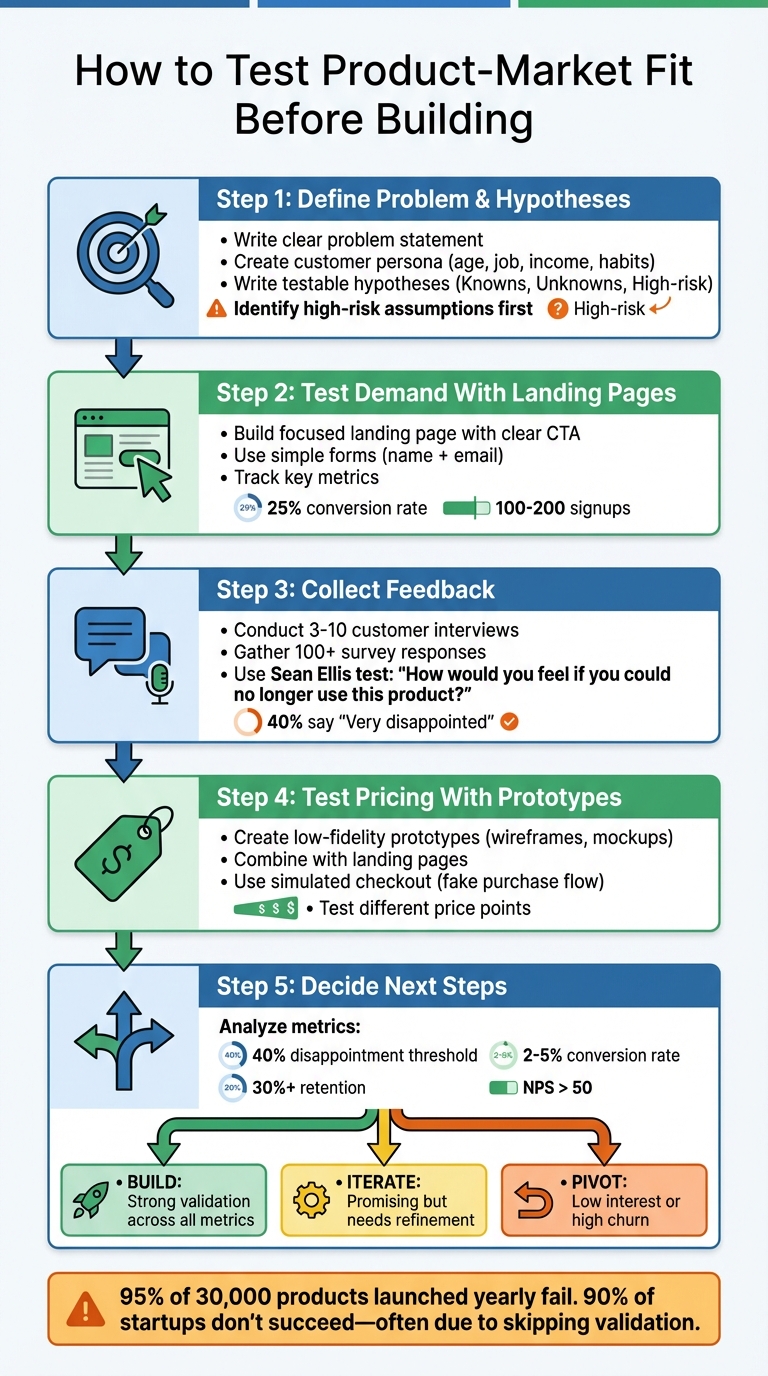
5-Step Process to Test Product-Market Fit Before Building
How to Find Product Market Fit - A Detailed Framework
Step 1: Define Your Problem, Customer, and Hypotheses
Start by pinpointing the problem you're solving, identifying your audience, and outlining your key assumptions. Having this clarity upfront ensures you avoid wasting time on irrelevant ideas. As Harvard Business School Online highlights, "Creating a satisfactory product begins with deeply understanding a problem and envisioning a world where it's resolved". This step lays the groundwork for meaningful testing later on.
Write a Clear Problem Statement
Zero in on one core issue that your audience is facing. For example, Amazon didn’t start with a grand vision of being a massive online retailer. Instead, they tackled a specific issue: "I want to buy X book that I can't find in any bookstore". By focusing on this pain point, they were able to craft a solution that truly resonated with customers.
Begin by asking yourself, "What’s preventing my audience from achieving their goals?". Then, engage with your potential customers. Ask open-ended questions like, "What challenges do you face in [specific area]?" or "How does this product solve a problem for you?". Pay close attention to their actions, not just their words - how people currently try to solve the problem often reveals valuable insights.
Create a Customer Persona
A customer persona is a detailed profile that represents your ideal customer. It’s based on research and helps you understand who you’re building for. Include specifics like their age, job, income, daily habits, and frustrations. For instance, instead of targeting "small business owners", narrow it down to "marketing managers at companies with 10–50 employees who handle their own social media but struggle to measure ROI."
Adding details like whether they live in urban or rural areas, their education level, and how much they already spend on addressing the problem helps you craft a solution that fits the U.S. market. This level of detail ensures your product speaks directly to their needs.
Write Testable Hypotheses
Clearly define and measure your assumptions. Andy Rachleff, Co-founder of Wealthfront, puts it well: "A value hypothesis is an attempt to articulate the key assumption that underlies why a customer is likely to use your product". For instance, a fintech company might hypothesize, "Tech-savvy millennials and Gen Z consumers want a simple, social way to send and receive payments."
Use tools like assumption mapping to organize your assumptions into categories: Knowns, Unknowns, and High-risk areas. For example, a high-risk assumption could be, "Users will trust AI-generated campaign suggestions enough to use them without manual edits". Testing these high-risk assumptions first is critical since they often determine whether your product will succeed.
Step 2: Test Demand With Landing Pages
After identifying your problem and understanding your audience, it’s time to find out if people are genuinely interested in what you’re offering. A landing page is a quick and effective way to gauge demand without needing to build your product. The idea is simple: use the page to collect real user interest with minimal effort. The data you gather here will guide your next steps, like surveys or prototypes.
Build a Landing Page That Works
Your landing page needs to be straightforward and focused. Start with a headline that speaks directly to your audience's problem and a clear call-to-action (CTA), such as "Join the Waitlist" or "Get Early Access." For instance, Goby’s landing page keeps it simple with the phrase “Brushing perfected”. Similarly, Branch Furniture uses “Office Furniture Made Easy”. These short, direct headlines immediately tell visitors what to expect.
Avoid clutter that might distract from your main goal. Add product mockups or illustrations to visually communicate your idea. Keep the design clean and focused.
When writing your copy, use language that resonates with your audience. As Scott McLeod emphasizes, "The most effective messaging uses language you've heard in 1:1 interviews and reviews". Address their pain points and explain how your product solves their problem. Focus on the benefits rather than just listing features. Keep forms simple - asking only for a name and email is often enough to start.
Since mobile traffic is dominant, make sure your landing page is optimized for smartphones. A delay of just one second in page loading can reduce conversions by 7%.
Set a clear goal before launching. Aim for a 25% conversion rate on your primary CTA and gather 100–200 signups from relevant traffic to validate demand.
Use LaunchSignal to Streamline Testing
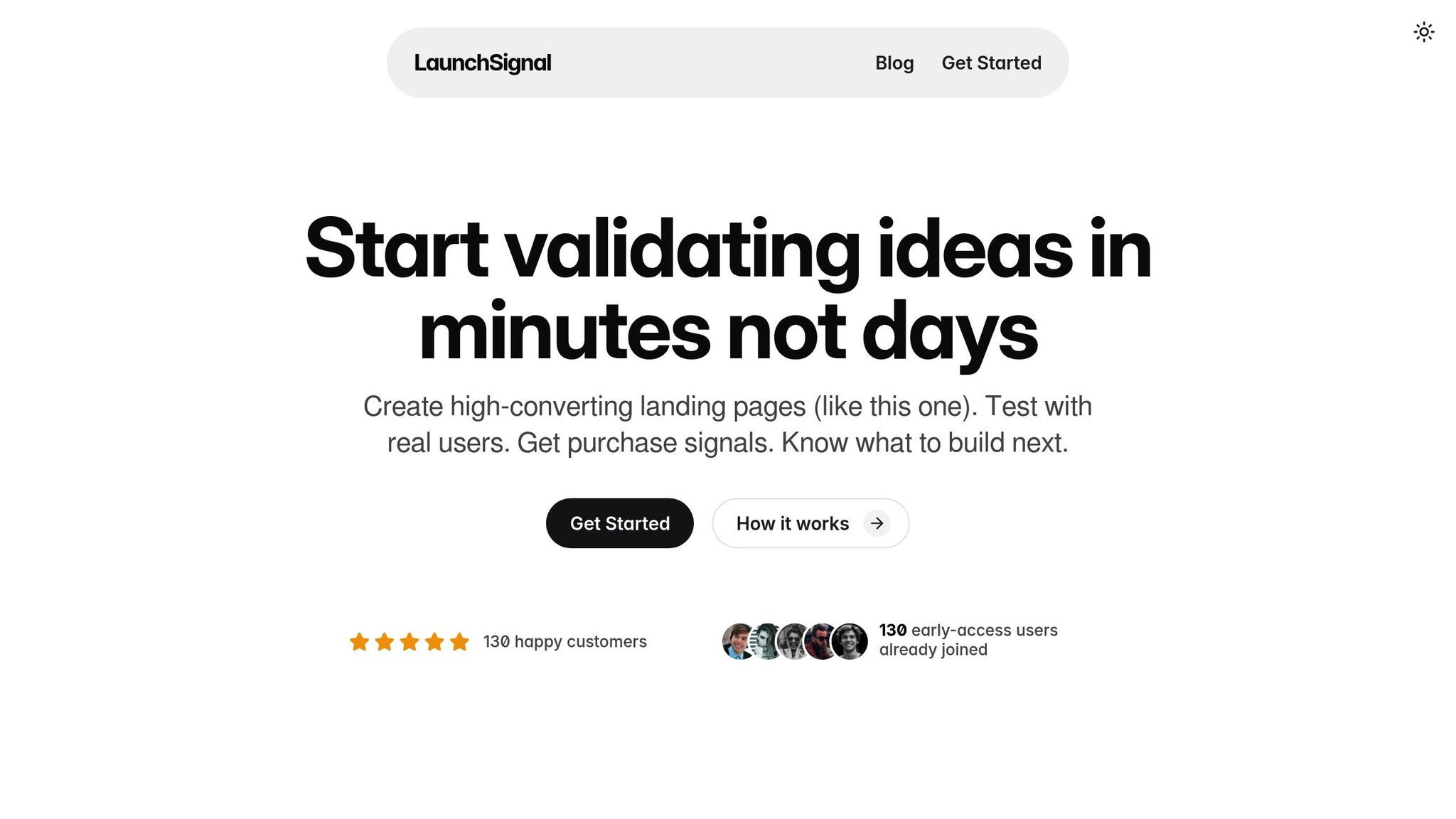
If you want to speed up the process, tools like LaunchSignal can help. LaunchSignal offers ready-to-use templates specifically designed for product validation, allowing you to launch quickly. These templates include built-in email capture forms, questionnaires, and even simulated checkout features to test pricing without processing actual payments.
The simulated checkout tool is particularly useful. It shows how many people are willing to click "Buy Now" at different price points, giving you valuable insights into pricing. You can even test several product ideas simultaneously by creating separate validation pages, then compare the results in one analytics dashboard. If you need deeper analysis, the data can be exported for further review.
For $99, LaunchSignal’s lifetime plan gives you access to three active validation pages and 10,000 monthly page views. It’s beginner-friendly - no coding or design skills required - so you can focus on refining your message and analyzing results.
Track the Metrics That Matter
To measure demand effectively, focus on key metrics like email capture rates, click-through rates (CTR), and simulated checkout conversions. Email capture rates show how many visitors are interested enough to share their contact details. CTR measures how well your CTAs and links engage visitors. Simulated checkout conversions reveal who’s ready to commit to buying.
Pay attention to your bounce rate, which indicates the percentage of visitors who leave without interacting. A high bounce rate might mean your messaging isn’t connecting with your audience. Use these insights to refine your approach.
Run A/B tests to improve your landing page. Experiment with elements like headlines, hero images, CTA wording, colors, and page length. Even small tweaks can make a big difference. For example, Blue Fountain Media increased conversions by 42% by adding a VeriSign trust seal to their lead form. Similarly, Scandiweb boosted their CTR by 35% and conversions by 89% by swapping a looped video for a static image that highlighted their unique selling point and featured a clear CTA.
Let your tests run for at least two weeks and aim for 100 conversions per variant to ensure your results are statistically reliable. Keep external factors, like holidays or competitor campaigns, in mind as they can affect your data. Use LaunchSignal’s analytics dashboard to track everything and make informed decisions about which ideas are worth pursuing further.
Step 3: Collect Feedback Through Surveys and Interviews
Once you've gauged initial interest with landing pages, it's time to dig deeper. Surveys and interviews are your tools for uncovering the why behind the interest. While landing pages measure curiosity, these methods uncover pain points, current solutions people use, and how much they'd be willing to pay. This step adds a layer of understanding, helping you refine your idea before diving into development.
Find People to Interview
Your first stop? The email list you built from your landing page. These individuals have already shown interest, making them great candidates for feedback. Beyond that, tap into your LinkedIn network, especially if you're focusing on a specific industry. You can also join niche communities like Slack groups, Discord servers, subreddits, or forums like Quora - places where your target audience is likely to hang out.
Make sure you’re recruiting participants who actively experience the problem you’re solving. Instead of targeting broad roles like "project managers", narrow it down to specifics, such as "project managers who update task trackers daily and handle multiple clients". Aim to interview 3–10 people and collect at least 100 survey responses to ensure your findings are statistically meaningful.
To streamline this process, start with a screener survey. Keep it neutral and focus on behaviors rather than demographics. Place any exclusion criteria upfront to save time, and avoid disclosing your company name or the purpose of the study to prevent bias. Offering fair compensation, like gift cards or early access to your product, can also encourage participation.
Run Customer Interviews
Once you've identified participants, it's time to dive into interviews. These conversations are not about pitching your product or asking if someone would buy it. Instead, the goal is to deeply understand their experiences. Marty Cagan, Founder of the Silicon Valley Product Group, puts it best:
"One of the biggest and most common mistakes product teams make is to have far more confidence in their product specifications than they should".
Ask open-ended questions that encourage storytelling. For example, instead of asking, "Would you use a product that does X?" try, "Walk me through the last time you faced this problem." This approach helps you uncover what people are currently doing to address the issue, what frustrates them about existing solutions, and whether they’re investing significant time or money on workarounds.
When discussing pricing, focus on real-world spending. Ask what they currently pay for similar solutions or what budget they’ve set aside. This gives you a clearer picture of their willingness to pay. If possible, have two people present during the interview - one to lead the conversation and another to take detailed notes. Interview a diverse group, including those familiar with your idea, those who aren't, and those using alternative solutions.
Use Product-Market Fit Surveys
Surveys are a great way to complement interviews, as they allow you to reach a larger audience quickly. A key component of these surveys is the Sean Ellis test, which asks:
"How would you feel if you could no longer use this product?"
Respondents choose from "Very disappointed", "Somewhat disappointed", or "Not disappointed". If at least 40% say they’d be "Very disappointed", you might be onto something with product-market fit.
Follow up with questions to understand their answers better. Ask what they see as the main benefit of your solution, the problem it solves, and what they’d turn to if your product didn’t exist. Include a question about problem urgency, such as: "How urgent is solving this problem for you?" (rated on a 1–10 scale). Scores of 8–10 indicate strong demand.
Keep the survey short - 10 questions or fewer - to maximize completion rates. Use a mix of multiple-choice and open-ended questions. Open-ended responses, in particular, can reveal your customers' pain points and the language they use to describe them, which is invaluable for refining your messaging.
sbb-itb-9a9c51d
Step 4: Test Pricing and Solutions With Prototypes
After validating interest and gathering customer feedback, the next step is refining your solution’s value and figuring out both its functionality and what people are willing to pay for it.
Create Simple Prototypes
Start with low-fidelity prototypes - basic, stripped-down versions of your idea. These could include clickable wireframes in Figma, a simple slide deck explaining your solution, or even a concept page describing the product’s purpose. The key here is to focus on solving the core problem and avoid overloading your prototype with unnecessary features. As Jiaona Zhang, an experienced product leader, puts it:
"If you try to solve every problem with your product, you'll do it all poorly. I call this the Peanut Butter Principle: spread too thin, it's no longer tasty."
Brad Nunnally, senior director of design, also stresses the importance of this phase, saying:
"The most important stage of any product design is testing and validation."
Your prototype should be detailed enough to let you observe how users interact with key tasks, such as locating a checkout button or completing a signup process. For physical products, you can host short showcases to gauge user reactions. These prototypes set the foundation for further testing, like integrating them with landing pages.
Combine Prototypes With Landing Pages
Once you’ve created a prototype, take testing a step further by pairing it with a landing page. A landing page allows you to present your prototype to potential users while collecting valuable data through email sign-ups. Be sure to clearly explain the problem your product addresses and include a status update, such as "in development" or "coming soon" [48–50].
Here’s a real-world example: In 2019, Alpha tested a concept called "Caretaker Monitor" by creating mockups and a landing page with a "Pre-book for Free" button. Users had to submit their email to sign up, which not only validated interest but also helped identify privacy-conscious users who might require special attention. To dig deeper, you could use tools like LaunchSignal to send follow-up questionnaires, asking participants about their current solutions, budgets, and how urgently they need a fix. This ensures you’re gathering feedback that really matters.
Test Different Price Points
It’s one thing to know people like your idea, but will they actually pay for it? As Gagan Biyani, Co-founder & CEO of Maven, advises:
"If your riskiest hypothesis is whether people will want your product, do not ask them. Force them to pay for it with their time or their money."
To test pricing, simulate a checkout process where users select a plan and proceed as if they’re about to pay (without actually charging them). This approach gives you a much clearer picture than simply asking users what they’d be willing to pay in a survey. It also helps you identify the "atomic unit" of your product - the smallest piece of value you can offer and sell.
Maven successfully used this method to test pricing before fully building their platform. By analyzing the results, you can determine which customer segments value your solution most and identify the features that matter most to them. These insights from prototype testing will guide the decisions covered in the next section.
Step 5: Decide What to Do Next
Take a close look at your data and determine your next steps. Achieving product-market fit isn’t a simple yes-or-no milestone - it evolves through stages, from Nascent to Developing, Strong, and eventually Extreme. Evaluate how well your product aligns with market needs and decide whether to build, tweak, or pivot.
Look for Signs of Product-Market Fit
Pay attention to key metrics like the Sean Ellis Test (40% rule), conversion rates (aim for 2–5%), retention rates (above 30% by day 30), churn rates (5–7%), and a Net Promoter Score that exceeds 50. These indicators can help confirm whether your customers truly rely on your product.
Avoid getting sidetracked by vanity metrics like total downloads. Instead, focus on clarity metrics - things like daily usage time or how quickly users complete core tasks. These numbers reveal whether users genuinely find value in your product. With this data, compare the performance of different concepts to identify the strongest contender.
Compare Results in LaunchSignal
Once you’ve gathered your metrics, use LaunchSignal's analytics dashboard to compare test results. Check which landing pages had the highest email signup rates, which fake checkout flows saw the most completions, and which survey responses indicated the highest purchase intent. Export the data to dig deeper, identifying trends like which customer groups showed the most enthusiasm or which price points caused the least resistance.
This comparison helps you pinpoint your best opportunity without relying on guesswork. If one idea consistently outshines the rest - better engagement, stronger survey feedback, and a higher willingness to pay - that’s your green light to move forward. On the other hand, if results are lackluster or all over the place, you may need to decide between refining your approach or pivoting entirely.
Make Your Decision
Use your validation data to choose one of three paths. Move forward and build if you’ve hit the 40% disappointment threshold, your conversion and retention rates are solid, and customers are ready to pay your target price. Iterate and refine if you see promising signs but your key metrics aren’t quite there yet - this could mean rethinking your positioning, targeting a different audience, or simplifying your features based on what you’ve learned. Pivot if your tests reveal low interest, high churn, or a mismatch between your solution and what people actually need.
Keep in mind that 95% of the 30,000 products launched each year fail, and 90% of startups globally don’t succeed - often because they skip this critical validation phase. Making a data-driven decision now can significantly improve your odds. Treat each iteration as a test of specific hypotheses, and don’t hesitate to make major changes if the evidence points in that direction. Remember, validation isn’t a one-and-done process. Even if you achieve product-market fit in one segment, expanding into new markets or adding features will require fresh rounds of testing.
Conclusion
Key Takeaways
Checking for product-market fit early can save you from costly missteps. The process boils down to three main steps: clearly identify your target customer and their problem, test demand using simple tools like landing pages, and validate pricing through prototypes or surveys. Start with direct conversations with potential customers, then use tools such as landing pages, fake checkouts, and interviews to gather valuable behavioral insights.
Focus on meaningful metrics. For instance, aim for at least 40% of users saying they'd be "very disappointed" if your product disappeared, and target conversion rates in the 2–5% range. Steer clear of vanity metrics like total downloads, which don't reflect true customer interest. Even at eDreams, 70–85% of tests don't succeed - proving that uncovering flawed assumptions is just part of the process.
With these tools and strategies, you're ready to take the next step.
Start Testing Today
Tools like LaunchSignal make testing simple and efficient. It offers landing page templates, email capture tools, questionnaires, and fake checkout flows - all designed to help you test up to three ideas at once. Results are displayed in a single analytics dashboard, allowing you to identify which customer groups show the most interest and which price points work best. For $99, you get a lifetime plan with 10,000 monthly page views and all the resources needed to make informed decisions before committing to development.
Start small: craft a clear hypothesis about your customer's problem, create a basic landing page to gauge demand, and let real user behavior guide your strategy. Remember, testing doesn't stop after finding product-market fit. Expanding into new markets or segments will always require fresh validation. Taking these steps now can significantly boost your chances of building something people genuinely want.
FAQs
What’s the best way to use landing pages to test if there’s demand for my product?
To gauge interest in your product, start by building a dedicated landing page that highlights its benefits and value in a clear and compelling way. Use eye-catching visuals and concise, persuasive text to grab attention quickly.
Once your page is live, drive traffic to it using social media campaigns, online ads, or email marketing. These methods can help you reach a targeted audience effectively.
Track engagement metrics like sign-ups, pre-orders, or even clicks on a "Learn More" button to measure interest. A strong response suggests there’s demand for your product. If the results are underwhelming, analyze the feedback and consider refining your messaging, design, or even the product itself to better align with what potential customers are looking for.
What’s the best way to conduct customer interviews effectively?
To get the most out of customer interviews, prioritize open-ended questions that delve into their challenges, needs, and experiences. Choose participants who genuinely reflect your target audience, and steer clear of leading questions that could skew their answers. If you're testing prototypes, pay close attention to how they interact with them, and encourage candid feedback about any pain points or areas that could use improvement.
Keep the conversation relaxed and natural - avoid making assumptions about their preferences. The aim is to gain a deep understanding of their motivations and frustrations, so make sure to actively listen and ask thoughtful follow-up questions to uncover valuable insights.
How can I figure out the best pricing strategy for my product?
Start by gauging your target customers' willingness to pay. Use tools like surveys or landing page experiments to figure out what they value most and how much they’re comfortable spending. This step is crucial for understanding the sweet spot between affordability and value.
Next, take a close look at the market size. This helps ensure your pricing makes sense in the context of demand and potential revenue. Without this step, you risk either underselling or pricing yourself out of the market.
To fine-tune your strategy, experiment with different price points among early adopters and closely monitor their responses. This approach allows you to find the right balance between perceived value and staying competitive. And remember, pricing isn’t a one-and-done decision - it’s an ongoing process. Stay flexible and ready to adjust as customer feedback and market trends evolve.
Start validating ideas in minutes not days
Create high-converting landing pages. Test with real users. Get purchase signals. Know what to build next.
Visit LaunchSignal