January 16th, 2026
Landing Page Testing for Early Validation
Validate product ideas quickly with one-page landing tests—use clear headlines, strong CTAs, visuals, and paid or organic traffic to measure real user interest.
Warren Day
Landing page testing is a simple way to check if your product idea has potential before investing too much time and money. By creating a single-page website and driving traffic to it, you can gather real data on user interest, such as sign-up rates and click-throughs. Here’s why this approach works:
- Low Cost, Quick Feedback: Build and test in days, not months.
- Data-Driven Decisions: Metrics like a 25%+ conversion rate indicate strong interest.
- Flexibility: Adjust messaging or pivot ideas early without wasting resources.
Key elements of a successful landing page include:
- Clear Headlines: Focus on the problem you solve and the benefit you deliver.
- Strong CTAs: Use action-oriented buttons like "Get Early Access."
- Visuals and Social Proof: Use mockups, videos, or testimonials to build trust.
Combine paid ads (e.g., Facebook, Google) with free traffic sources (e.g., niche communities, social media) to test your page effectively. Tools like LaunchSignal simplify the process with templates, analytics, and traffic-driving features, saving you time and effort.
Core Components of a Validation Landing Page
Writing a Clear Headline
Your headline is the most important part of your validation page. Research shows that five times as many people read the headline compared to the body copy. That means you’ve got about five seconds to convince visitors they’re in the right place. The key isn’t being clever - it’s being clear about the benefit you’re offering.
A strong headline answers three essential questions: What is this product? Why should I care? How is it different from what’s already out there?. For instance, instead of something vague like "Revolutionizing Team Collaboration", go for "Get Your Team’s Tasks Done 50% Faster Without Endless Meetings." This approach tells visitors exactly what problem you solve and what outcome they can expect.
Here’s a real-world example: Saxo Bank, an online investment bank in Denmark, revamped a PPC landing page by adding a clear headline with relevant information and a strong value proposition. The result? A 99.4% boost in conversions and a 48.2% drop in cost-per-conversion.
When crafting your headline, focus on the primary benefit, not just features. For example, if your product helps freelancers manage invoices, avoid starting with "Cloud-Based Invoice Management System." Instead, try "Get Paid Faster: Track Every Invoice in One Place." Testing different headlines can make a big difference - a time-sensitive benefit, for instance, can increase lead generation by over 9.5%.
Once your headline grabs attention, your call-to-action buttons need to seal the deal.
Designing Effective Call-to-Action Buttons
Your call-to-action (CTA) button is where curiosity turns into action. Phrases like "Sign Up" or "Submit" are too generic and don’t guide users on what’s next. Instead, use specific, action-oriented language like "Get Early Access", "Join the Waitlist", or "See How It Works."
Position your main CTA above the fold and repeat it at the bottom of the page to catch users early and late in their journey. Using a contrasting button color can boost opt-ins by up to 86%.
"If your CTA doesn't match your visitor's conversion intent, it doesn't matter what you split test on your landing page - it won't work."
– Johnathan Dane, Founder, KlientBoost
Your CTA should align with the visitor’s journey. For example, if visitors are coming from social media, asking them to "Book a Demo" might feel like too much too soon. A softer ask like "Join Waitlist" or "Get Updates" could work better. TruckersReport, a niche job board, saw a 79.2% increase in landing page conversions by using A/B tests. These included shortening the lead form (resulting in a 13.56% lift) and optimizing the page heading (a 21.7% lift).
Keep your lead form simple - just ask for essentials like name and email to reduce friction.
Next, visuals and social proof can help build trust and deepen engagement.
Adding Visuals and Social Proof
Visuals and social proof are powerful tools for building trust when validating a product idea. High-quality visuals make your product feel real. Whether it’s mockups, concept illustrations, or short explainer videos, these elements help visitors imagine using your product. Including a video on your landing page, for instance, can boost conversion rates by up to 80%. Just keep it short - under two minutes - and focus on a single key pain point.
It’s also a good idea to show your product in action. For example, if you’re promoting a meal-planning app, instead of a static screenshot, display a mockup of the app being used during grocery shopping. This approach makes it easier for visitors to visualize how your product fits into their lives. Scandiweb improved its homepage click-through rate by 35% by swapping a looped background video for a static image that clearly highlighted its unique selling point and a clear CTA.
Social proof helps overcome the trust issues that come with new products. If you don’t have customer testimonials yet, share other trust-building elements like the number of people on your waitlist, your relevant experience as a founder, or logos of tools your product integrates with. For example, WikiJob added a simple three-line testimonial above their conversion form and saw a 34% increase in sales. Similarly, Blue Fountain Media increased conversions by 42% just by adding a VeriSign trust seal to their lead generation form.
Place these trust signals strategically - near your CTA or lead form - to give visitors that final push toward conversion. For products still in development, you can establish credibility by showing that you understand your audience’s challenges or by highlighting any media mentions your idea has received.
Creating Your Landing Page with LaunchSignal
Starting with LaunchSignal Templates
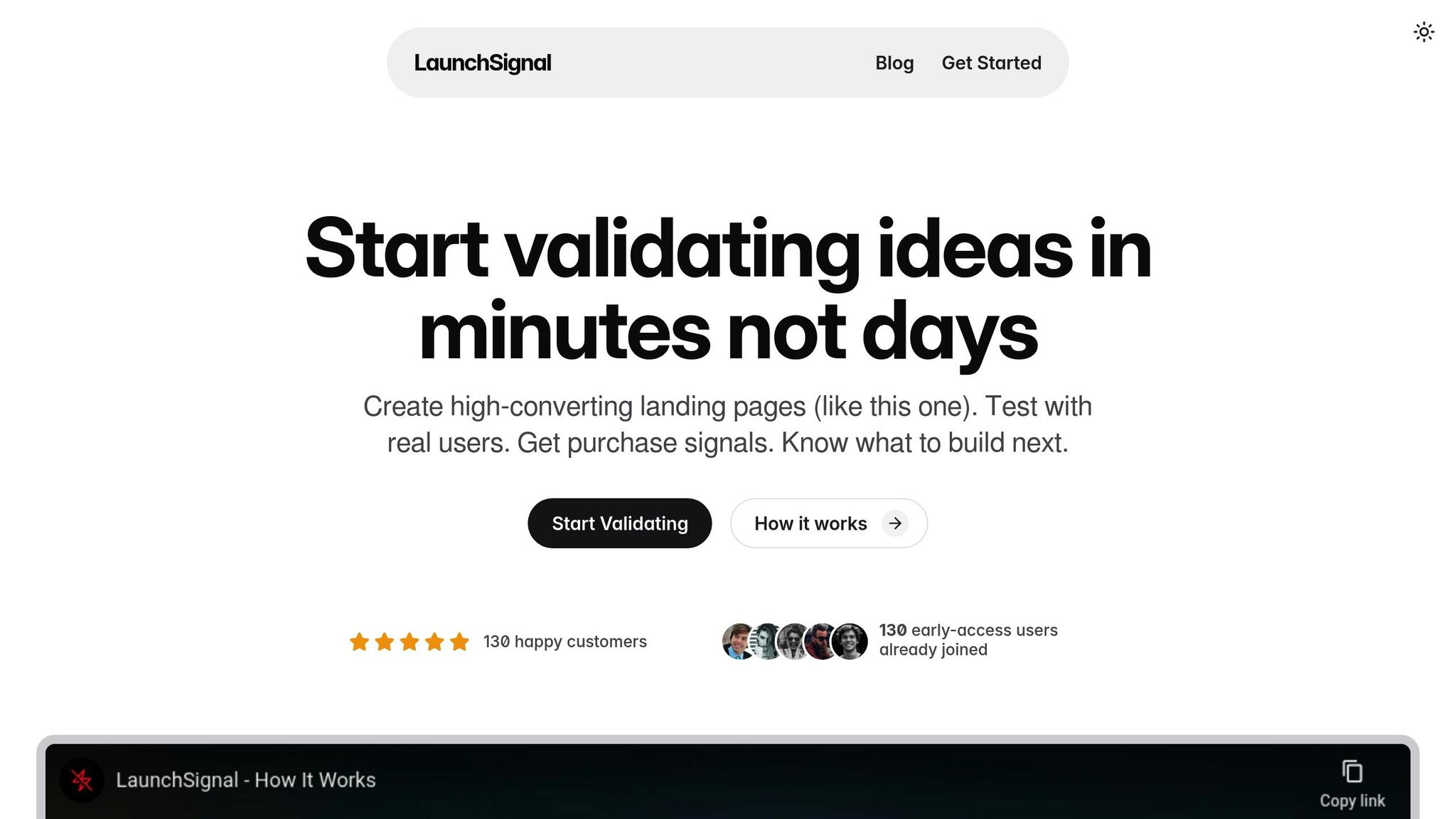
LaunchSignal makes building a landing page simple. All you need to do is input your value proposition, and the AI takes care of the rest, generating a page designed to convert. This eliminates the need for lengthy design processes, allowing you to focus on crafting a message that clearly communicates the benefits of your idea. Once your page is live, LaunchSignal goes a step further by comparing your conversion rates to niche-specific benchmarks. These benchmarks are based on data from thousands of successful launches across industries like SaaS, e-commerce, and services. This setup helps you gather real user insights and fine-tune your idea using data-driven feedback.
"Don't rely on gut feeling. Get hard data before you invest years of your life." - LaunchSignal
Collecting User Data and Feedback
LaunchSignal isn’t just about creating landing pages - it also drives real traffic to them. By running paid ad campaigns, the platform ensures your page gets seen by actual users, who provide valuable feedback. It also collects leads through email sign-ups, and those leads are yours to keep. As the data comes in, LaunchSignal evaluates your performance against industry benchmarks. Interestingly, even a low conversion rate is viewed as a win - it signals that your idea might not have market fit, saving you time and effort. As LaunchSignal explains, "If your score is low? That's a success! You saved months of building the wrong thing".
After gathering feedback, you can easily tweak your page using LaunchSignal’s intuitive tools.
Customizing Your Page Without Code
With LaunchSignal, your product description is all it takes to create a layout. If you want to make adjustments, simply refine your text, and the AI will instantly regenerate an optimized version of your page. For those testing multiple ideas at once, LaunchSignal also offers a programmatic API, making it easier to validate multiple business concepts simultaneously.
Getting Traffic to Your Landing Page
Once your landing page is ready, the next step is to bring in targeted traffic to test and validate your ideas in real time.
Using Paid Advertising
Facebook Ads are an excellent starting point for quickly generating traffic and testing your messaging. With a budget as low as $5 per day, you can gather hundreds of impressions. This platform is ideal for reaching "cold traffic" - people who may not be actively searching for your solution but could be interested based on their demographics and interests.
After refining your messaging on Facebook, shift to Google Ads to target users with higher intent. People clicking on Google Ads are actively searching for solutions, making them more likely to convert. For early testing, aim for a cost per click (CPC) under $2 and a cost per lead (CPL) under $20. To ensure your ads attract the right audience, use "phrase match" keywords rather than "broad match" for more precise targeting.
Make sure your landing page’s messaging and visuals align with the promises made in your ads. This consistency ensures accurate validation data. Additionally, include UTM tracking parameters in your links to measure which ads, keywords, or audiences are driving the best results.
| Channel | Intent Level | Primary Strength | Best For |
|---|---|---|---|
| Google Ads | High | Captures active searchers | Validating specific solutions/keywords |
| Facebook Ads | Low to Medium | Low cost, high volume | Testing messaging and value props |
| LinkedIn Ads | Medium | Professional targeting | B2B product validation |
Once you've gathered initial insights from paid channels, you can expand your strategy with free traffic sources.
Using Free Traffic Sources
Free methods not only complement paid ads but also help build credibility and long-term engagement.
Niche communities are a great way to connect with your audience without spending any money. Instead of sharing promotional links, focus on providing value by answering questions and offering insights in subreddits, Slack groups, or Discord servers where your target audience is active. Always follow the community rules before participating.
Twitter/X threads allow you to share longer stories and provide more context while linking to your landing page. Threads typically get better engagement than single tweets. Encourage your team members to share the landing page through their personal accounts to tap into their networks. With 54% of people using social media to research products, make sure your social media profiles include a clear value proposition and a direct link to your landing page.
For a more sustained approach, optimize your landing page for organic search. Focus on informational keywords that align with the problems your idea solves. If you already have high-ranking content on your website, link it to your landing page to boost visibility and authority. Organic search traffic often comes from users with higher intent, making it especially valuable for validating bottom-of-funnel ideas.
sbb-itb-9a9c51d
Setting Goals and Tracking Performance
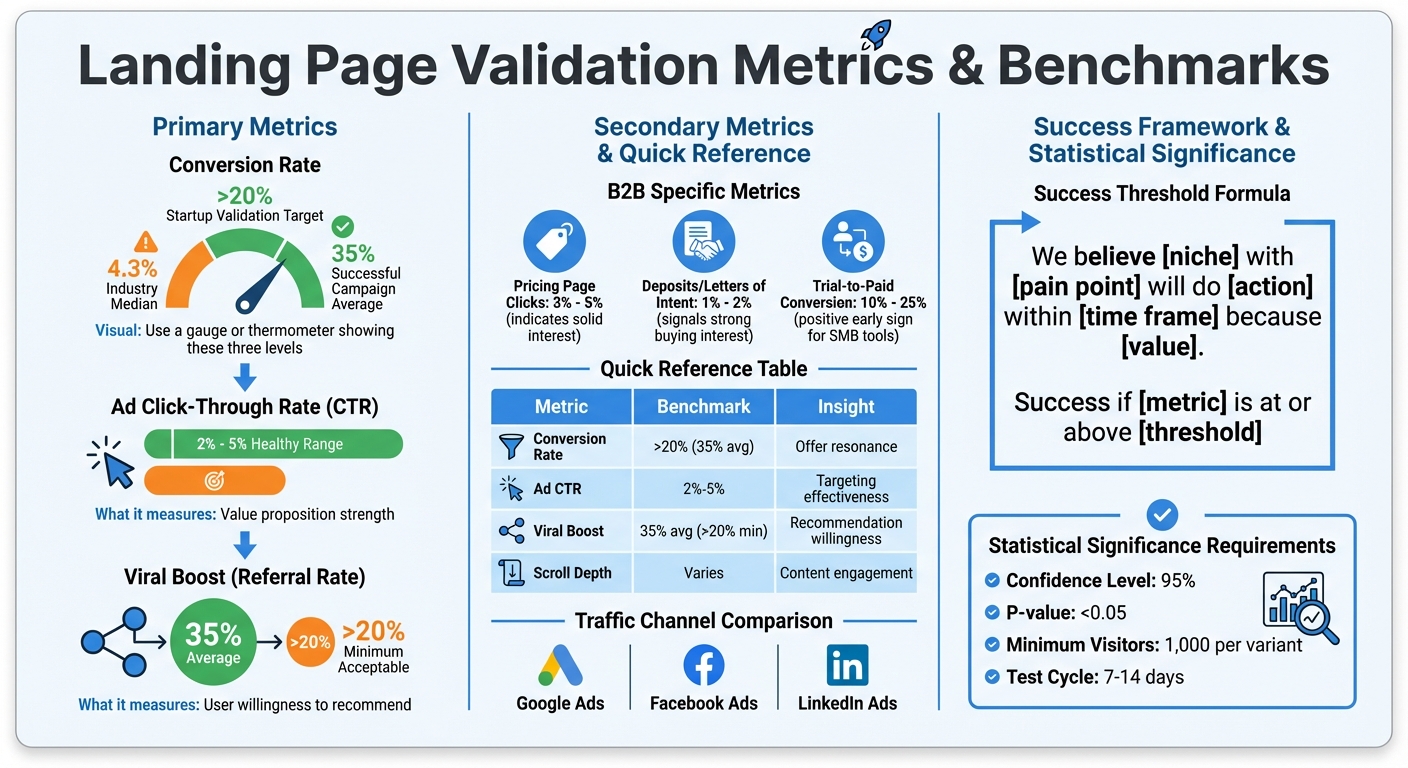
Landing Page Validation Metrics and Benchmarks for Startup Success
Once you've started driving traffic to your idea, the next step is setting clear benchmarks to gauge its viability. Without specific success criteria, it’s tough to decide whether to move forward, pivot, or stop altogether. Let’s dive into the key metrics you should be tracking.
Choosing the Right Metrics
The conversion rate is your most critical indicator of validation. While the median landing page conversion rate across industries is 4.3%, early-stage validation demands a much higher standard. For startup validation campaigns, aim for a conversion rate above 20%, with successful campaigns averaging around 35%. If you’re collecting email signups, also monitor form start and abandonment rates. A high abandonment rate could mean you’re asking for too much information upfront.
Another important metric is Viral Boost, or your referral rate. This measures how compelling your idea is - do users find it exciting enough to share with others? The average referral rate for startups is 35%, and anything under 20% suggests users aren’t willing to invest their "social capital" in recommending your idea.
Your ad click-through rate (CTR) is another key signal. It shows whether your value proposition is strong enough to get people to visit your page. A healthy CTR falls between 2% and 5%. Once they’re on your site, track scroll depth and time on page to see if visitors are engaging with your content or leaving right away. For B2B products, keep an eye on clicks to pricing pages - a 3% to 5% click rate indicates solid interest.
Here’s a quick summary of the key metrics:
| Metric | Benchmark | What It Tells You |
|---|---|---|
| Conversion Rate | >20% (35% average) | Whether your offer resonates with visitors |
| Ad CTR | 2%–5% | Effectiveness of your audience targeting |
| Viral Boost | 35% average (>20% min) | Whether users are willing to recommend your idea |
| Scroll Depth | Varies by page length | Whether your content keeps visitors engaged |
Once you’ve identified these metrics, the next step is to set clear thresholds for success.
Setting Success Thresholds
Before launching, define your success criteria. Use a structured hypothesis like this:
"We believe [niche] with [pain point] will do [action] within [time frame] because [value]. Success if [metric] is at or above [threshold]". This approach ensures you’re committing to measurable outcomes rather than adjusting goals after seeing results.
Wait until you reach statistical significance - 95% confidence, p < 0.05, and at least 1,000 visitors per variant - before drawing conclusions.
"Typically, you need to get to statistical significance, so a particular threshold you set for the test parameters indicates there's been enough traffic over a given amount of time to start assessing the data."
– Meghan Carreau, Co-Founder of Aztech
To speed up decision-making, run tests in 7- or 14-day cycles. If your conversion rate falls below 20% or your Viral Boost drops under 20%, interview those who did sign up to understand why they weren’t inclined to share. For B2B offers, a 1% to 2% rate for deposits or Letters of Intent signals strong buying interest. If you’re testing a trial-to-paid model for an SMB tool, look for a 10% to 25% conversion rate as a positive early sign.
Avoid checking results mid-test to prevent false positives. Let your experiment run its full course - whether that’s hitting the sample size or the time limit - before analyzing the data.
Using Data to Improve Your Idea
Once you’ve gathered enough data to reach statistical significance, the real challenge begins: turning those numbers into clear, actionable steps. This is where you validate your idea or uncover a better path forward. Building on metrics tracking and user behavior analysis, this section explores how to transform raw data into strategies that drive improvement.
Reading User Behavior Patterns
Start by identifying where visitors lose interest. Heatmaps can reveal where users click, while scroll depth tracking pinpoints exactly where they drop off. If your bounce rate is high - meaning visitors leave immediately - it could signal a mismatch between your ad copy and the landing page content, or an unclear value proposition.
Another key area to examine is form analytics. Look at "hesitation time" (how long users pause before filling out a field) and abandonment rates for specific questions. For example, in 2024, Hootsuite used Qualaroo surveys to discover that 65% of their visitors needed more product details before converting. By adding dashboard screenshots, transparent pricing, and testimonials, they saw a 16% increase in conversions, backed by 98% statistical significance.
If your sign-up rate is under 5%, it’s a red flag for a weak value proposition. Strong engagement metrics like time on page and scroll depth paired with low conversions often indicate issues with your call-to-action or form design.
Comparing Multiple Ideas at Once
Testing several product concepts simultaneously can help you figure out which "job to be done" resonates most with your audience. Tools like LaunchSignal’s A/B/n testing allow you to compare multiple ideas, keeping the best performer as your baseline until another variant proves superior.
The ICE Framework can help you prioritize ideas for testing. Rank each concept by Impact (potential improvement), Confidence (likelihood of success), and Ease (effort required). Focus on a primary metric, like conversion rate, to determine winners. At the same time, monitor "guardrail" metrics - such as bounce rate or page load time - to avoid unintentionally harming other aspects of performance.
Segment your data by device (mobile vs. desktop) or visitor type (new vs. returning). Sometimes, an idea might not perform well overall but could excel significantly within a specific, high-value segment. For instance, Penn Foster, an online college, created a landing page variant tailored to deliver only relevant information with targeted CTAs. This approach led to a 202% boost in click-to-lead conversions.
Once you’ve identified the best-performing idea, refine it further to maximize its impact.
Adjusting Based on Results
Run tests in cycles of 7 to 14 days to speed up results and avoid wasting resources on features your audience doesn’t want. Before starting, define a clear hypothesis with measurable outcomes. This keeps you focused on specific goals and prevents shifting targets after seeing the data.
"A failed A/B test is not a waste of time. Every test provides an opportunity to learn more about your audience and refine your approach."
– Josh Gallant, Founder, Backstage SEO
Use a Validation Scorecard to evaluate results across five areas:
- Desirability: Does the product solve a real pain point?
- Signal Strength: Are users engaging with pricing or making deposits?
- Viability: Does the customer lifetime value (CLV) justify the customer acquisition cost (CAC)?
- Feasibility: Can you deliver this quickly?
- Risk: Are there regulatory or other constraints?
If you miss your target twice in a row, consider testing higher-impact variants, such as adding pricing or deposit requirements. Alternatively, pivot based on qualitative insights from user interviews.
Combine quantitative data with session recordings to better understand user drop-offs. Tailor your landing page copy to match the exact phrases customers use in interviews to eliminate confusion. Even tests that don’t succeed reveal what your audience dislikes - document every insight to guide your next round of experiments.
Conclusion
Key Benefits of Landing Page Testing
Landing page testing takes the guesswork out of product development by relying on solid data rather than intuition. Instead of sinking months and thousands of dollars into building a full-fledged product, you can test the waters with minimal resources - just a simple layout, visuals, and some compelling copy. This approach helps validate whether a specific customer group is willing to pay for your solution. Here's a telling stat: 27% of startup founders say their biggest hurdle is the time it takes to validate ideas while building the product. By flipping the script and prioritizing validation before development, you can run full Build-Measure-Learn cycles in just 7 to 14 days. This not only speeds up the path to revenue but also helps you avoid the costly mistake of creating features that miss the mark with customers.
Alex Robb, Founder of Launching Next, sums it up perfectly:
"Without validation, target customers may not perceive your product's value. That's why I place validation above product development, as validation drives the roadmap."
This method also cuts financial risk by focusing on meaningful metrics like sign-up rates, clicks on pricing, and deposits - rather than vanity stats like page views or social media followers. These behaviors provide clear signals of customer intent. For example, showing pricing early is a quick way to gauge willingness to pay. If your B2B landing page gets a 3–5% click-to-pricing rate and a 1–2% purchase rate, you've got a strong case to move forward.
How LaunchSignal Simplifies the Process
To make the most of landing page testing, having the right tools is crucial - and that's where LaunchSignal comes in. It tackles the common roadblocks founders face when trying to validate ideas quickly. With its no-code drag-and-drop builder, you can create a professional validation test in under 30 minutes - no developer needed. This fast setup directly addresses the time constraints that hold back more than a quarter of founders.
On top of that, LaunchSignal’s built-in analytics dashboard turns raw visitor data into actionable insights. You can test multiple product ideas side by side, track real user behaviors with features like email capture, questionnaires, and fake checkouts, and even export the data for deeper analysis. For just $99 as a lifetime deal, you get 3 active validation pages and up to 10,000 monthly page views - plenty of room to test early ideas and make informed decisions. By combining speed, affordability, and actionable insights, LaunchSignal makes validation accessible for any founder, no matter their technical skills or budget.
FAQs
How can I tell if my landing page headline is working effectively?
Think of your headline as a critical part of your landing page - it deserves the same level of attention and testing as any other key element. Start by figuring out your current conversion rate (for example, 2.5% of visitors signing up) and setting a clear improvement goal. From there, craft alternative headlines that take different angles, such as highlighting a stronger benefit, creating curiosity, or introducing a sense of urgency.
Next, run an A/B test. Show these headline variations to similar traffic segments and track how they impact metrics like conversion rates or click-through rates. Once you’ve gathered enough data to achieve statistical significance, compare the results to see which headline performs best.
If you’re looking for a way to streamline this process, LaunchSignal offers tools to help you quickly create landing pages, collect user insights, and analyze performance. Regularly testing and tweaking your headlines can lead to smarter, data-backed decisions that improve outcomes and bring your ideas to life.
What are the best practices for creating effective CTAs on a landing page?
An effective call-to-action (CTA) is a must for boosting conversions on a landing page. To start, focus on crafting CTA text that is clear, action-oriented, and highlights the benefit. Use phrases like "Sign up for early access" or "Get your free guide" to immediately show users what’s in it for them. Keep the message short and easy to read at a glance.
The design of the button matters just as much. Choose a high-contrast color that draws the eye, make sure it's large enough for easy clicking on both desktop and mobile, and consider adding subtle effects like shadows or hover animations to make it feel interactive. Placement is another critical factor - position your CTA in highly visible areas, such as above the fold or after important sections, where users are most likely to notice it.
Don’t forget to test and improve your CTA over time. Experiment with different text, colors, or placements to figure out what resonates with your audience. Tools like LaunchSignal can help you fine-tune your CTAs by providing real-time insights and data to maximize your landing page’s effectiveness.
How can I use landing page data to refine my product idea?
To fine-tune your product idea, take a close look at critical metrics from your landing page. Pay attention to conversion rates, click-through rates, questionnaire feedback, and fake checkout completions. These numbers reveal what aspects - like features, headlines, or pricing - strike a chord with your audience.
Use this information to tweak your product concept, refine your messaging, or adjust your pricing strategy. Tools such as LaunchSignal can streamline the process by collecting and comparing data across different ideas, helping you make informed decisions with confidence and speed.
Start validating ideas in minutes not days
Create high-converting landing pages. Test with real users. Get purchase signals. Know what to build next.
Visit LaunchSignal