April 27th, 2026
How to Test Product Ideas with Landing Pages
Validate product demand fast with landing pages—create focused pages, run targeted ads, track conversion and user feedback, then iterate or pivot based on real data.
Warren Day
Testing a product idea before building it saves time and money. A quick, cost-effective way to validate demand is by using landing pages. Here's the process:
- Create a Landing Page: Showcase your idea and prompt actions like sign-ups or pre-orders.
- Define Success Metrics: For consumer products, aim for a 5%-10% sign-up rate; for B2B, target 1%-2% deposits or Letters of Intent.
- Drive Traffic: Use paid ads, social media, or email to attract your target audience.
- Analyze Results: Metrics like conversion rates, click-through rates, and user feedback reveal demand and guide next steps.
Tools like LaunchSignal simplify this process by generating optimized landing pages and tracking performance. If your idea resonates, move forward. If not, refine or pivot based on data.
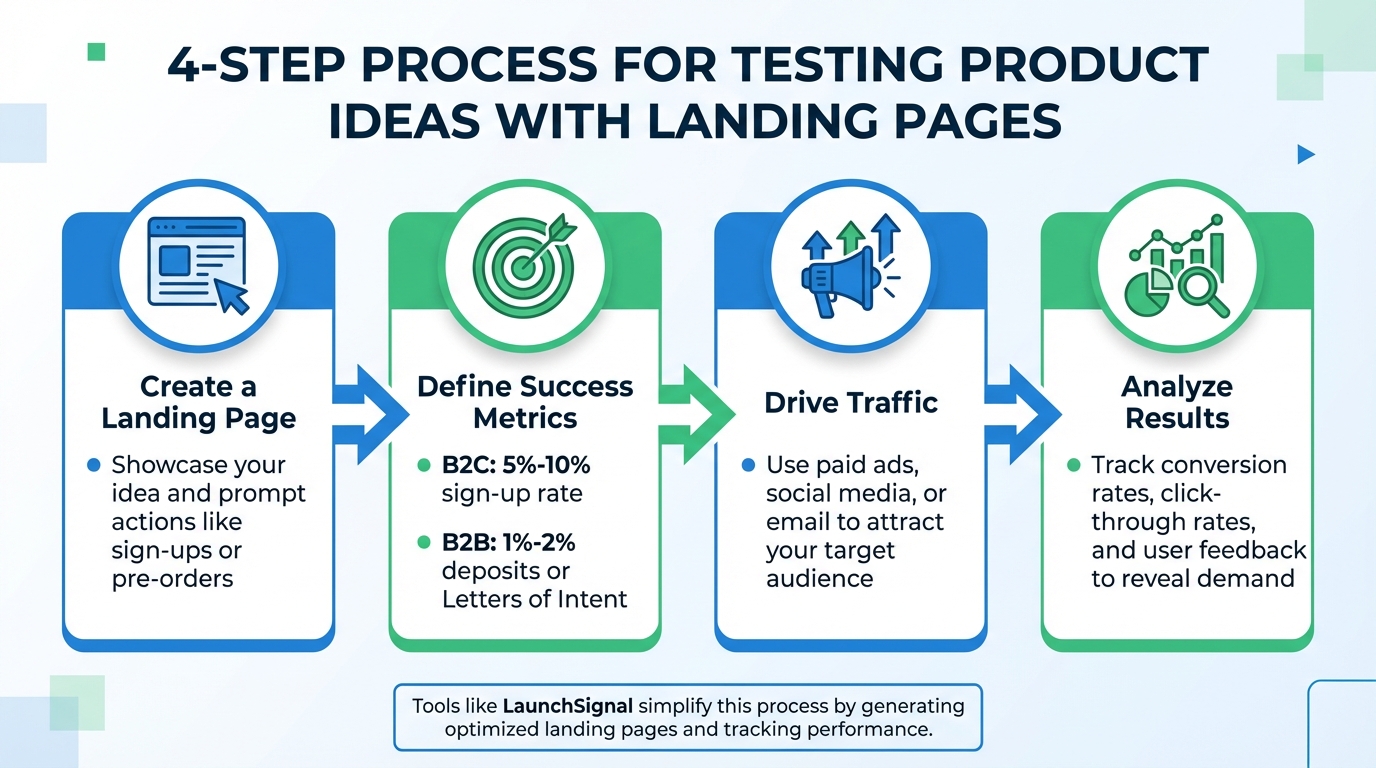
4-Step Process to Validate Product Ideas with Landing Pages
Define Your Product Idea and Success Metrics
Before creating a landing page, it's crucial to outline exactly what you're testing. Break your product idea into three key elements: the problem it solves, the unique value it offers, and the method or approach it uses. Think of your product idea as a hypothesis that can be tested.
You also need to identify your target audience. Instead of casting a wide net, narrow your focus. For instance, instead of targeting "fitness enthusiasts", zero in on "busy parents looking for 15-minute home workouts." This level of specificity makes your messaging more impactful and improves conversion rates.
Write a Clear Value Proposition
Your value proposition is the cornerstone of your landing page - it tells visitors what your product does and why it matters to them. You’ve got about five seconds to grab their attention. Focus on the results your product delivers rather than just listing features. For example, instead of saying "advanced scheduling software", try "automate client scheduling in seconds." Test your value proposition by pitching it to someone unfamiliar with your product and then to a potential customer.
Set Specific Validation Goals
Define your success metrics upfront to avoid shifting the goalposts later. A solid validation statement might look something like this:
"We believe [niche] with [pain] will do [action] within [time window] because [value]. Success if [metric] is at or above [threshold]."
For consumer products (B2C), a sign-up conversion rate between 5% and 10% is generally enough to consider scaling. Rates above 10% suggest strong interest, while rates below 5% might mean your value proposition needs work. For business-focused products (B2B), validation could mean landing 2–3 paying pilot customers or achieving a 1%–2% conversion rate for deposits or Letters of Intent. Pay close attention to behavioral metrics - such as email signups, clicks on pricing, or simulated purchases - since these reveal genuine customer interest.
| Metric Type | Target Benchmark |
|---|---|
| B2C Sign-up Rate | 5%–10% (strong if >10%) |
| B2B Deposits/LOI | 1%–2% |
| Click-to-Pricing Rate | 3%–5% |
| Trial-to-Paid Conversion | 10%–25% |
Build Your Landing Pages with LaunchSignal
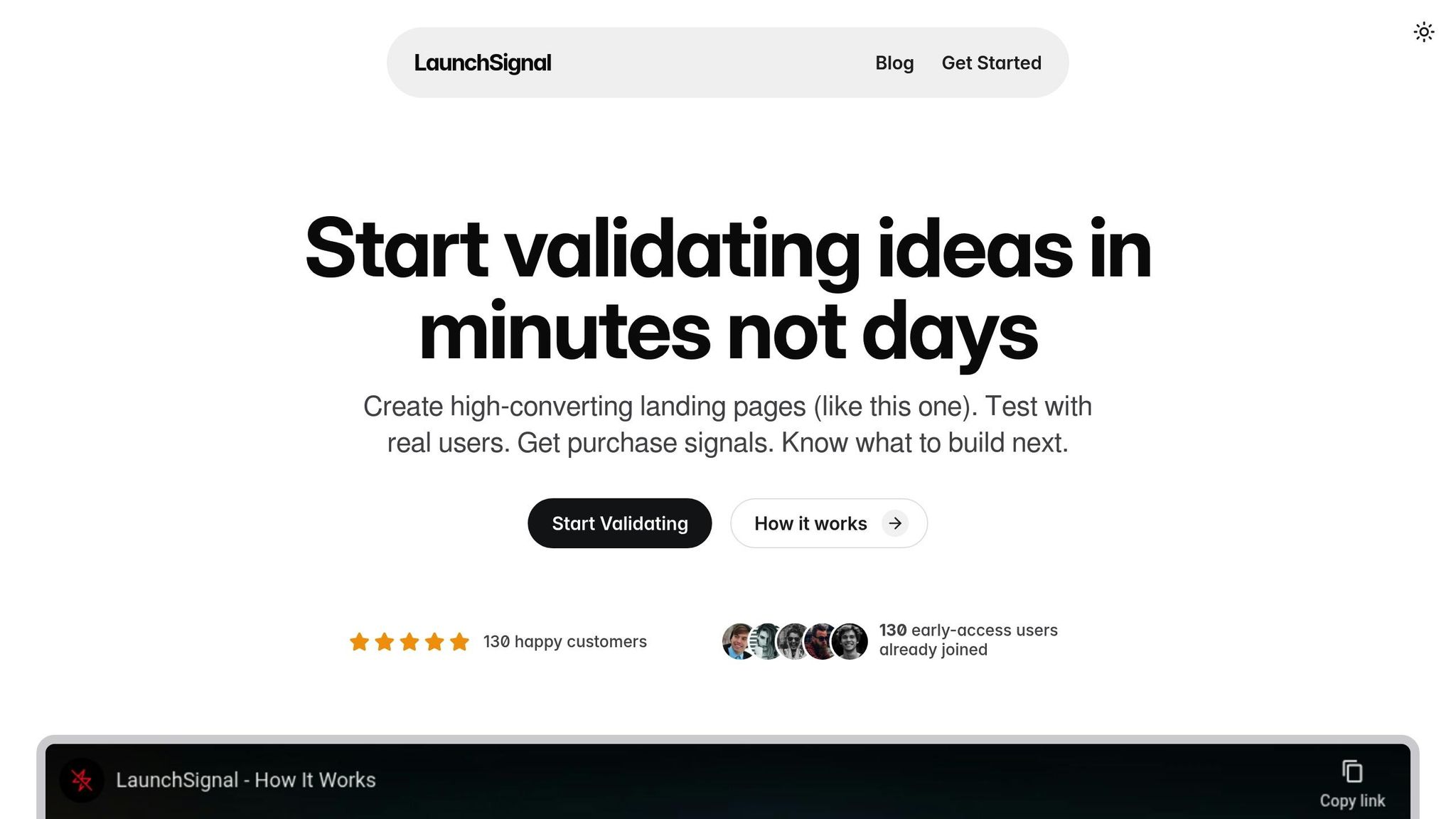
Time to create your landing page! With LaunchSignal, you can generate conversion-focused pages in no time - all from your value proposition. No design or coding expertise required. Just input your product's value proposition, and the platform does the rest. It analyzes your product description and crafts a layout designed to drive conversions, drawing insights from thousands of successful launches across SaaS, e-commerce, and service industries.
Choose and Customize Templates
LaunchSignal takes the guesswork out of creating optimized templates. By simply entering your product's value proposition, the platform generates a layout tailored to your offering. Headlines and call-to-action (CTA) placements are strategically positioned to encourage conversions. Plus, the pages are designed for skimming - since that's how most visitors browse - making your key benefits and headlines stand out.
Want to test different angles? Quickly create multiple versions of your page highlighting various benefits, such as ease of use, cost-effectiveness, or time savings. This approach helps you identify which message resonates best with your audience, all without spending hours tweaking designs. Once your layout is ready, you can integrate tools to collect real user feedback.
Add Email Capture, Questionnaires, and Fake Checkouts
LaunchSignal’s built-in tools make it easy to gauge interest and gather leads. Keep your email capture forms simple - research shows that forms with just one field (like an email address) convert best. Use a benefit-focused CTA like “Get Early Access” or “Join the Waitlist” to encourage action.
For deeper insights, add short, multi-step questionnaires to learn about your audience’s feature preferences without overwhelming them. Want to test purchase intent? Use a fake checkout button with labels like “Pre-order” or “Buy Now.” When clicked, redirect users to a “Coming Soon” page and let them know the product is still in development. This method provides a stronger signal of buying interest than email signups alone. Best of all, every lead you capture is yours to use in future marketing efforts.
Send Traffic to Your Landing Pages
Your landing page is ready to go - now it’s time to focus on driving the right traffic to test and validate your product idea.
Reach Your Target Audience
Using paid search ads through platforms like Google Ads is a great way to attract high-intent users who are actively searching for solutions similar to yours. These visitors are already looking for what you’re offering, which makes them more likely to engage with your landing page.
On the other hand, social media platforms like Facebook, Instagram, and LinkedIn excel at reaching specific groups through visually engaging content. However, social media traffic often comes with lower purchase intent compared to paid search. As Johnathan Dane, Founder of KlientBoost, puts it:
"If your CTA doesn't match your visitor's conversion intent, it doesn't matter what you split test on your landing page - it won't work".
For colder audiences on social media, opt for softer calls-to-action (CTAs) like "Learn More" instead of more direct ones like "Buy Now."
Email marketing is another effective channel, particularly for reaching warm leads or leveraging your existing network. Sending personal invitations to check out your landing page can drive highly relevant traffic, especially from people who already know and trust you.
It’s essential to align your landing page messaging with the promises made in your ads. For example, Saxo Bank saw major success when they tested a landing page for their currency-trading platform. By aligning their headline and visuals with their PPC ad copy (highlighting "free, no risk, $100,000 demo account"), they achieved a 99.4% increase in conversions and a 48.2% drop in cost-per-conversion.
| Traffic Type | Intent Level | Recommended CTA |
|---|---|---|
| Paid Search (Branded) | High (Hot) | Book Demo | Buy Now | Start Trial |
| Paid Search (Informational) | Medium (Warm) | Download Whitepaper | Sign up for Webinar |
| Social Media (Native) | Low (Cold) | Read Blog | View Infographic | Free Guide |
Once you’ve attracted the right visitors, test different messaging approaches to uncover the most compelling way to communicate your value.
Test Multiple Ideas Simultaneously
After setting up targeted traffic strategies, consider using tools like LaunchSignal to test various product angles at the same time. Focus on exploring fundamentally different value propositions - such as emphasizing convenience versus affordability.
When starting out, divide your ad budget equally across multiple variations. As data rolls in, you’ll quickly identify which concept resonates most with your audience. This method doesn’t just help you find the best-performing landing page design - it also sheds light on which product idea solves a problem that truly matters. AI-driven tools can further enhance this process, increasing conversions by up to 30% by directing visitors to the most effective version.
Running traffic from different channels simultaneously provides even deeper insights. For instance, your email subscribers might respond better to one concept, while PPC visitors may prefer another. These findings are invaluable for fine-tuning your product idea based on real-world feedback. By analyzing these patterns, you can make informed decisions about product iterations and refine your offering to meet the needs of your target audience.
sbb-itb-9a9c51d
Review Data and Adjust Your Product Idea
As you start gathering traffic, it's time to dive into the metrics that will help you validate your product idea.
Monitor Conversion Rates and User Responses
Using tools like LaunchSignal's analytics, you can assess how well your landing page is performing. Start by looking at your conversion rate - this is the percentage of visitors who take an action, like signing up, completing a questionnaire, or even going through a mock checkout. A conversion rate above 20% is a good sign that you're hitting the mark with your audience, and successful startup campaigns often see rates closer to 35%.
Next, check your Ad Click-Through Rate (CTR). A healthy range for validation campaigns is between 2% and 5%. If your CTR is under 2%, it’s a strong indicator that your ad copy or visuals aren't connecting with your audience.
Another key metric is the Viral Boost, which measures how willing users are to refer others. On average, referral rates hover around 35%, but with incentives, they can climb to 50%. If your referral rate falls below 20%, it’s a warning sign that your idea might not be generating enough excitement. Alex Robb, Founder of Launching Next, sums it up well:
"Startup idea validation proves a potential customer will pay for a clear job using the cheapest behavior-based test, with thresholds and a clear go or no-go rule".
Don’t underestimate the value of survey responses and open-ended feedback. These can highlight pain points or features your audience wants but that you may have overlooked. For example, if visitors start filling out your signup form but don’t finish, it could mean your process is too complicated or your value proposition isn’t clear enough.
LaunchSignal also offers "Truth-Seeking Benchmarks", which let you compare your results with thousands of other launches in SaaS, e-commerce, and services. These benchmarks help you figure out if your numbers reflect real customer interest or if you need to make adjustments.
Use these insights to guide your next steps.
Decide Next Steps Based on Results
Your data should inform what you do next. For instance, if your conversion rate is above 10% and engagement metrics like time on page and scroll depth are strong, but signups are still lower than expected, the issue might not be your idea - it could be friction in your signup process or a weak call-to-action (CTA). In this case, refine by testing new CTAs or simplifying the form.
On the other hand, if your conversion rate is below 5% or your bounce rate is sky-high (over 70-80%), your value proposition likely isn’t resonating with your audience. This might mean it’s time to pivot. Dive into your survey data to identify what’s missing, and test a completely different approach.
If your efforts continue to fall short, LaunchSignal can save you time by helping you avoid building a product that doesn’t have market potential. The platform can even suggest pivots based on your data, steering you toward an idea that aligns better with what customers want.
When testing changes, consider using the "If-Then-Because" framework. For example: "If we change the CTA to 'Get Early Access,' then sign-ups will increase because it adds a sense of exclusivity." Test one variable at a time so you can clearly identify what’s driving performance.
Conclusion
Using landing pages to test product ideas can save you months of development time and thousands of dollars. Instead of waiting a year to gauge interest, you can validate your market in just a few days.
Traditional development demands significant resources, but landing page validation only requires a small ad budget and minimal setup. Tools like LaunchSignal take this a step further by using AI to create optimized pages and run paid ad campaigns automatically. This means you're not relying on guesswork - you’re gathering concrete data directly from potential customers.
Armed with clear metrics, your next steps become obvious. As LaunchSignal advises:
"Don't rely on gut feeling. Get hard data before you invest years of your life".
By comparing your results to benchmarks from thousands of other launches, you can gauge your product's potential. For example, if your conversion rate hits 25% or higher, it’s a strong signal you’re on the right track. If it falls short, the insights you’ve gained can still steer you away from investing in the wrong product.
Whether confirming potential or signaling the need for a pivot, these insights are invaluable. This agile approach allows you to test, adjust, and refine quickly - without writing a single line of code. LaunchSignal handles page creation, traffic management, and data analysis, freeing you to focus on improving your offer and making informed decisions about what to build next.
In short, landing page validation turns product development into a fast, cost-efficient, and data-driven process that delivers actionable results in no time.
FAQs
How can I use landing pages to test if my product idea is worth pursuing?
To see if your product idea has legs, start by building a simple, focused landing page. Use it to showcase your concept and explain the value it offers. Then, run targeted campaigns to drive traffic to the page and track key engagement metrics - like email sign-ups, survey completions, or clicks on your call-to-action.
If you notice low interest or engagement, it might be a sign that your idea needs some tweaking before you take the next step. This method gives you real-world feedback while keeping risks low, helping you make smarter decisions about your product’s future.
What metrics should I track to validate a product idea with landing pages?
When you're testing a product idea with landing pages, it's crucial to keep an eye on key performance metrics that can help you gauge interest and engagement. One of the most important metrics is the conversion rate - this tells you how many visitors are taking the action you want, like signing up or filling out a form. It's a clear indicator of whether your page is doing its job.
Another metric to watch is the bounce rate, which shows how many people leave your page without interacting. A high bounce rate might mean your page isn't grabbing attention or delivering what visitors expect.
Don't forget to track the click-through rate (CTR) as well. This measures how effective your call-to-action is at getting visitors to engage further. Lastly, keep an eye on form completion rates to see if users are comfortable sharing their information. Together, these metrics offer a solid foundation for refining your product idea and making smarter decisions during development.
What are the best ways to drive traffic to a landing page for testing a product idea?
To effectively drive traffic to your landing page for product validation, start by running targeted paid advertising campaigns. These ads allow you to zero in on specific audiences, gauge genuine market interest, and gather valuable feedback from potential customers. By focusing on relevant traffic, you increase the likelihood of collecting insights that truly matter.
Another approach is to tap into social media and content marketing. Share your landing page in online communities, post on social platforms, or use email campaigns to connect with people who might resonate with your idea. Craft clear and engaging messages that highlight your value proposition, encouraging visitors to take meaningful actions like signing up or providing feedback.
Lastly, make use of analytics tools to track visitor behavior and measure your results. This data helps you fine-tune your strategy, compare concepts, and make smarter decisions to strengthen your product validation efforts.
Start validating ideas in minutes not days
Create high-converting landing pages. Test with real users. Get purchase signals. Know what to build next.
Visit LaunchSignal