January 19th, 2026
How to Test Product Ideas Without Spending Money
Validate product ideas without spending money. Define assumptions, create a free landing page, drive organic traffic, collect emails and test purchase intent.
Warren Day
Did you know that 42% of startups fail because there’s no market need for their product? Many entrepreneurs waste time and money building solutions no one wants. But you can avoid this. Here’s how: test your product idea for free before investing in it.
Key Steps to Test Your Idea Without Spending Money:
- Define the Problem: Focus on solving a top-priority issue for your target audience.
- Write a Clear Hypothesis: Specify your user, their problem, and your solution.
- Test Assumptions: Identify and validate the riskiest beliefs about your idea (e.g., demand, pricing).
- Build a Landing Page: Use free tools like LaunchSignal to gauge interest and collect emails.
- Drive Free Traffic: Share your idea on social media and niche communities like Reddit or Quora.
- Analyze Data: Track metrics like sign-ups and conversion rates to measure demand.
Testing early saves time and money. If your idea resonates, move forward. If not, adjust or explore a new direction. Don’t gamble your savings - test smartly.
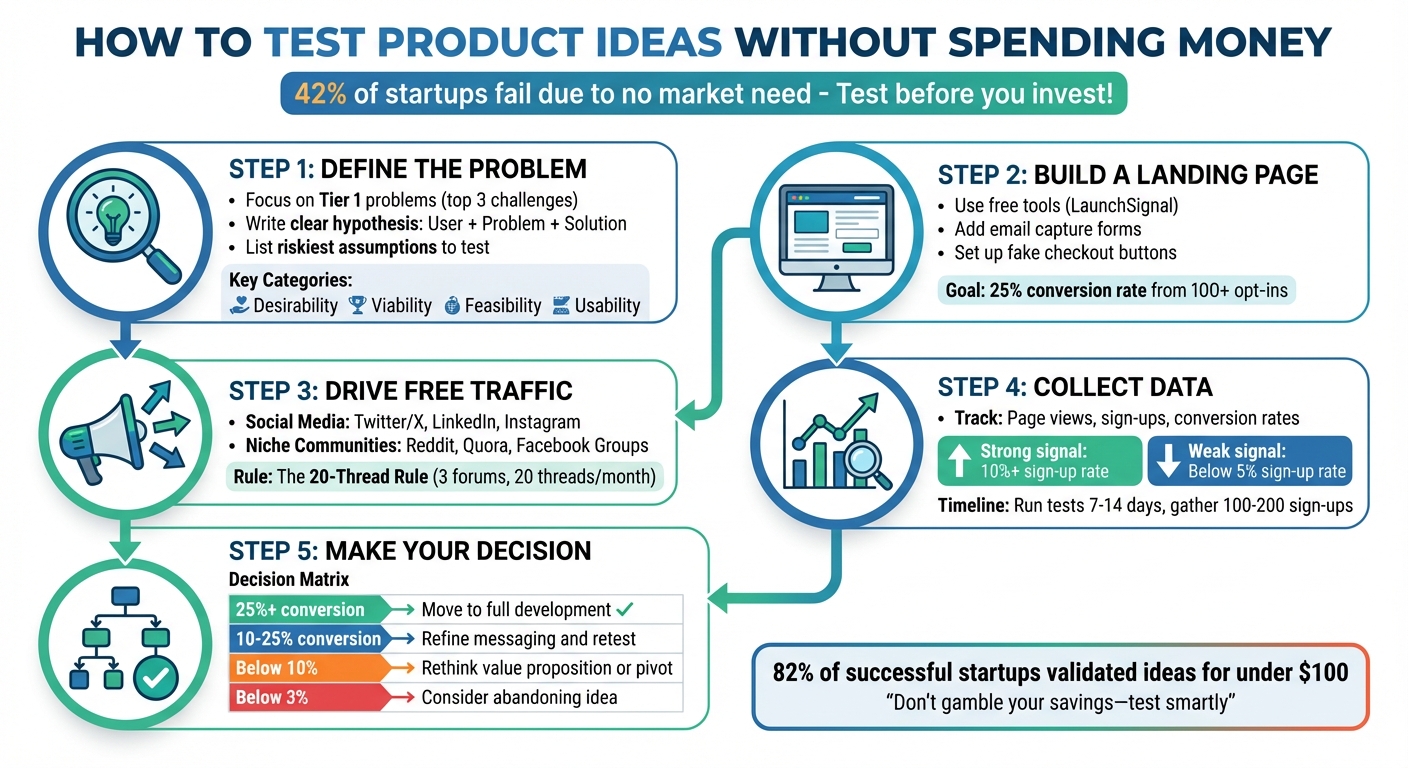
5-Step Process to Test Product Ideas Without Spending Money
Step 1: Define Your Product Idea and Core Assumptions
Before diving into development, take a step back and define exactly what you're working on. Skipping this step is one of the biggest missteps entrepreneurs make. In fact, 42% of startup failures are due to a lack of market need. They create something no one wants because they never clearly outlined the problem they were solving.
Start by writing down your product idea. Daymond John, CEO of FUBU, puts it best:
Find a problem, not a product. Find the solution, not an audience.
Determine if you're addressing a Tier 1 problem - one of the top three challenges your target audience encounters daily. If your idea ranks lower on their list of priorities, it’s unlikely they’ll allocate time or money to it. For instance, freelancers struggling with missed deadlines due to scattered tasks across emails and spreadsheets face a Tier 1 problem. A tool that organizes their calendar with color codes? That’s more of a nice-to-have than a must-have.
Write a Clear Product Description
Start with a one-sentence problem statement. Use this formula: "When a user faces a [trigger], they want an [outcome] so they can achieve a [result]". For example: "When freelancers juggle multiple clients, they want a single dashboard so they can stop missing deadlines."
Next, craft your core hypothesis. Be specific about your user, their pain point, and your solution. For example, instead of saying "busy professionals", narrow it down to "freelancers managing 5+ clients who struggle to track deadlines across scattered spreadsheets". The more detailed you get, the easier it becomes to test your idea.
Once you’ve defined the problem and your hypothesis, you can move on to testing by identifying the assumptions behind your idea.
List the Assumptions You Need to Test
Pinpoint your riskiest assumptions - the beliefs that, if proven wrong, could derail your entire business. These typically fall into four categories: Desirability (do they want it?), Viability (will they pay for it?), Feasibility (can it be built?), and Usability (will they use it?).
Write each assumption as a testable statement. For instance: "Freelancers will pay $49/month to stop missing deadlines" or "Users will transition from spreadsheets to a new tool within 7 days". Set a clear success benchmark upfront, like "6 out of 10 people must confirm this is a major problem", to avoid misleading validation. Using free tools to test these assumptions helps you confirm whether your idea has market potential without spending money. This groundwork is essential before moving on to creating an effective landing page.
Step 2: Build a Landing Page with LaunchSignal
Now that you've outlined your assumptions, it's time to test them quickly - no coding required. A landing page is a straightforward way to gauge genuine user interest. Let’s break down how you can set up your testing platform step by step.
Create Your Landing Page in Minutes
With LaunchSignal, you can build a test-ready landing page in no time. All you need to do is provide a brief description of your product - highlighting the problem it solves and its target audience. The platform uses AI to generate a layout designed to maximize conversions, strategically placing key elements like headlines and call-to-action buttons. It even includes performance benchmarks to help you evaluate your results. As LaunchSignal puts it, "Don't rely on gut feeling. Get hard data before you invest years of your life".
Once your page is live, it’s time to make it interactive.
Add Email Capture and Questionnaires
To collect actionable insights, incorporate tools like email forms and questionnaires. An email capture form allows you to gather contacts from visitors who are genuinely interested - building a list you can use for validation, beta testing, or launch updates. Questionnaires, on the other hand, help you collect feedback on specific topics like customer pain points or pricing expectations. If your conversion rate isn’t meeting your expectations, LaunchSignal’s system analyzes the data and suggests adjustments based on market trends and feedback.
Set Up Fake Checkouts to Test Purchase Intent
Email signups show interest, but they don’t necessarily prove people are willing to pay. To test purchase intent, add a "Buy Now" button that leads to a "Coming Soon" message. Each click on this button signals intent to buy. Your goal? Aim for a 25% conversion rate from at least 100 opt-ins to validate demand.
This approach gives you a clearer picture of whether your idea has real potential.
Step 3: Get Free Traffic to Your Landing Page
Your landing page is ready - now it’s time to get visitors. The good news? You don’t need to spend a cent on ads. With the right tactics, you can connect with people already searching for solutions.
Share on Social Media Platforms
Start by focusing on the social platforms your audience uses most. For tech products and B2B ideas, Twitter (now X) is a great fit. Share a brief post highlighting the problem your product solves and include a link to your landing page. LinkedIn is ideal for professional audiences - write posts about the challenges your product addresses and engage with comments to spark conversations. If you’re targeting consumers, Instagram is a natural choice. Create short videos or eye-catching infographics to showcase your idea.
Make sure your profile works as a digital business card. Use a clear bio with a link to your landing page and ensure your branding is consistent across platforms. Engagement is key - reply to comments, acknowledge mentions, and interact with your audience. Try hosting Q&A sessions or running polls to learn about their pain points. This builds trust and naturally encourages people to explore your landing page.
These efforts also set the stage for connecting with more focused audiences in niche communities.
Post in Niche Communities
Beyond social media, niche communities give you direct access to your ideal audience. Broad social posts might not always lead to conversions, but places like Reddit, Quora, and Facebook Groups can. On Reddit, subreddits like r/Entrepreneur work well for startup ideas, but you’ll find even more targeted groups by digging deeper. On Quora, answer questions related to the problem your product solves, and subtly include your landing page link. Industry-specific Facebook Groups can also bring in high-quality traffic.
Before diving in, follow The 20-Thread Rule: join three relevant forums and contribute to 20 threads each month. This builds your credibility and ensures you’re not seen as a spammer. When you share your landing page, lead with value - offer a free guide, ask for feedback on solving a shared issue, or run a small giveaway. Once you’ve gained trust, you can even add your landing page link to your forum signature.
These communities not only drive traffic but also help you gauge interest in your product before making major investments.
sbb-itb-9a9c51d
Step 4: Collect and Review User Data
Once your landing page starts attracting visitors, it's time to dig into the data to see if your idea is resonating.
Track Metrics with LaunchSignal Analytics
This is where you find out if all the effort you’ve put in so far is paying off. LaunchSignal’s analytics dashboard helps you understand how users are interacting with your landing page. Keep an eye on three key metrics: page views, email sign-ups, and conversion rates. If your sign-up rate hits 10% or higher, that’s a strong signal of interest. On the other hand, if it’s below 5%, it might mean your value proposition isn’t hitting the mark.
Other useful metrics include scroll depth and time on page. For example, if visitors are reading through your content but not signing up, the issue could lie in your call-to-action placement or the design of your form. LaunchSignal also offers "Truth-Seeking Benchmarks", which let you compare your conversion rates against data from thousands of successful launches in industries like SaaS, e-commerce, and services. These benchmarks help you see whether you’re meeting industry standards or lagging behind.
To get even more detailed, track each button on your page separately. For instance, create distinct tracking events for call-to-actions (CTAs) at the top of the page versus those at the bottom. A great example of this approach comes from Michael Hoessly, who tested his startup idea "Pingvite" in September 2025. Using Instagram ads to drive traffic to his landing page, he achieved a 4% ad click-through rate and a 24% conversion rate for his “Get Pingvite” CTA. He also used a clever test called “painted doors” for a feature labeled "New Group." When users clicked on “Create Group,” they saw a message saying the feature was still in development. This allowed him to gauge interest without actually building the feature.
Once you’ve gathered your quantitative data, it’s time to dive deeper with user feedback.
Analyze Feedback to Measure Demand
While metrics show trends, feedback reveals the why behind user behavior. Use responses from your questionnaires to identify recurring pain points or feature requests. If the same issue keeps popping up, it’s a clear sign that the problem is worth solving.
Another way to measure demand is through fake checkouts. For instance, when users click a "Buy Now" button that leads to a "Coming Soon" message, it’s a strong indicator of purchase intent. A great example of this strategy comes from 2021, when Waterboy co-founders Mike Xhaxho and Connor Saeli validated demand for their hydration product. They built an SMS list of 18,000 to 20,000 interested users. When they launched a pre-sale, they sold their entire first production run in just one hour.
If your results aren’t as strong as you’d hoped, don’t lose heart. LaunchSignal can provide automated suggestions for tweaking your product based on the data you’ve collected. Sometimes, the market isn’t rejecting your idea - it’s just pointing you toward a better approach.
Step 5: Use Data to Make Your Next Decision
Now that you've collected user data, it's time to analyze it and decide whether to move forward, make adjustments, or let the idea go.
Review Your Key Metrics
Start by examining your primary call-to-action (CTA). If the conversion rate is 25% or higher, you're likely hitting product-market fit. A 10%–20% pre-order conversion rate suggests strong interest, though there's room for improvement. But if you're seeing less than 10%, it might mean your value proposition isn't resonating. And for rates under 3%, the concept may need a serious rethink.
Take a closer look at your click-through rates, sign-up rates, and form abandonment data. If there's a disconnect between these metrics, it could point to issues with your pricing, offer, or even the design of your forms.
To ensure your conclusions are reliable, gather enough data - aim for at least 100 to 200 sign-ups - and let your tests run for about 7 to 14 days. This gives you a more accurate picture of user behavior.
With these numbers in hand, use the following insights to guide your next steps.
Decide What to Do Next
Once you've reviewed your analytics, it's time to act. If your primary CTA conversion rate is 25% or higher and users are engaging further - like pre-ordering or revisiting your site - you're ready to move ahead with development.
Take Bola Grills as an example. In 2025, founder David Levy used an Indiegogo campaign to test demand for a new grill design. Over 30 days, the campaign raised $22,000 and secured 94 pre-orders, offering enough validation to move into full production.
But what if engagement is high, yet conversions remain low? That might signal a need to pivot. In 2021, Mary Gui, founder of Sock Candy, launched her sock brand with a mix of cotton and sheer styles. By digging into Shopify Analytics and Instagram engagement, she discovered that sheer styles were far outselling the others. This insight led her to shift her brand's focus almost entirely to sheer fashion socks.
And if engagement remains flat despite multiple tweaks? It may be time to walk away. Growth marketer Scott McLeod sums it up perfectly:
Fall in love with the problem, not the solution.
A practical guideline here is the "Two-Miss Rule." If you fail to hit your target metrics twice, even after making changes, it might be smarter to explore a completely different idea rather than continuing to invest in the current one.
Here's a quick summary to help you interpret your results and decide your next move:
| Signal Strength | Primary CTA Conversion Rate | Recommended Action |
|---|---|---|
| Strong | 25% or higher | Move to full development |
| Moderate | 10%–25% | Refine messaging and test again |
| Weak | Below 10% | Rethink the value proposition or pivot |
| Very Weak | Below 3% | Consider abandoning the idea |
Conclusion
Testing a product idea doesn’t have to drain your wallet or take months of effort. With the right game plan, you can validate demand in just a week using free tools and a simple landing page. Here’s a surprising stat: 82% of successful startups validated their ideas for under $100. This shows that smart validation is about strategy, not splurging.
Here’s the basic process: define your core assumptions, create a straightforward landing page using tools like LaunchSignal to gather real user feedback, drive free traffic from social platforms and niche communities, and then analyze the data to make an informed decision. This method can help you avoid the fate of the 42% of startups that fail because there’s no market need for their product.
Validation isn’t about proving your idea is perfect - it’s about uncovering the truth before committing your time and money. As Nancy Twine, founder of Briogeo, wisely puts it:
"I’ve always been taught to take smart risks".
Early testing is one of those smart risks that can make all the difference.
If you’re looking for an easy way to start, LaunchSignal simplifies the entire process. For just $99 lifetime access, you can test up to three product ideas, collect email sign-ups, run fake checkout tests, and access detailed analytics. It’s a small price to pay to avoid spending months building something no one wants.
So, don’t wait until you’ve built a full product to find out if there’s demand. Start testing now, and let real user data guide your next step.
FAQs
How can I tell if my product idea solves a major problem?
A major problem is one that causes real frustration, inconvenience, or loss - something people are eager to solve, often willing to pay for a fix. To figure out if your idea tackles such a problem, keep an eye out for these three key signs:
- The issue pops up often in conversations with your target audience.
- It results in noticeable costs - whether in time, money, or effort.
- Current solutions are either unavailable or don’t meet users’ needs.
You don’t need to spend money to test this. Start by gathering insights using free tools. Create quick surveys with platforms like Google Forms or post poll-style questions in online spaces like Reddit, Facebook groups, or X (formerly Twitter). Ask your audience how much the problem affects them and if they’d pay for a solution.
Next, set up a basic landing page that highlights the problem and offers either a "fake checkout" or an email sign-up option. If visitors are leaving their email or clicking "Buy Now", you’ve got a strong signal that your idea resonates. Tools like LaunchSignal make it easy to build these pages and track real interest, helping you validate your idea without overcommitting resources.
What are the best ways to get free traffic to my landing page?
Driving free traffic to your landing page can work wonders when you use the right approaches. A great starting point is sharing the link on your personal and business social media accounts. Platforms like X (formerly Twitter), Facebook, LinkedIn, and Instagram are perfect for this. Don’t stop there - encourage your followers to share the link, helping you reach an even broader audience.
Another effective tactic is engaging with online communities where your target audience is already active. Think niche subreddits, forums, or Discord groups. But here’s the key: don’t just drop your link and leave. Join the conversation, contribute meaningful insights, and build credibility. When people see you adding value, they’re far more likely to click on your link.
You can also optimize your landing page for search engines. Make sure to use clear, keyword-rich headlines, write compelling meta descriptions, and ensure your page loads quickly. These tweaks can help you attract organic traffic over time.
Lastly, tap into your email list or reach out to partners and influencers. A simple request for them to share your page or feature it in a newsletter can drive highly qualified traffic - at no cost. Tools like LaunchSignal make this even easier by providing landing page templates and features like email capture, questionnaires, and fake checkout simulations. These tools help you measure which strategies are working best, so you can quickly refine your efforts for maximum impact.
How can I use data to decide whether to move forward with my product idea?
To figure out your next steps, start by diving into the key metrics from your landing page. Look at things like email sign-ups, questionnaire responses, and fake checkout completions. For example, if your metrics hit targets like a 5% conversion rate on fake checkouts or 100 qualified email leads within 7 days, it’s a strong signal that your idea has potential. At that point, you can move forward with development or even start testing paid ads. But if the numbers don’t stack up, don’t sweat it - use this as a chance to fine-tune elements like your headline, value proposition, or pricing before testing again.
Pair these numbers with the qualitative feedback you’ve gathered from questionnaires or comment sections. Positive insights, like feature suggestions, can help you zero in on areas worth developing further. On the flip side, feedback like “too expensive” or “not interested” points to a need to rethink your pricing or positioning. This combination of quantitative and qualitative data is your roadmap for quick iterations and another round of testing until you see consistent, promising results.
Tools like LaunchSignal make this process easier by pulling all your metrics into one simple dashboard. This way, you can spot winning ideas without the guesswork. When a clear winner stands out, move forward with confidence. If not, keep tweaking and testing to stay on track and data-focused.
Start validating ideas in minutes not days
Create high-converting landing pages. Test with real users. Get purchase signals. Know what to build next.
Visit LaunchSignal