February 9th, 2026
How to Conduct Customer Interviews for Product Validation
Guide to customer interviews: set goals, recruit the right users, ask open questions, analyze patterns, and prioritize features.
Warren Day
Customer interviews are one of the simplest ways to ensure your product solves real problems. Here's the deal: assumptions can lead to wasted time and features nobody wants. Interviews help bridge the gap by uncovering customer needs, frustrations, and motivations - things data alone can't show.
Key Steps to Get Started:
- Set clear goals: Focus on learning, not confirming your assumptions.
- Ask the right questions: Tailor questions to uncover real pain points, not just preferences.
- Find the right participants: Target users who represent your audience and their challenges.
- Prepare an interview guide: Structure sessions to stay on track and gather meaningful insights.
- Analyze findings: Look for patterns across interviews to guide product decisions.
Customer interviews don't just validate a product idea - they help you prioritize features and avoid building solutions no one needs. Start small with 5–8 interviews to identify trends, and always focus on understanding what users do, not just what they say they want.
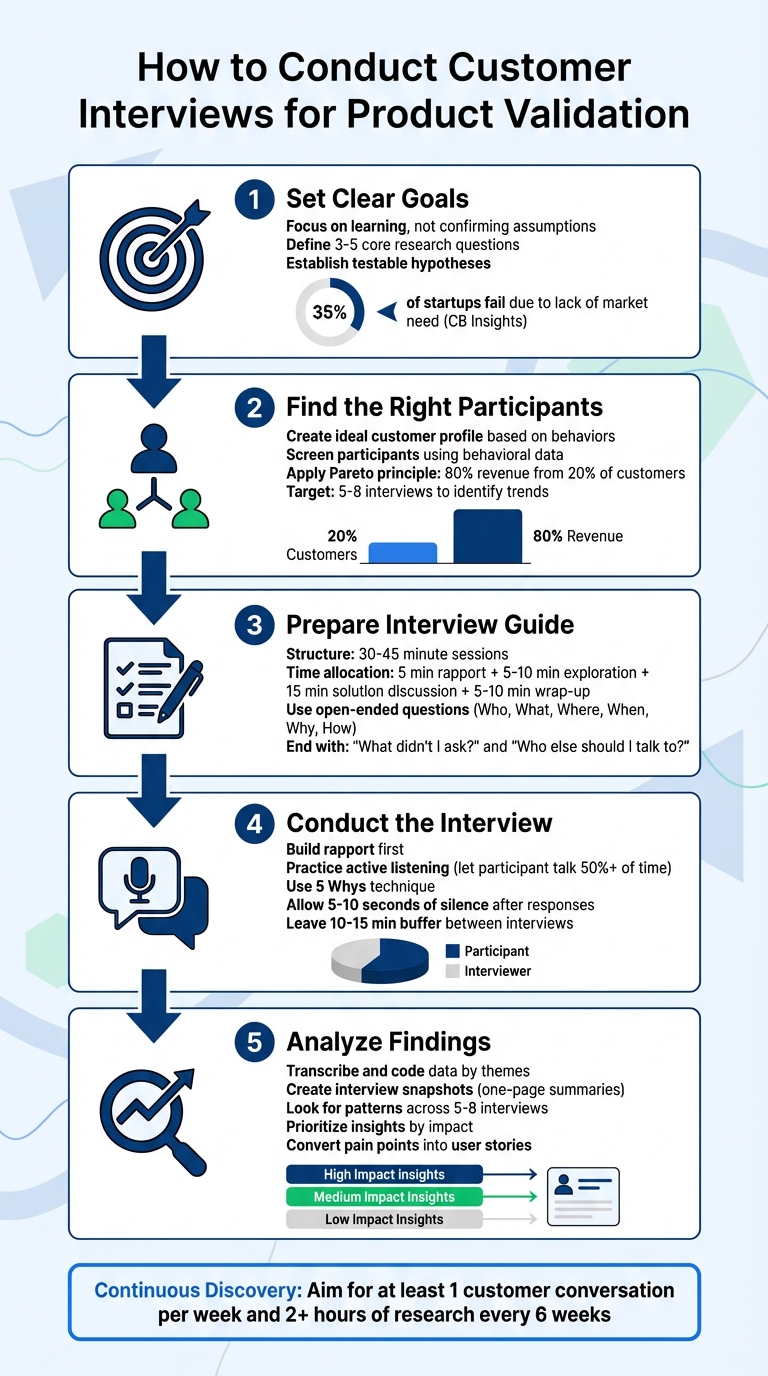
5-Step Customer Interview Process for Product Validation
Set Clear Objectives and Hypotheses
Before diving into interviews, it’s crucial to pinpoint exactly what you aim to learn. Without clear objectives, conversations can easily veer off track, leading to irrelevant or unproductive discussions.
Start by jotting down what you already believe about your customers' challenges. This step helps surface your assumptions, ensuring they don’t unintentionally shape your questions or skew your interpretations. As Mike Kuniavsky, Technology R&D Senior Principal at Accenture Labs, wisely notes:
"Never go into user research to prove a point, and never create goals that seek to justify a position or reinforce a perspective".
Your research goals should focus on uncovering insights, not validating preconceptions. Instead of a broad objective like "see if customers like the app", aim for something more specific, such as "understand how customers navigate data and identify obstacles." This precision lays the groundwork for meaningful, focused discussions.
Identify Your Research Questions
The questions you ask should align with your current stage in product development. Are you exploring a new opportunity, confirming the severity of a particular problem, or validating that your solution addresses a real need? Each phase demands a tailored approach.
For instance, ProductPlan conducted 30 interviews with product managers before writing a single line of code. Their goal wasn’t to ask, "Would you use our tool?" but rather to dig into existing workflows and pinpoint areas of friction. This approach - focusing on the problem first - helps avoid "passion blindness", where enthusiasm for a solution overshadows whether the problem truly matters to customers.
Craft three to five core questions that will steer your product’s direction. Examples include: "How much time do customers currently spend on this task?" or "What workarounds have they developed to overcome this challenge?" These questions should aim to uncover the depth of the pain point, not just surface-level preferences.
Define Success Criteria and Hypotheses
With your research questions in hand, the next step is to develop testable hypotheses. A hypothesis is essentially a tentative answer you’re putting to the test. For example: "Customers navigate data slowly because the filters are hidden." Use a simple structure: "If [target user] uses [feature], then [predicted behavior/benefit] will occur."
Equally important is determining what evidence would disprove your hypothesis. Ask yourself, "What feedback would compel us to pivot or abandon this feature?" For example, if fewer than 30% of participants mention a specific problem without prompting, it might indicate the issue isn’t pressing enough to address.
It’s worth noting that 35% of startups fail due to a lack of market need, according to CB Insights. To avoid this common pitfall, establish clear criteria for distinguishing between "nice-to-have" features and essential "pain-killer" solutions. Your hypotheses should guide your product decisions, even if the findings challenge your initial assumptions.
sbb-itb-9a9c51d
Find and Screen the Right Participants
Once you've set your objectives, the next step is finding participants who can provide meaningful feedback. Speaking with the wrong people not only wastes time but also leads to irrelevant insights. As Aha! wisely notes: "Discovery interviews only produce meaningful insights when you speak to the right people". Interviewing the wrong group could result in building features that no one actually wants. Here’s how to ensure you're talking to the right individuals who truly represent your target audience.
Create Your Ideal Customer Profile
Start by building a detailed profile of the participants you need. This goes beyond basic demographics like age or job title. Instead, focus on behaviors, challenges, and motivations. Combine hard data - such as purchasing habits, company size, and usage frequency - with softer insights like their goals, fears, and what drives their decisions.
A Pareto analysis can help here: 80% of your revenue often comes from just 20% of your customers. Identifying this high-value group early on is crucial.
To refine your profile further, apply the 5 Rings of Buying Insight framework. Ask yourself:
- What’s motivating them to look for a solution right now?
- What outcomes are they expecting?
- What obstacles could prevent them from using your product?
- What influences their research and decision-making process?
- Which features matter most when they compare options?
Your Sales, Support, and Customer Success teams are invaluable resources here. They interact daily with customers and can point out who’s vocal, who’s struggling, and who fits the mold of your ideal future buyer. Once you’ve defined this profile, the next step is ensuring participants align with it.
Screen Participants
After identifying your ideal profile, it’s time to screen candidates to confirm they’re a match. Rely on behavioral data rather than just job titles. For instance, focus on active power users, as well as former users who faced challenges.
Automated in-app triggers can help you identify potential participants, and asking for referrals (“Who else should I talk to?”) can expand your reach efficiently. Aim for a balanced mix of participants: loyal fans, critics, prospects who considered your product but didn’t buy, and even customers who switched to competitors.
Before committing to a full interview, use a pre-interview survey or a quick screening call to verify participants meet your criteria. When reaching out, keep sessions short - around 20 minutes - to encourage participation. Clearly communicate how they’ll benefit from the session to boost response rates. By following these steps, you’ll ensure your interviews are both productive and insightful.
Prepare Your Interview Guide
A well-thought-out interview guide keeps you on track, ensuring you cover the right topics without overwhelming participants. Rob Hayes, Founder of Foundation.pm, highlights its importance: "A good guide is arguably the most important part of your testing plan". Without it, you risk veering off course and missing out on critical insights. The goal is to create a structured yet natural conversation that aligns with your validation objectives. A focused guide ties every question back to the goals you’ve already set, helping you plan an effective and productive interview.
Plan the Interview Structure
Break your interview into clear, timed segments. For a 30–45 minute session, you might allocate: 5 minutes for building rapport and setting expectations, 5–10 minutes to explore the participant’s current experiences, 15 minutes for discussing or testing your solution, and 5–10 minutes for follow-up questions and wrap-up. This structure ensures you cover all necessary topics without overwhelming your participant.
When framing questions, focus on real experiences rather than hypothetical scenarios. For example, instead of asking, "Would you use this feature?", try, "Can you tell me about the last time you tried to solve this problem?". This approach grounds the conversation in reality and avoids speculative answers. As Teresa Torres, author of Continuous Discovery Habits, points out: "We don't want to build our products based on what people aspire to do. We want to build our products based on what people actually do".
End your session with two key questions: "What did I not ask that I should have?" and "Who else should I talk to?". These questions help uncover gaps in your research and expand your network. If you’re working with early-stage ideas, avoid introducing a prototype too soon; instead, focus on understanding the participant’s pain points. A demo at this stage can shift attention away from their needs.
Write Open-Ended Questions
Once your structure is in place, concentrate on crafting open-ended questions. These encourage detailed responses instead of simple yes/no answers. Use prompts that start with "Who", "What", "Where", "When", "Why", or "How". For instance, instead of asking, "Is this design confusing?", ask, "What would you expect to happen when you click here?". This phrasing avoids leading the participant and invites more authentic feedback.
Consider using the "5 Whys" technique, where you repeatedly ask "why" to uncover the root cause of a problem. Another method is laddering, which starts with technical features and moves toward emotional benefits. Begin with a specific feature, explore the outcome it creates, then identify the general benefit and the emotional payoff. This process helps reveal deeper motivations behind customer behaviors.
Practice active listening by staying silent after asking a question. Hiten Shah, Founder of CrazyEgg and KISSmetrics, advises: "When you want to do interviews and get emotion and stories out of your customers... it's very important to actually be quiet. If you ask a question, you should shut up and wait until they answer it". Allow 5–10 seconds of silence after they finish speaking; participants often share more meaningful insights when given extra time. If they don’t respond right away, rephrase your question rather than offering suggestions.
Conduct the Interview: Best Practices
Build Rapport and Set Expectations
Once your guide is ready, it's time to focus on setting the right tone for the interview. Those first few minutes are critical for creating a relaxed and open environment. Start with easy, conversational questions like asking about the participant's role or how they came across your product. A simple "tell me about yourself" can work wonders in helping them feel at ease before diving into more detailed topics.
Make it clear that the session is all about understanding their challenges - not a sales pitch or product demo. Let them know the interview is strictly for internal research and won't be used for advertising. This reassurance often encourages more honest and candid feedback. When recruiting participants, frame the interview as an opportunity for them to gain something valuable, like insights into improving their processes, rather than just a favor you're asking of them.
If you're recording the session (as previously mentioned during recruitment), remind participants at the start. This allows you to focus fully on the conversation without the distraction of taking detailed notes. Whether the session is in-person in a calm, tidy space or remote from a location of their choice, the goal is always to create a comfortable setting. Ethnographic approaches - observing users in their natural environment - can uncover behaviors and insights that traditional interviews might miss.
Practice Active Listening and Observation
Active listening isn't just about hearing words - it's about picking up on the nuances. Pay close attention to shifts in tone, casual remarks, or even comments that stray from your planned questions. These moments often reveal the most genuine insights.
Show you're engaged by using verbal affirmations and nonverbal cues. Nodding, smiling, or saying something like, "If I understand you correctly..." can make participants feel heard while keeping your own biases out of the conversation. If you notice an emotional undertone, follow up with questions like, "It sounds like that process frustrates you", to dig a little deeper.
Keep an eye out for mismatches between what participants say and their body language. Video or in-person interviews are especially helpful for catching these subtle cues. For example, when reviewing wireframes or concepts, pay attention to moments where they pause, skip over elements, or react visibly - whether that's excitement or hesitation. If someone says, "It's fine", but their expression tells a different story, ask follow-up questions like, "Why do you feel that way?" to uncover the real sentiment.
Consider having a dedicated note-taker or silent observer in the session. This allows you to maintain natural eye contact and stay fully present while someone else captures non-verbal cues and emotional reactions. By actively listening and observing, you can translate these interactions into actionable insights for refining your product.
Lastly, leave a 10–15 minute buffer between interviews. Use this time to jot down key takeaways and reset your focus. This break helps prevent any lingering thoughts or fatigue from one session from affecting the next. With these practices, you'll be better equipped to gather meaningful, unbiased insights.
Analyze Your Interview Data
Organize and Summarize Your Findings
Once your interviews are complete, it's time to turn those conversations into actionable insights. Start by transcribing your recordings into text using a reliable transcription tool. Before jumping into analysis, read through the full transcript several times. This helps you catch subtle details that may not have stood out during the interview itself.
The next step is to systematically code your transcript. Use color-coded tags to label sections by topic or customer segment - for example, "onboarding friction" or "pricing concerns." Then, group similar feedback together using affinity mapping to uncover broader themes. Assign each cluster a title, or even better, a memorable quote that encapsulates the theme.
For each participant, create an interview snapshot - a one-page summary that includes their photo, a standout quote, key details about their role, an experience map of their journey, and a list of opportunities you identified (like unmet needs or pain points). These snapshots help keep the customer’s story front and center during analysis and make it easier to share insights with your team. As Teresa Torres, author of Continuous Discovery Habits, puts it:
"The goal is to find the key moments in the story where opportunities emerged. This tells us how we can help this customer".
Repetition across interviews is a goldmine. Words or phrases that come up again and again signal what truly matters to your audience. Be sure to distinguish between functional feedback (practical issues) and emotional expressions (frustrations or desires) to gauge the severity of the problem. Start analyzing your data after completing five to eight interviews - this is often enough to identify emerging patterns.
Connect Findings to Your Validation Goals
With your data organized, it’s time to connect the dots between your findings and your initial validation goals. Revisit your original hypotheses and compare them to the patterns in your coded data. Did your audience confirm your assumptions about their biggest challenges? Or did they surprise you with problems you hadn’t anticipated?
To assess the reliability of your findings, use the Ladder of Evidence. Insights based on past behavior - what customers have actually done - carry more weight than speculative answers about what they might do in the future, such as "Would you use this?".
Prioritize insights by their potential impact. Consider how each finding could influence your strategy, revenue, customer experience, or feasibility. Roy Opata Olende, Head of UX Research at Zapier, explains it well:
"It shows you whether you should prioritize X feature or Y feature because there's an insight from a real customer that shows you something is a bigger problem".
Keep in mind, you're not looking for one-off opinions. Validation comes from identifying patterns across multiple interviews - typically five to eight conversations - rather than focusing on a single perspective. If you're working with a cross-functional team (like a product manager, designer, and engineer), their diverse viewpoints can help spot details you might overlook.
Finally, translate your findings into clear, actionable opportunities. These insights will guide your next steps, whether that means refining your product concept, generating landing page ideas to test demand, adjusting your target audience, or moving forward with confidence that you’ve validated real demand.
Turn Findings into Product Decisions
Once you've gathered and validated your insights, it's time to turn them into actionable changes for your product.
Create User Stories and Prioritize Features
The next step is to translate your interview findings into clear product decisions. Start by converting customer pain points into user stories that guide development. A great way to frame these stories is by using the Jobs-to-be-Done approach: "Help me [action] so I can [outcome]." This method keeps the focus on solving the core problem rather than rushing to implement specific feature requests.
When deciding which stories to address first, rely on Assumptions Mapping. This tool helps identify which findings involve the highest risk and the least certainty. These are the areas that should be validated first. Pay attention to issues that surfaced repeatedly across multiple interviews, as these indicate broader trends. Avoid prioritizing one-off requests from isolated conversations.
Focus on real user behavior instead of hypothetical answers when crafting user stories. Observing what users actually do provides more reliable data than what they say they might do. Before committing to full development, test your ideas with low-fidelity prototypes or even simple manual solutions. This structured process ensures your research directly informs development.
"No research without action, no action without research."
This principle from Kurt Lewin perfectly captures the importance of connecting your findings to tangible outcomes.
Plan Your Next Validation Steps
Customer interviews are just the beginning. Before diving into development, back up your insights with quantitative data like product analytics, surveys, or usage metrics. This broader perspective reduces the risk of making costly decisions based on incomplete information.
What you do next depends on your stage in the validation process. If you've confirmed a problem exists, shift from the "Problem Space" to the "Solution Space" by exploring how to address it. This could involve creating prototypes for card sorting exercises, running A/B tests, or even crafting a landing page to gauge interest. Tools like LaunchSignal can help you test demand by setting up landing pages with email capture, questionnaires, or fake checkouts to measure real purchase intent - all without writing a single line of code.
Building a habit of continuous interviewing can keep your product decisions rooted in current customer needs. Teams that dedicate at least two hours to customer research every six weeks report better user experiences compared to those that don’t. Aim for at least one customer conversation per week. Regular interviews ensure your product evolves alongside user expectations. Share your research findings with marketing, sales, and support teams to enhance decision-making across your entire organization.
Conclusion
Customer interviews are one of the most cost-effective ways to avoid creating features nobody wants, confirm your specifications, and ensure you're solving real problems. As ProductPlan aptly states, "Product managers aren't fundamentally in the business of developing products - they're in the business of solving customers' problems".
By following a structured approach - like the one outlined in this guide - you can move from simply guessing what customers need to making informed, data-driven decisions. Start with at least 10 interviews during the discovery phase, and aim for 20 or more when validating your MVP. Determine if your product addresses an urgent, must-solve problem - a "painkiller" that customers will adopt right away - or if it’s more of a nice-to-have feature that might struggle to gain traction.
Teams that regularly connect with customers often deliver better experiences. Make customer engagement a priority from the beginning, and consider using a buddy system during interviews to capture insights you might otherwise miss. Focus on understanding what customers have done in the past rather than relying on their predictions about the future. And remember, let them do most of the talking - ideally more than 50%.
FAQs
How can I find the right people to interview for customer insights?
To find the right participants for your research, start by clearly defining your learning goal and identifying the people who are directly affected by the problem you're addressing. These are the individuals whose experiences will provide the most relevant and actionable insights. Interviewing people outside this group can lead to skewed or unhelpful feedback.
Develop detailed customer personas that capture key traits of your target audience, such as their job roles, challenges, and decision-making responsibilities. It's important to distinguish between users (the ones who will interact with your product) and buyers (the ones who make purchasing decisions), as both groups bring valuable but different perspectives. Use data sources like analytics, customer support tickets, or sales records to pinpoint individuals who have recently dealt with the problem you're solving. A brief questionnaire can further confirm their relevance and suitability.
When narrowing down participants, focus on three key factors:
- Recency: Have they encountered the problem within the last 3–6 months?
- Fit: Do they match the criteria outlined in your customer personas?
- Diversity: Aim for a mix of participants across industries, company sizes, and regions to gather well-rounded insights.
To streamline the recruitment process, tools like LaunchSignal can be helpful. These platforms allow you to create targeted landing pages with embedded questionnaires to attract and screen potential participants efficiently. A well-thought-out selection process ensures you engage with individuals who can offer meaningful feedback to validate and refine your product idea.
What are the best open-ended questions to ask during customer interviews?
Open-ended questions are a powerful tool for gathering genuine insights from customers. Unlike yes/no questions, they invite more detailed and thoughtful responses. Here are a few prompts that can help you dig deeper during interviews:
- "Can you walk me through the last time you tried to solve [the problem you're addressing]?" This provides a window into their process, the obstacles they faced, and any creative workarounds they may have tried.
- "What’s the most frustrating part of [the task or problem]?" Frustrations often reveal the biggest pain points and areas where improvements are most needed.
- "What would your ideal solution look like?" This question allows customers to outline their expectations and dreams in their own words, giving you a clear picture of what they truly value.
These kinds of questions help you collect rich, qualitative data. Once you’ve gathered this information, you can validate your findings with tools like LaunchSignal to ensure your product ideas align with what users actually need.
How do I use customer interview insights to make better product decisions?
Start by getting your interview data in order. Transcribe your notes and tag key statements that highlight problems, behaviors, or emotions. Once tagged, group similar themes together to uncover patterns and recurring customer needs. For example, you might discover that "busy professionals want a quick way to capture meeting notes without typing." Use a simple framework, like an impact-effort matrix, to prioritize these findings. Focus on factors like how often the issue comes up, how painful it is for users, and how well it aligns with your goals.
After identifying the top insights, turn them into testable hypotheses. For example: "Adding a one-click voice-to-text feature could boost sign-ups by 10%." Create small-scale experiments to validate these ideas - like a landing page to measure interest. Use tools to track real user actions, such as email sign-ups or test purchases, and analyze the results to pinpoint the most promising concepts. By iterating based on actual feedback, you can ensure your product decisions directly address what your customers need.
Start validating ideas in minutes not days
Create high-converting landing pages. Test with real users. Get purchase signals. Know what to build next.
Visit LaunchSignal