December 19th, 2025
7 Ways to Collect User Feedback Without a Product
Seven practical, low-cost ways to collect user feedback before building—interviews, surveys, landing pages, no-code prototypes, social tests, concierge trials, and expert reviews.
Warren Day
Building something nobody needs wastes time and money. In fact, 42% of startups fail because they create products without market demand. Collecting user feedback early - before development - can save you from costly mistakes. Even five user interviews can reveal 85% of usability issues, and fixing problems early costs 10x less than after launch.
Here are seven methods to gather feedback without a product:
- Customer Discovery Interviews: Talk directly to potential users to understand their problems and needs.
- Online Surveys: Use tools like Google Forms or Typeform to collect data from a larger audience.
- Landing Page Smoke Tests: Create a simple webpage to measure interest through sign-ups or clicks.
- Social Media Testing: Post your idea or monitor discussions on platforms like Reddit or X.
- No-Code Prototypes: Build interactive mockups with tools like Figma to test usability.
- Concierge/Wizard of Oz Tests: Simulate your product manually to observe user behavior.
- Expert Feedback Sessions: Consult industry professionals for insights and direction.
Quick Tip: Start small with interviews, then validate findings with surveys or landing pages. Each method helps refine your idea while avoiding unnecessary development costs.
1. Customer Discovery Interviews
Customer discovery interviews are a crucial starting point to ensure your product aligns with real user needs. These one-on-one conversations - whether virtual or in-person - help uncover user experiences, frustrations, and challenges. The purpose isn’t to sell your idea but to understand existing solutions and determine if your concept solves a genuine problem - all before writing a single line of code. This approach sets the stage for validating ideas early in the process.
Interestingly, conducting just 5–7 interviews can reveal key patterns and uncover up to 85% of usability issues. Instead of focusing on large-scale data, these interviews dig into the "why" behind user behavior, offering insights that go beyond numbers. As Marketing Analyst Lars Lofgren puts it:
"An hour of getting raw, direct, honest feedback is more valuable than a hundred customer surveys".
Type of Signal: Qualitative Insights
These interviews primarily provide qualitative feedback. By listening to personal stories, frustrations, and motivations, you gain a deeper understanding of the context behind user actions - something that raw data alone can’t deliver.
Time and Cost (in USD)
While the monetary cost of these interviews is minimal, ranging from $0–$50 per session, they do require a significant investment of time for recruiting participants and analyzing their feedback.
Ideal Stage for Use
Customer discovery interviews are most effective during the early exploratory phase, before developing a Minimum Viable Product (MVP). This is the perfect time to confirm that your product addresses a real problem rather than an imagined one. For example, if you’re planning a hotel booking app, you might ask potential users, "How do you currently book a hotel?".
Pro Tips for Effective Interviews
- Avoid interviewing friends and family, as their feedback is often biased and unlikely to reflect your actual market.
- Clearly define your ideal customer profile, including demographics and psychographics, and reach out personally. Early-stage users are more likely to respond to a direct message from a founder than to automated outreach.
- Don’t limit yourself to enthusiastic prospects. Speaking with users who abandoned similar services can reveal hard but valuable truths about market gaps.
2. Online Surveys and Questionnaires
Online surveys are a great way to gather feedback from a large group of users, whether that's dozens or even hundreds. While interviews give you detailed, personal insights from a smaller sample, surveys allow you to collect structured data from a much broader audience. This helps you spot trends and figure out if the problems you've identified are widespread or more specific to a niche group.
Surveys can provide both quantitative data, like ratings, and qualitative insights through open-ended questions. For instance, you might ask users to rate how often they face a particular problem on a scale of 1–10 and follow up with a question like, "What's the most frustrating part of this issue?" This combination makes it easier to prioritize features and address the most pressing concerns. Surveys work well alongside interviews, offering a way to confirm trends with a larger dataset.
Type of Signal
Surveys are great for capturing attitudinal signals - what people say they want or feel. However, it’s worth noting that these don’t always match up with what users actually do. For example, someone might express interest in a feature but not be willing to pay for it. Use surveys to understand user pain points and gauge interest, but don’t rely on them alone to predict user behavior.
Time and Cost (in USD)
Surveys are an affordable research tool. Basic platforms like Google Forms are free and easy to use. If you need more advanced features, paid options like SurveyMonkey or Typeform offer flexible pricing tiers, including free plans for starters. For targeted responses, research panels such as Lyssna or Maze can deliver results in as little as 30 minutes. The main expense here is the time you’ll spend designing and analyzing the survey.
Best Stage of Idea Maturity
Surveys are most useful during the early stages of your idea - specifically, the discovery and validation phases. After conducting a few interviews to identify key themes, you can use a survey to see if those themes resonate with a larger audience. For example, you might confirm that small business owners frequently struggle with invoice tracking. To ensure high-quality responses, keep your survey short - around 5 to 10 questions - so respondents stay engaged and provide thoughtful answers.
3. Landing Page Smoke Tests with LaunchSignal
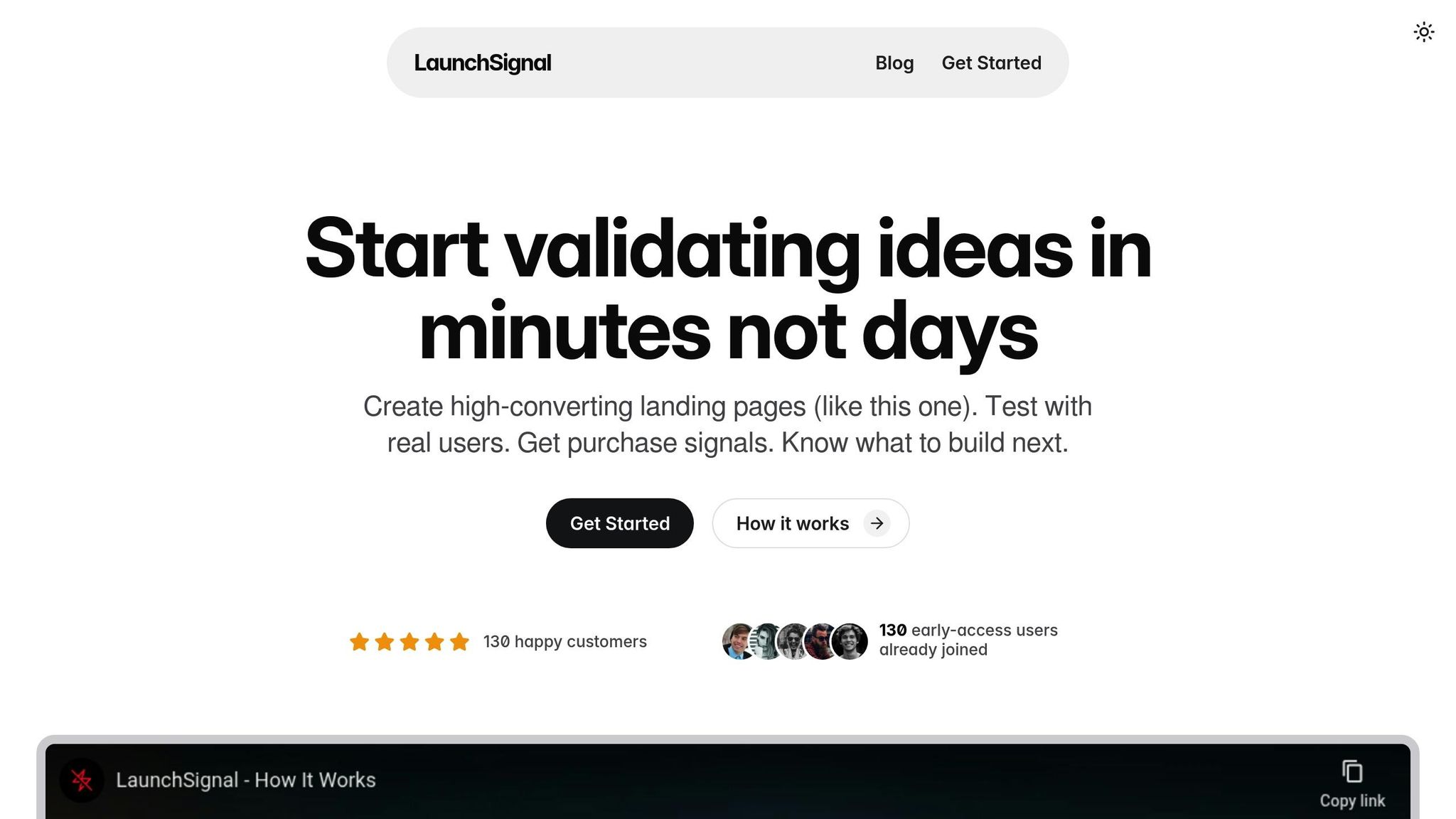
A landing page smoke test is a simple yet effective way to validate your product idea before diving into development. It involves creating a basic webpage that explains your product concept and then driving traffic to it. By tracking actions like sign-ups or pricing clicks, you can measure real interest and gauge whether your idea has potential.
Take the example of ProductPlan. Back in 2013, its founders tested the waters for roadmapping software by setting up a straightforward landing page and directing targeted traffic to it. The conversion rates and follow-up conversations they observed confirmed there was enough demand to move forward. Tools like LaunchSignal make this process even easier. With pre-designed templates, you can set up a validation page in minutes - no coding or design experience required. This approach not only measures demand but also connects early qualitative feedback with concrete user behavior.
What’s more, this method helps you build a list of genuinely interested users. These early supporters can provide valuable feedback for future iterations. As ProductPlan emphasized:
"Before a single line of code is written, feedback from real people can help you validate your concept, size up the market, and estimate potential demand".
Type of Signal
Landing page tests generate behavioral signals - insights based on what users actually do rather than what they say. Actions like email sign-ups, clicks on specific features, or even attempts at a fake checkout reveal genuine interest and potential purchase intent.
Time and Cost (in USD)
This method is both quick and affordable compared to building a full product prototype. Your main costs include the landing page tool and ad spend to attract visitors. For instance, LaunchSignal offers a Lifetime plan for $99, which includes features like three active validation pages, 10,000 monthly page views, email capture, questionnaires, fake checkouts, and analytics. Running digital ad campaigns on platforms like Google Ads or LinkedIn can start delivering meaningful insights within one to two weeks.
Best Stage of Idea Maturity
Landing page smoke tests work best in the earliest stages of your idea - before any development begins. They’re a great next step after conducting initial customer interviews, helping you validate demand on a broader scale. Essentially, this method answers the question, "Should we build this?" rather than "How should we build this?".
4. Social Media Concept Testing
Social media platforms offer a treasure trove of unfiltered opinions about the challenges your product aims to solve. Unlike formal surveys, where responses can feel rehearsed, platforms like Reddit, X, Facebook groups, and Quora capture raw, genuine reactions. These spaces host ongoing conversations where potential users openly vent their frustrations and share their needs.
You can approach concept testing in two ways: proactively by posting your idea and measuring engagement, or reactively by monitoring existing discussions. For example, exploring relevant Reddit threads can reveal how users currently address their problems and highlight what they find frustrating. Additionally, tracking mentions of competitors can shed light on unmet needs or recurring complaints - valuable insights for fine-tuning your idea.
Tools like Hootsuite, Brand24, and Mention simplify this process by automating keyword and competitor tracking. These tools often uncover insights that formal surveys might miss. As Tom Blondi, Chief Revenue Officer at SocialWhirled, wisely noted:
"Very few of us can create the perfect idea without feedback. If you've got a great idea and you present it to someone, and they immediately like it with no reservations, it's not a good idea".
Type of Signal
Social media testing provides both qualitative and behavioral signals. On the qualitative side, you get candid feedback and honest opinions about user pain points. On the behavioral side, metrics like likes, shares, comments, and click-through rates reveal how well your idea resonates. If you’re running paid campaigns to drive traffic to a validation page, you can also measure purchase intent through sign-ups and conversions.
Time and Cost (in USD)
Organic monitoring costs nothing, though using automated tools may involve a monthly subscription fee. For paid ads on platforms like LinkedIn or Facebook, costs will vary based on your budget. This method is particularly effective during the discovery and idea validation stages, helping you gather insights before committing significant resources to development. When combined with other methods, it forms a well-rounded validation strategy.
5. No-Code Prototypes and Clickable Mockups
Interactive prototypes take idea validation a step further by allowing users to engage directly with your concept. With no-code tools like Figma, Justinmind, or Userback, you can create clickable versions of your product idea - no coding required. This hands-on approach helps uncover valuable insights by observing how users interact with your design.
Here’s how it works: present your prototype to users and ask them to complete specific tasks, like signing up or locating pricing information. Pay close attention to where they struggle or succeed. As Jeff Gothelf, a Product Management and Human-Centered Design Consultant, explains:
"Each design is a proposed business solution - a hypothesis. Your goal is to validate the proposed solution as efficiently as possible by using customer feedback".
This method answers two key questions: Does the prototype address the user's problem? And is it intuitive to use? Considering that over 73% of consumers prioritize customer experience when making purchasing decisions, and 85% of product managers emphasize testing ideas before launch, this step is crucial for success.
Type of Signal
No-code prototypes provide a mix of feedback signals:
- Qualitative insights: Users share their thought processes and pinpoint areas for improvement.
- Behavioral data: Observing how users navigate the interface reveals where they encounter challenges.
- Purchase intent: Testing whether the solution resonates with users before full development begins helps validate its appeal.
Time and Cost (in USD)
Creating a prototype is far quicker and more affordable than building a fully functional product. As CPO Club notes:
"Asking users what they think is a cheap way of validating an idea. Then you can follow up by creating a simple prototype and iterating on it. This is still much cheaper than developing working software".
Many no-code tools offer free or budget-friendly plans, making them accessible for startups. For instance, Figma is great for design, Justinmind excels in usability testing, and platforms like Google Forms or Typeform can gather additional feedback through surveys. With these tools, teams can gather meaningful user insights in just a few hours.
Best Stage of Idea Maturity
This method is most effective after validating your initial idea but before diving into full development. It’s ideal for the discovery, proof of concept, and prototyping stages. By testing specific features in a low-risk environment, you can refine your solution iteratively - showing your prototype to users, gathering feedback, and making improvements until the design feels right.
Next, we’ll look at methods that refine user feedback even further through controlled experiments.
sbb-itb-9a9c51d
6. Concierge and Wizard of Oz Tests
Manually delivering your service is a smart way to validate your product idea before writing a single line of code. Concierge and Wizard of Oz tests allow you to simulate your product's functionality using human effort, giving you a firsthand look at whether users find your solution compelling enough to adopt. These methods go beyond interviews and surveys by adding behavioral observation to your early-stage validation toolkit.
In a Concierge test, you personally guide users through the experience, manually providing the service while learning about their needs. On the other hand, a Wizard of Oz test creates a polished, realistic front-end experience for users while you handle the back-end manually. A classic example is Zappos, which started by photographing shoes in local stores and manually processing orders before investing in a full-scale inventory system.
As Christian Idiodi, Partner at Silicon Valley Product Group, puts it:
"We have to test that what we've built is actually valuable. We have to test that people can use it. We have to test that it works for our business. We have to test that we know how to build it. Don't guess, just test!"
This approach helps reduce the risk of creating a product that doesn’t meet market needs - a factor responsible for 38% of startup failures. By observing real user interactions, you can discover whether people would switch from their current methods and spot usability issues that surveys might miss.
Type of Signal
These tests deliver strong behavioral and qualitative insights. Watching users interact with your service reveals not just what they do but why they do it, exposing pain points that might otherwise stay hidden.
Time and Cost (in USD)
The main expense here is your time, as you’ll be acting as the "wizard" or "concierge." This is far cheaper than building out full features. Ben Hoggan, Director of De-Risking at Notre Dame's IDEA Center, explains:
"The benefit that I get out of UserTesting is I get to figure out really quickly, at a really early stage, whether an idea has legs or not."
Just one hour of direct user feedback can often provide more value than analyzing hundreds of surveys. Plus, addressing issues at this stage is about 100 times cheaper than fixing them after launch.
Best Stage of Idea Maturity
These tests work best during the discovery and prototyping phases. They allow for rapid, low-cost iterations and are perfect for resolving internal design debates with real customer input - long before you start coding. This manual approach lays the groundwork for the more automated validation methods that follow.
7. Expert and Industry Feedback Sessions
Once you've analyzed user behaviors through prototypes and controlled testing, it's time to seek guidance from industry experts. These seasoned professionals can offer a big-picture perspective, helping you determine if your product idea addresses a meaningful problem. Their insights often go beyond surface-level observations, shedding light on the "why" behind industry trends and highlighting potential blind spots.
Take the example of ProductPlan founders Jim Semick and Greg Gould. Back in 2013, before writing a single line of code for their roadmapping software, they conducted market validation interviews with industry professionals. This feedback not only confirmed their concept but also influenced the design of their initial feature set. Expert advice like this can uncover overlooked issues and refine your approach, proving its immense value.
Type of Signal
These sessions are a goldmine for qualitative insights. They help you understand user motivations, pinpoint pain points, and refine your strategic direction. Experts can also help you evaluate whether your planned features resonate or if you're missing critical elements that could make or break your concept.
Time and Cost (in USD)
Keeping sessions short - around 30 minutes - not only respects the experts' time but also increases the likelihood they'll participate. A basic study typically takes about three days, covering planning, interviews, and analysis. The costs are surprisingly low, often just a few hundred dollars for incentives, which can be as simple as buying coffee or lunch. Compare that to large-scale research studies, which can cost hundreds of thousands of dollars, and it's clear why this approach is so appealing.
Best Stage of Idea Maturity
Expert feedback works best during the early strategize and discovery phases - before you've committed significant resources to development. At this stage, adjustments are still relatively inexpensive, and you can explore new directions or refine your value proposition. This expert input complements earlier user feedback, aligning your concept with market realities before diving into heavy investment.
Method Comparison Table
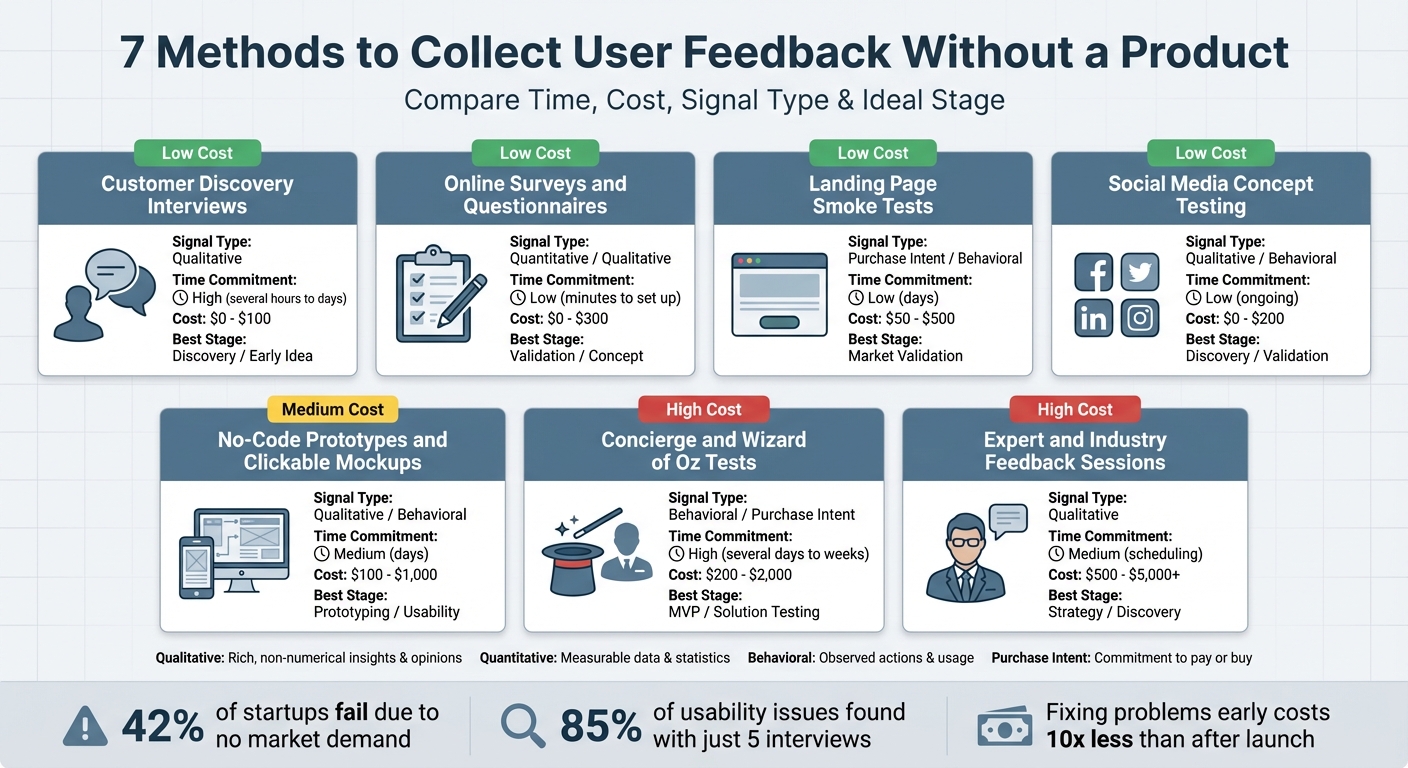
Comparison of 7 User Feedback Methods: Cost, Time, and Best Stage
Below is a concise table comparing seven different feedback methods, making it easier to choose the best strategy based on your idea's stage, budget, and timeline.
Each method serves a unique purpose: some focus on understanding user motivations, while others assess actual user behavior. For instance, purchase intent signals - like email signups or fake checkout attempts - are particularly strong indicators because they require users to demonstrate a level of commitment.
The table highlights the key differences in time, cost, and suitability for various stages of idea development. While qualitative methods like interviews explore user motivations, behavioral methods test real-world commitment. Costs and time requirements also vary widely - interviews may require significant time but little money, whereas expert consultations can range from $500 to over $5,000 depending on the consultant's expertise.
| Method | Signal Type | Time Commitment | Estimated Cost (USD) | Best Idea Stage |
|---|---|---|---|---|
| 1. Customer Discovery Interviews | Qualitative | High (several hours to days) | $0 - $100 | Discovery / Early Idea |
| 2. Online Surveys and Questionnaires | Quantitative / Qualitative | Low (minutes to set up) | $0 - $300 | Validation / Concept |
| 3. Landing Page Smoke Tests | Purchase Intent / Behavioral | Low (days) | $50 - $500 | Market Validation |
| 4. Social Media Concept Testing | Qualitative / Behavioral | Low (ongoing) | $0 - $200 | Discovery / Validation |
| 5. No-Code Prototypes and Clickable Mockups | Qualitative / Behavioral | Medium (days) | $100 - $1,000 | Prototyping / Usability |
| 6. Concierge and Wizard of Oz Tests | Behavioral / Purchase Intent | High (several days to weeks) | $200 - $2,000 | MVP / Solution Testing |
| 7. Expert and Industry Feedback Sessions | Qualitative | Medium (scheduling) | $500 - $5,000+ | Strategy / Discovery |
To get the most out of these methods, consider combining them. For example, start with customer discovery interviews to explore the problem space, then validate your findings with landing page smoke tests to gauge market demand. This layered approach ensures a more thorough and effective validation process.
Conclusion
Gathering user feedback before development is a game-changer. It helps steer efforts toward meaningful progress instead of wasting resources on features nobody needs. The seven strategies discussed earlier focus on ensuring you're creating the right product - not just building it the "right way".
The numbers speak for themselves: 42% of startups fail because they tackle problems no one cares about. Early validation helps test risky assumptions, saving time and money before diving too deep. To succeed, a new product often needs to feel 9X better than what's already out there to overcome user hesitation. Early feedback shows whether you're on track to meet that challenge.
"Validation isn't about proving you're right. It's about learning early, before the stakes get high." - Jamie Russell-Curtis, Head of Content, Altar.io
As you plan your next steps, choose validation methods that fit your current stage. Start with customer discovery interviews, then move to more tangible tests like landing pages. Focus on measurable user actions - like email signups or payment attempts - to back up your insights and attract the right collaborators, including technical co-founders.
Perfection shouldn’t be the goal. Iterative validation allows your product to grow in line with real user needs. Each round of feedback brings you closer to something people will actually pay for.
FAQs
How can I make sure my product idea solves real user problems before building it?
To make sure your product idea addresses actual user needs, start by connecting directly with your target audience. You can use surveys to collect general insights, conduct one-on-one interviews to dig deeper into specific pain points, and test basic prototypes or concepts to see how people react in real time.
The goal is to uncover the challenges your users are dealing with and ensure your idea provides a real solution. By gathering feedback and refining your concept early in the process, you can avoid wasting time and resources while building something that genuinely connects with your audience.
What are some affordable ways to gather user feedback before building a product?
One of the easiest and most budget-friendly ways to gather early user feedback is by using surveys and questionnaires. These tools are simple to distribute and can reveal a lot about user preferences and needs without breaking the bank. They’re great for collecting both quantitative data (like percentages or patterns) and qualitative insights (such as detailed opinions or suggestions).
Another low-cost approach is having informal interviews with potential users. These one-on-one chats can uncover deeper insights into their challenges and expectations, all without requiring a large financial commitment. By combining these methods, you can gain a clearer picture of your audience while sticking to a tight budget.
How can landing page tests help gauge real user interest?
Landing page tests are a smart way to measure genuine user interest by monitoring actions like sign-ups or clicks on your call-to-action. These behaviors reveal whether visitors are truly intrigued by your concept.
High engagement typically signals that your idea is striking a chord with your target audience. Conversely, if engagement falls flat, it might be time to tweak your concept or fine-tune your messaging. The best part? You can gather these insights without having to fully develop your product.
Start validating ideas in minutes not days
Create high-converting landing pages. Test with real users. Get purchase signals. Know what to build next.
Visit LaunchSignal