January 17th, 2026
How Dynamic Content Boosts Landing Page Conversions
Use real-time personalization—location, traffic source, and behavior—to tailor landing pages, reduce bounces, and lift conversion rates.
Warren Day
Dynamic content transforms landing pages by tailoring them to each visitor's needs, driving higher engagement and conversions. Unlike static pages, which show the same message to everyone, dynamic content adjusts in real time based on factors like location, search terms, or behavior. This personalization meets user expectations and improves results, with studies showing:
- 76% of consumers prefer personalized experiences.
- Personalized CTAs convert 202% better than static ones.
- Dynamic pages can achieve conversion rates up to 750% higher than generic ones.
Key benefits of dynamic content include reduced bounce rates, better alignment with visitor intent, and higher ROI on ad spend. For example, companies using tailored CTAs have seen conversion rate jumps as high as 232%. By focusing on personalization triggers like geographic location, traffic source, or device type, you can create landing pages that resonate with your audience and guide them toward action.
Dynamic content isn't just a tech upgrade - it's a practical way to make every visitor's experience more relevant and effective.
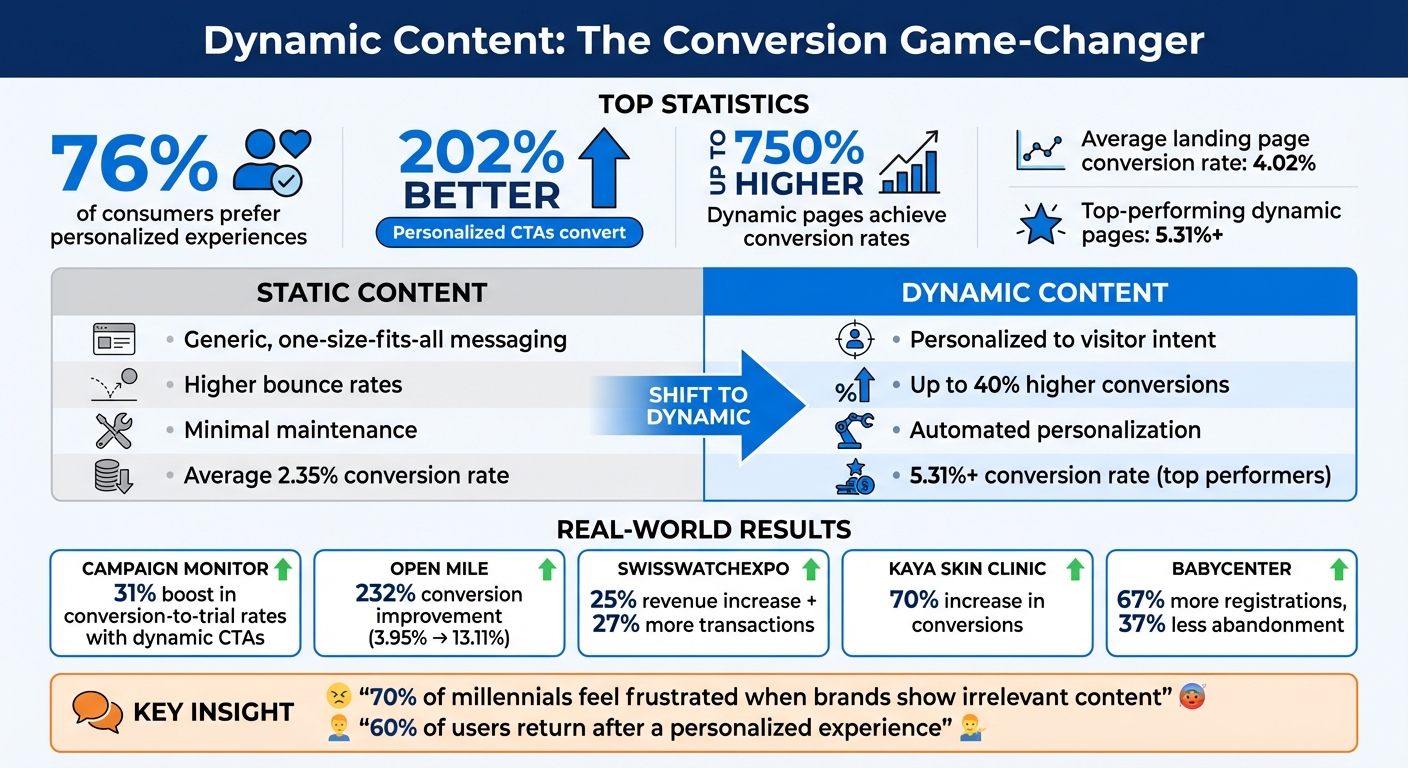
Dynamic vs Static Landing Pages: Conversion Rate Comparison and Key Statistics
Why Static Landing Pages Don't Convert Well
Static landing pages treat every visitor the same, assuming they all have identical needs. Whether someone clicks on a Google ad for "enterprise CRM software" or searches for "free project management tools", they’re presented with the same content. This mismatch creates friction. When visitors don’t see what they’re looking for, they leave - often within seconds.
Here’s the reality: the average landing page conversion rate is just 4.02%. But landing pages with personalized experiences and strong ad relevance can convert up to 750% better than generic ones. And it’s not just about numbers - 70% of millennials report feeling frustrated when brands show them irrelevant content. This disconnect is a recipe for poor engagement, as we’ll explore further.
How Generic Messaging Reduces Engagement
Imagine this: a first-time visitor exploring their options sees the same "Sign Up Now" call-to-action as a returning customer who’s already subscribed. Neil Patel nails it when he says:
"A non-dynamic CTA in this case is a UX glitch and a missed opportunity as well"
This one-size-fits-all approach often leads to "page bloat" - cluttered pages overloaded with banners and CTAs. The result? Slow-loading, confusing experiences that drive visitors away instead of converting them. On the flip side, personalized and dynamic CTAs cut through the noise and deliver what matters most to visitors. They’re proven to convert 202% better than static ones.
Lost Opportunities from Lack of Personalization
Static pages don’t just hurt engagement - they’re a missed opportunity for conversions. They fail to respond to key signals like geographic location, search intent, or device type (mobile vs. desktop). This disconnect between the ad "hook" and the landing page "bait" wastes ad spend and frustrates potential customers.
The financial impact of personalization is hard to ignore. For example, personalized product recommendations can drive up to 31% of total e-commerce revenue. Behavior-triggered emails with dynamic content have a 152% higher click-through rate than static ones. And 76% of consumers say they’re more likely to consider purchasing from brands that tailor their content. Static pages, by failing to adapt, leave both conversions and revenue on the table.
These limitations underscore why dynamic content isn’t optional - it’s essential for meeting visitor expectations and driving results.
What Is Dynamic Content and How Does It Work?
Dynamic content changes automatically in real time, using visitor data to adjust elements like headlines, images, or calls-to-action (CTAs). These adjustments are based on factors such as location, ad source, or device type. Imagine a landing page that instantly adapts to a visitor’s context, tailoring the experience to their specific needs.
The best part? You don’t need to be a developer to make it happen. Today’s landing page builders come with user-friendly tools that let you set up dynamic content without writing any code. These platforms rely on triggers like URL parameters, cookies, or geographic IP detection to instantly swap out content elements.
To better understand the benefits, let’s compare dynamic content with its static counterpart.
Dynamic Content vs. Static Content
Static content shows the same message to everyone, no matter who they are or where they’re coming from. While it’s easier to maintain, this approach doesn’t account for individual visitor needs. Whether someone is a first-time visitor or a loyal customer, they’ll see the same content.
Dynamic content, on the other hand, adjusts messaging to align with each visitor’s intent. For example, Campaign Monitor implemented dynamic CTAs tailored to specific campaign goals and saw a 31% boost in conversion-to-trial rates. This highlights the advantage of meeting visitors with content that resonates.
| Feature | Static Content | Dynamic Content |
|---|---|---|
| User Experience | Generic, one-size-fits-all messaging | Personalized and tailored to intent |
| Performance | Higher bounce rates due to generic content | Better engagement and up to 40% higher conversions |
| Maintenance | Minimal effort after launch | Initial setup, but automates personalization |
| Best Use Case | Blog posts, brand awareness pages | PPC campaigns, retargeting, high-intent pages |
By understanding these differences, it’s clear how dynamic content can create more meaningful interactions.
Variables That Power Dynamic Content
Dynamic content relies on specific visitor data to deliver a more tailored experience. One of the most commonly used variables is geographic location. With IP detection, you can display local currencies, nearby store locations, or region-specific offers. For example, Indochino created location-specific landing pages for areas where new showrooms were opening, achieving nearly 20% conversion rates.
Traffic source is another game-changer. Content can adapt based on whether a visitor arrived via a Google ad, Facebook campaign, or email link. For instance, aligning landing page headlines with the exact search terms from your ads can dramatically lower bounce rates.
Other impactful variables include device type (mobile vs. desktop), visitor behavior (like pages viewed or items added to a cart), and lifecycle stage (new vs. returning customers). These behavioral insights allow for precise targeting without requiring complex manual work.
"Dynamic landing pages are an incredible way for marketers to access the power of personalization without tearing their hair out over hundreds of variables."
– Josh Gallant, Founder of Backstage SEO
The best approach? Start small. Focus on one or two high-impact variables, like location or traffic source, and expand your strategy as you see results.
How Dynamic Content Increases Engagement and Conversions
Dynamic content takes personalization to the next level by not just improving relevance but actively driving engagement and conversions. Here’s a compelling stat: 76% of consumers are more likely to consider a purchase when their experience is personalized, and 78% are more likely to buy again from brands that get it right.
Instead of applying a one-size-fits-all approach, dynamic content adjusts in real time to meet individual preferences. For instance, if someone clicks on an ad about "family vacations", they should land on a page featuring family-friendly options - not content about solo travel or business trips. And for returning customers, skip the generic newsletter sign-up; focus on something tailored to their past interactions.
Matching Messages to Visitor Intent
Dynamic Text Replacement (DTR) is a game-changer for aligning content with visitor intent. It works by automatically updating headlines and copy to reflect the exact keywords a user searched for or the ad they clicked. Say someone searches for "affordable running shoes." Your headline should say exactly that - "Affordable Running Shoes" - not something vague like "Premium Athletic Footwear."
The source of traffic is equally important. For example, a visitor coming from a Facebook ad about "luxury travel" expects to see high-end resort imagery, while someone clicking through a "budget vacation" email is looking for deals and discounts. OptinMonster applied this strategy with SeedProd, customizing their PPC landing page headlines to align with paid traffic intent. The result? They cut their cost per acquisition by 47%. This kind of tailored messaging naturally makes calls-to-action (CTAs) more effective.
Adapting CTAs to Increase Click-Through Rates
Getting CTAs right means understanding where your visitors are in their journey. For example, a first-time visitor might see "Get 10% Off Your First Order", while a returning customer is greeted with "Shop Your Favorites Again". HubSpot takes this a step further by updating CTAs after each conversion. Once you’ve downloaded their eBook, the button changes to "Request a Demo" instead of prompting you to download the same eBook again.
Location-based CTAs are another powerful tool. Instead of a generic "Free Shipping" offer, visitors see something specific like "Free Shipping to Denver", based on their IP address. A/B testing these dynamic CTAs can reveal which variations resonate most with different audience segments. Asics, for instance, uses this strategy to display the nearest physical store locations on product pages, making it easier for customers to shop locally.
Keeping Visitors on the Page with Relevant Content
Relevance is the glue that keeps visitors engaged. Generic content is a surefire way to drive people away, but 60% of users return after a personalized experience. Dynamic content helps reduce bounce rates by eliminating irrelevant distractions and guiding visitors to the next logical step based on their behavior.
Spotify nails this with location-based pages that automatically adjust language and currency. A visitor in the U.S. sees English and prices in dollars, while someone in Germany gets German and prices in euros. Sephora takes it even further by tailoring product listings and visuals to regional preferences. For example, Indian visitors see collaborations with Indian designers and shipping offers in rupees, while U.S. visitors are shown Father's Day gift ideas. These thoughtful adjustments make everything feel tailored to the user, ensuring they stay engaged and connected to the experience.
Data and Results: How Dynamic Content Improves Conversions
Conversion Metrics That Show Improvement
The numbers don’t lie - dynamic content delivers real results. For instance, personalized calls-to-action (CTAs) convert 202% better than their generic, static counterparts. Even more impressive, first-person CTAs like "Get my discount" outperform second-person alternatives by 90%.
Consider this: while the average landing page conversion rate hovers around 2.35%, top-performing dynamic pages achieve rates of 5.31% or higher. A standout example is SwissWatchExpo’s cart abandonment campaign. By adding a 15-minute countdown and dynamic product text, they saw a 25% revenue boost and a 27% increase in online transactions over just three months.
Another success story comes from Open Mile. When they replaced static elements with a bold CTA and refreshed visuals in an A/B test, their conversion rate jumped from 3.95% to 13.11% - a staggering 232% improvement. Similarly, Kaya Skin Clinic transformed its landing page by dynamically showcasing its Facebook community, leading to a 70% increase in conversions.
These examples highlight how dynamic content can address the limitations of static landing pages, offering a powerful solution to engagement and conversion challenges.
How Different Industries Use Dynamic Content
Dynamic content isn’t just a one-size-fits-all tool - it’s a versatile strategy that adapts to the needs of different industries, delivering measurable results across the board.
In e-commerce, SwissWatchExpo illustrates this perfectly. By implementing cart abandonment timers and personalized product recommendations, they achieved a 25% revenue increase and a 27% boost in transactions. Over in the B2B and SaaS space, lifecycle-based CTAs - like a "Request a Demo" prompt - drive 202% higher conversions.
Lead generation pages also thrive with dynamic content. BabyCenter, for example, tailored its landing pages to match search intent for terms like "baby names." By replacing generic content with simplified, relevant messaging, they increased registrations by 67% and reduced page abandonment by 37%. On top of that, targeting users based on pregnancy stages added an extra 2–7% conversion lift.
Other industries have their own success stories. Healthcare providers use social proof to build trust, while streaming giants like Netflix rely on personalized recommendations - a feature estimated to be worth $1 billion annually. Across sectors, these tailored strategies prove that understanding user context and delivering relevant messaging can dramatically enhance performance.
sbb-itb-9a9c51d
How to Implement Dynamic Content: Step-by-Step
Choosing the Right Personalization Variables
To make dynamic content work effectively, start by identifying a few key personalization triggers. Instead of trying to personalize everything at once, focus on 2–3 variables that have the biggest impact on your audience's journey.
One of the most critical variables is search keywords. For instance, if someone clicks an ad for "project management software for small teams", your landing page headline should reflect that exact phrase. This technique, known as "message match", can boost conversion rates by as much as 750% compared to generic pages. Another powerful trigger is geographic location. By using IP detection, you can show local currency, nearby store locations, or region-specific promotions.
Traffic source is another factor to consider. Visitors coming from a Facebook ad promoting a limited-time discount expect to see that same offer on the landing page - not a generic homepage. Likewise, device type should influence your design decisions. Mobile users often prefer shorter headlines and quick actions like click-to-call buttons, while desktop users might engage better with more detailed forms. For B2B audiences, leveraging data like industry role or company size can refine your targeting. A great example is HubSpot: first-time visitors are offered an eBook download, and after they provide their details, the page updates dynamically to promote a tailored software demo with pre-filled contact information.
To make these triggers even more effective, map them to specific personas. For example, if you're targeting B2B SaaS marketing managers with teams of 5–10, use data like UTM parameters and referral sources to guide your personalization efforts. This approach ensures you're focusing on high-traffic segments that are more likely to convert. Once you've identified the right triggers, start creating variations to test their impact.
Building and Testing Dynamic Landing Pages
After identifying your personalization variables, the next step is to create tailored content variations for key elements on your landing page. This means developing multiple versions of headlines, hero images, call-to-action language, and social proof that can be dynamically swapped based on visitor data.
Make sure your personalized content stands out above the fold - this includes the headline, value proposition, and call-to-action, all visible without requiring users to scroll. Adjust your page layout depending on the audience. For mobile users, keep forms short and highlight immediate benefits, while desktop layouts can include more detailed information.
When implementing dynamic content, you can choose between methods like separate URLs, dynamic swapping, or full-site personalization. A straightforward option is to use UTM parameters. For example, adding tags like ?source=facebook&audience=parents to your URL can trigger matching headlines and images without needing a complex backend system.
Set clear goals for each variation and aim for at least 100 conversions per variant before deciding on a winner. To refine your approach, use tools like heatmaps or session recordings to see how visitors interact with your page. Avoid making decisions based on short-term trends - let the data guide you. If you're looking for a more streamlined way to manage this process, consider using specialized tools designed for dynamic content creation.
Using LaunchSignal to Build Dynamic Pages
LaunchSignal simplifies the process of creating and testing dynamic landing pages by removing technical hurdles. With its ready-made landing page templates, you can deploy high-performing pages in just minutes - no coding or developer expertise required.
The platform includes built-in tools like email forms, questionnaires, and even mock checkouts to gather real user feedback before committing to a full launch. These features integrate seamlessly with LaunchSignal's analytics dashboard, giving you insight into which content variations generate the most engagement and conversions - all within a single system.
For dynamic content, LaunchSignal uses a flexible template system that works like global blocks. You can customize these blocks once and apply updates across multiple page variations instantly. This makes it easy to test different headlines, value propositions, and calls-to-action for various audience segments without needing to rebuild entire pages.
LaunchSignal also offers a cost-effective plan: for $99, you get a lifetime package that includes 10,000 monthly page views and supports up to three active validation pages at a time. This provides enough traffic to conduct meaningful tests. Additionally, the platform allows you to export your data, so you're not tied to their system. You can pull results into spreadsheets or other analytics tools to fine-tune your strategy. With its combination of ease, affordability, and integrated analytics, LaunchSignal makes dynamic landing pages accessible even for smaller teams or budgets.
Tracking and Improving Your Results
Metrics to Track
Dynamic content has been shown to significantly boost engagement and conversion rates, but the real key to success lies in tracking your results accurately.
Start by measuring the conversion rate lift - the percentage increase compared to your static baseline. This is your main indicator of success. For instance, if your static page converts at 2.35% and your dynamic page hits 5.31%, you've achieved a lift of about 126%, placing your page among the top 25% of landing pages.
Go beyond just tracking major actions like purchases or sign-ups. Keep an eye on micro-conversions, such as video views, PDF downloads, or add-to-cart actions, as these can signal early buyer interest. Engagement metrics like time spent on the page and scroll depth are equally important. If you notice rapid bounces or incomplete forms, it could point to issues with your dynamic elements.
Also, focus on the click-through rates (CTR) of your CTAs. Personalized CTAs often see a noticeable boost in CTR. Break down performance by traffic source, device type, and visitor type (new vs. returning) to see which groups respond best to personalization. For example, email traffic tends to convert at around 19.3%, compared to 12% for paid social and 10.9% for paid search. These insights not only highlight what's working but also guide your next steps.
Using Data to Refine Your Strategy
Once you've gathered your metrics, the next step is to use that data to sharpen your strategy and improve your landing page performance.
Tools like heatmaps and session recordings can reveal why certain dynamic elements outperform others. For example, Bandwidth used heatmaps to identify friction points on their product pages, leading to a 12% increase in visit-to-lead conversions. Similarly, ArchiveSocial adjusted their primary CTA - moving it above the fold and using contrasting colors based on user behavior data - and saw a 101% jump in form clicks.
Segmenting your audience data can also help you create more targeted variations. Analyze trends by demographics, location, and past behavior to determine which personalization factors matter most. If you're seeing high form abandonment rates, consider simplifying the form fields or making your value proposition clearer. Keep an eye on page load times, too - dynamic content can sometimes slow things down, and load times over three seconds can lead to higher bounce rates.
"The goal isn't just to find 'winners' every time - it's to build a deeper understanding of what drives your users to convert." - Josh Gallant, Founder, Backstage SEO
Before testing, set clear benchmarks and aim for at least 95% confidence in your results. Continuous iteration is essential. For instance, Open Mile tested a new top section with a different background color and a more prominent CTA, which boosted their conversion rate from 3.95% to 13.11% - a staggering 232% improvement. Even small, data-backed changes can lead to impressive results.
Conclusion
Dynamic content has the power to turn ordinary landing pages into highly personalized experiences. By aligning your messaging with visitor intent, adjusting calls-to-action in real time, and tailoring content based on location, behavior, or search history, you can significantly reduce friction and make it easier for prospects to take action. Studies consistently show that consumers favor experiences that feel tailored to them.
But this shift from static to dynamic content isn't just about improving engagement metrics - it’s about speeding up product validation and making better decisions. Instead of relying on gut feelings, you can experiment with different messages, analyze which audience segments respond best, and fine-tune your strategy based on real data. This method not only increases conversions but also provides invaluable insights, especially during the early stages of product development. Understanding what resonates with your audience can be the difference between a successful launch and a missed opportunity.
This approach sets the stage for practical application. Tools like LaunchSignal make it easy to create high-performing landing pages without the need for custom development. With ready-to-use templates, built-in analytics, and features like email capture, questionnaires, and even mock checkouts, you can test multiple product ideas at once and gather the user feedback that truly matters.
To get started, focus on one or two personalization elements that align with your audience's needs. Launch a dynamic variation and monitor the results. As you collect data and refine your approach, you'll gain a clearer understanding of what drives your users to convert - insights that will pave the way for smarter, more effective growth strategies.
FAQs
How does dynamic content help increase landing page conversions?
Dynamic content can significantly enhance landing page conversions by delivering tailored experiences that align with a visitor's unique preferences, behavior, or location. By presenting content that feels directly relevant to each user, it minimizes distractions and helps guide them toward the desired action.
Unlike static pages, which offer the same experience to everyone, dynamic content adapts in real time to address individual needs or interests. This approach not only keeps users engaged but also establishes trust - making them far more likely to turn into leads or customers.
What factors should you consider when personalizing landing pages with dynamic content?
Dynamic content works best when it adjusts to the specific characteristics of each visitor. For instance, location - whether it’s a city, state, or country - can be used to display relevant offers, shipping options, or even localized language. Similarly, tailoring the experience to the device type, like mobile or desktop, ensures a layout that feels natural and user-friendly. Another essential factor is the referral source or campaign intent, which helps align your messaging with what the visitor expects to see.
You can also tap into behavioral data, such as pages a user has browsed or items they’ve added to their cart, to refine imagery and calls-to-action. Demographics, like age group or industry, offer another layer of insight for creating more targeted content. Don’t overlook the time of day or seasonal trends either - these can be perfect opportunities to highlight promotions, like holiday sales or limited-time offers. By weaving these elements into your strategy, you create a personalized experience that not only grabs attention but also encourages action.
How can I use dynamic content on my landing pages without technical skills?
You don’t need to be a coding expert to add dynamic content to your landing pages. Tools like LaunchSignal make the process straightforward with their ready-to-use templates and user-friendly editors that take care of personalization for you.
Here’s how it works: Choose a dynamic content template that comes with placeholders for personalized elements like text, images, or forms. Then, use the drag-and-drop editor to tweak the design and add dynamic features such as {{visitor_name}} or {{location}}. These placeholders automatically adapt based on visitor data. You can also set up triggers - like a visitor’s location or the ad they clicked on - to display specific content tailored to different audiences.
When your page is good to go, preview it to confirm everything looks and functions correctly, then publish it with a single click. LaunchSignal even includes built-in analytics, so you can track performance and fine-tune your pages over time. It’s an easy, no-code way to create personalized, engaging experiences that drive conversions.
Start validating ideas in minutes not days
Create high-converting landing pages. Test with real users. Get purchase signals. Know what to build next.
Visit LaunchSignal