January 26th, 2026
How Emotional Triggers Boost Landing Page Conversions
Use seven emotional triggers—trust, curiosity, urgency, social proof—and targeted copy, visuals, and CTAs to improve landing page conversions.
Warren Day
Emotions drive decisions. When people land on your site, their choices are powered by feelings rather than logic. Research shows that 95% of decisions happen subconsciously, guided by emotional triggers like trust, curiosity, urgency, and social proof. For example, emotionally engaging ads can increase sales by 23%, while even small increases in negative emotions can cut conversions by 25%.
Key takeaways:
- Emotional triggers like trust, fear, and hope influence decisions instantly.
- Short, emotionally charged copy (under 100 words) can boost conversions by up to 50%.
- Headlines and visuals that evoke emotions outperform feature-focused content.
- Social proof (e.g., reviews, real-time activity) builds confidence and drives action.
- CTAs that emphasize benefits and urgency turn emotions into clicks.
The bottom line: If your landing page connects emotionally, visitors are more likely to act. Use storytelling, personalization, and visuals to make your message resonate.
The Psychology Behind Emotional Triggers
What Are Emotional Triggers?
Emotional triggers are like mental shortcuts that tap into feelings to influence decisions. They take abstract benefits - like "better productivity" - and tie them to tangible emotions, such as the satisfaction of "leaving work on time for once."
It’s important to note that these triggers aren’t about manipulation. Instead, they reflect how our brains naturally process information. Common examples include emotions like greed, fear, altruism, envy, pride, shame, and hope. For instance, a headline like "Become the parent you've always wanted to be" doesn’t just sound appealing - it resonates deeply with self-image and the desire to feel competent.
Here’s the thing: people don’t buy features; they buy the emotional payoff or the relief a solution offers. A landing page that simply says "300 templates" might state a fact, but one promising "Build faster landing pages without having to rely on developers" taps into the frustration of delays and the joy of independence.
Understanding this connection is crucial for grasping how emotions shape buying behavior.
How Emotions Drive Purchase Decisions
Science has shown that emotions are central to decision-making. Neuroscientist Antonio Damasio’s research reveals that even simple choices, like picking what to eat, become paralyzing without emotional input.
Our brains rely on what’s called System 1 - an emotional, fast-thinking process that handles decisions almost instantly. This instinctive approach evolved to prioritize survival, where missing a threat could be far more dangerous than passing up an opportunity.
"95% of cognition happens beyond our conscious brain, coming instead from our subconscious, emotional brain." – Gerard Zaltman, Author of How Customers Think: Essential Insights into the Mind of the Market
The data backs this up. Nielsen analyzed 100 ads across 25 brands and found that emotionally engaging ads boosted sales by 23%, while those relying heavily on logic fell flat. A fascinating experiment by Rob Walker and Joshua Glen underscores this concept. They bought inexpensive thrift store items, paired them with emotionally charged stories written by professional writers, and auctioned them on eBay. The result? Items that cost mere pennies sold for nearly $8,000 in total, raking in a staggering 2,700% profit - all driven by emotional storytelling.
7 Emotional Triggers That Increase Conversions
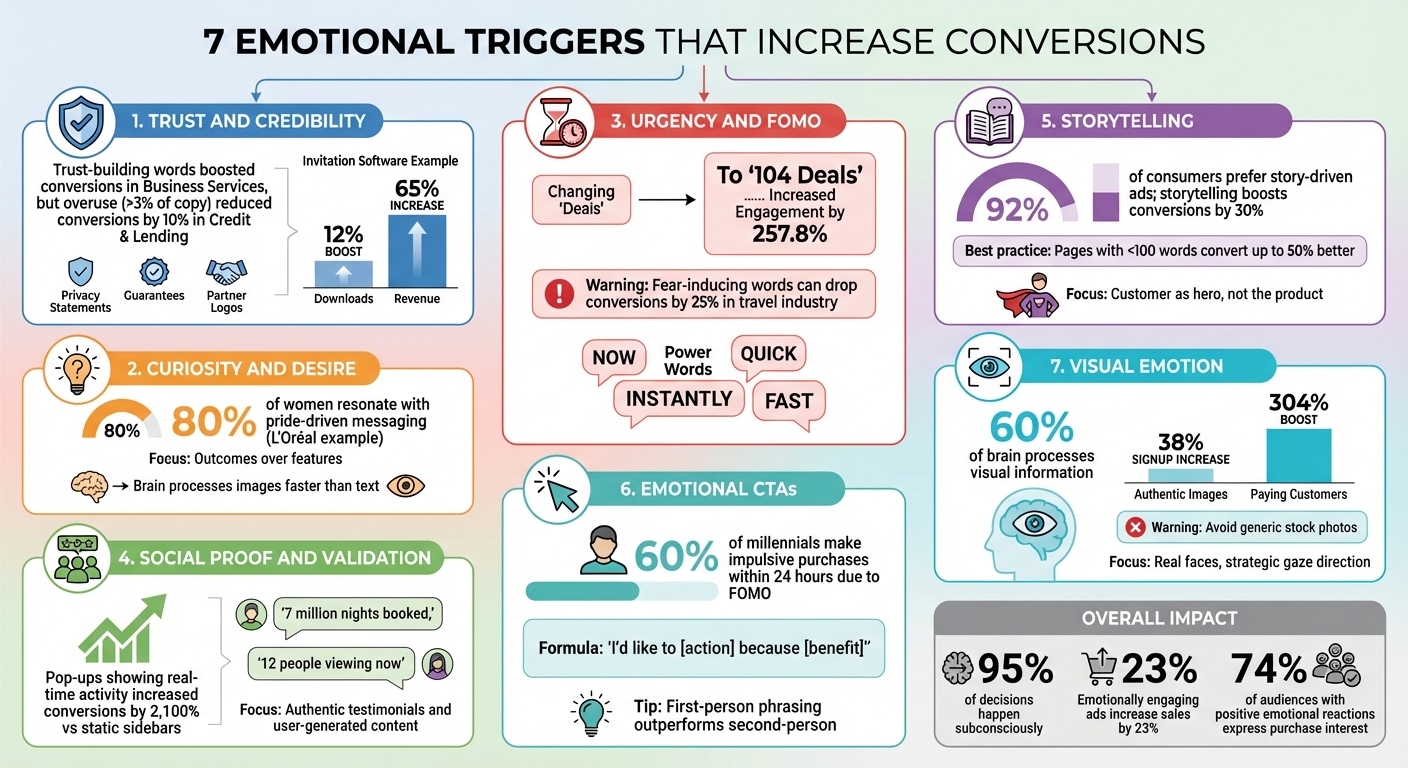
7 Emotional Triggers That Boost Landing Page Conversions
Now that we’ve established how emotions fuel decision-making, let’s dive into the specific triggers that turn casual visitors into paying customers. These aren’t just abstract ideas - they’re proven psychological drivers backed by extensive data from millions of landing page visitors.
Trust and Credibility
Trust is the foundation of every decision. When someone lands on your page, their first thought is, "Is this safe?" This instinct ties directly to our basic need for security, as outlined in Maslow's hierarchy.
A study analyzing over 74 million visitors across 64,000+ landing pages found that words like "leading", "compliance", "account", and "powerful" boosted conversions in Business Services. However, in Credit & Lending, overusing these terms (more than 3% of copy) actually reduced conversion rates by up to 10%. The takeaway? Trust signals are powerful, but they must be used sparingly.
Building trust requires visible, clear cues. Add privacy statements under email fields, explain why you’re collecting data, and highlight guarantees like "cancel anytime" or satisfaction policies. Including logos of trusted partners or publications can further establish credibility. For example, one invitation software company saw a 12% boost in downloads and a 65% revenue increase after implementing these strategies.
Visual elements also play a big role. Photos of real people looking toward your call-to-action (CTA) can make the action feel more approachable and natural. On the flip side, steer clear of generic stock photos - they often come across as impersonal and can erode trust.
Curiosity and Desire
Curiosity creates a need to know, while desire fuels the need to act. When people encounter a gap between what they know and what they want to know, they feel compelled to fill it. Desire complements this by tapping into how people see themselves - purchasing a product isn’t just about the item; it’s about becoming a better version of themselves.
Take L’Oréal’s iconic tagline, "Because You’re Worth It." It resonates with 80% of women because it appeals to pride and self-worth. Similarly, your headlines should focus on outcomes rather than features. Instead of saying, "300 templates available", try, "Build landing pages in minutes without waiting for developers." This approach speaks directly to frustrations like delays and the desire for independence.
Pair curiosity-driven headlines with visuals that evoke the desired emotion. Since the brain processes images much faster than text, showing the benefits of your product visually can amplify the impact. By aligning curiosity and desire with your offer, you create a seamless connection between what visitors want and what you provide.
Urgency and FOMO
Urgency pushes people to act by introducing a deadline. Without a clear time constraint, visitors often default to "I’ll think about it later" - which usually means they never come back. This taps into loss aversion, where the fear of missing out (FOMO) is a stronger motivator than the promise of gaining something new.
In one test with over 163,000 visitors, changing a generic "Deals" link to a more specific "104 Deals" increased engagement by a staggering 257.8%. Specific numbers make opportunities feel more real and immediate.
Use phrases like "only 3 spots left" or "limited inventory available" to highlight scarcity, but always be honest. Faking urgency can permanently damage your credibility. In industries like travel, even a small percentage of fear-inducing words like "fee" or "limited" can drop conversion rates by up to 25%.
Instead of focusing on what visitors might lose, emphasize what they’ll gain by acting now. Words like "Now", "Quick", "Instantly", and "Fast" are simple yet effective in prompting immediate action.
Social Proof and Validation
Social proof answers the question, "Have others like me done this?" It taps into our natural need for validation - if others are doing it, it must be worth considering.
Specific and recent examples work best. Replace vague claims with statements like "Join thousands of smart marketers" or "7 million nights booked so far" to show your product or service is trusted. Featuring customer reviews, case studies, and user-generated content can lower emotional resistance to buying.
Real-time activity can also capitalize on the bandwagon effect. Notifications like "12 people are viewing this right now" or "Sarah from Austin just signed up" create a sense of urgency and community. Pop-ups and overlays showing timely social proof can increase conversions by as much as 2,100% compared to static sidebars. Authenticity is critical - use real names, data, and testimonials. Even a hint of fake social proof can backfire and erode trust.
How to Write Emotionally Resonant Landing Page Copy
Emotions are the driving force behind decisions, and your landing page copy needs to tap into this to inspire action. Once you’ve identified the emotional triggers that resonate with your audience, the next step is integrating them seamlessly into your copy. Recognizing these triggers is the foundation - applying them is what transforms your landing page into a powerful tool.
Writing Headlines That Trigger Emotion
Your headline’s job is simple: make visitors care enough to keep reading. The best headlines don’t just outline features - they speak directly to the outcomes your audience desires. For instance, instead of saying, "Unlimited storage space", try something like, "Never worry about running out of space again." The first describes a feature, while the second connects with a need or goal.
Great headlines also appeal to how visitors see themselves - or how they want others to see them. This taps into both self-image and social-image emotions. For example, "Become the marketer you can be proud of" focuses on personal growth, while "The only tool that will make people ask, 'How did you launch so fast?'" appeals to the desire for social recognition. Tailor your message to align with what motivates your audience most.
Another effective approach? Highlight a shared frustration. Phrases like "soul-crushing meetings" or "boring jobs" unite your audience against a common problem. This makes your solution feel like a natural ally rather than just another option.
Next, let’s explore how storytelling can deepen the connection with your visitors.
Using Storytelling to Connect with Visitors
Stories work because they bypass logic and connect directly to emotions. Research shows that 92% of consumers prefer ads that tell a story, and storytelling can boost conversion rates by as much as 30%. The key is relatability.
Position your customer as the hero - not your product. Your brand’s role is to guide them toward success. For example, show how your product transforms their journey from frustration or fear to relief and pride. This mirrors the emotional rollercoaster they’re already experiencing.
"The product isn't the focus. Instead, the emotions that drive your customer's purchasing decisions take center stage." - Talia Wolf, Founder, GetUplift
Keep it short and impactful. An analysis of over 74 million visitors revealed that pages with fewer than 100 words can convert up to 50% better in some industries. Brevity ensures your story lands without overwhelming the reader.
Now, let’s channel these emotional insights into action with a call-to-action that delivers.
Creating Emotionally Driven CTAs
Your call-to-action (CTA) is where emotion turns into action. A great CTA doesn’t just tell visitors what to do - it reminds them why it matters. Use a value-driven approach like this: “I’d like to [specific action] because [the benefit].” For example, "Start my free trial to validate my idea this week" is far more compelling than a generic "Sign Up."
Interestingly, first-person phrasing like "Start my trial" often outperforms second-person phrasing like "Start your trial." This small tweak helps users feel personally invested in the action. Pair this with words that promise quick results - like "instantly", "now", or "immediately" - to appeal to the need for instant gratification.
"CTAs must instantly communicate their benefit. The length isn't as important as the value." - Talia Wolf, Founder, GetUplift
Make your CTA button visually stand out with contrasting colors, and consider adding a short line of supportive text beneath it. This can reinforce the value or ease any hesitation. With 60% of millennial consumers making impulsive purchases within 24 hours due to FOMO, a clear and urgent CTA can be the final push they need.
sbb-itb-9a9c51d
Using Personalization and Visuals to Amplify Emotion
Combining personalization with impactful visuals can make your message hit home. When your landing page feels like it’s speaking directly to a visitor, it creates a stronger emotional bond. It’s not about flashy extras - it’s about making every element feel meaningful and relatable.
Here’s how personalized content and well-chosen visuals can deepen those emotional connections.
Personalizing Content Based on User Behavior
Personalization makes visitors feel seen and valued, which can directly impact conversions. By tailoring content to reflect user behavior, you shift from a bland, one-size-fits-all approach to a conversation that feels relevant and engaging. For instance, if a visitor arrives via an industry-specific blog, showcasing testimonials or case studies from others in that same field can demonstrate that your solution is tailored for them.
Rather than listing features, focus on how those features solve problems. Instead of saying, "Our platform has 50+ integrations", say, "Easily connect the tools you already use - no interruptions to your workflow." This kind of dynamic, user-specific content builds trust and naturally nudges visitors toward taking action.
When personalization is paired with thoughtful visuals, the result is an experience that feels custom-made, amplifying emotional engagement.
Choosing Visuals That Evoke Emotion
Visuals are often the first thing visitors notice, and they play a huge role in shaping impressions. Since 60% of the human brain is wired to process visual information, the images you choose can significantly influence how visitors feel about your brand. Human faces, in particular, are powerful - expressions of joy, relief, or confidence can trigger those same emotions in your audience [17, 9].
Strategic visuals can also guide attention. For example, Talia Wolf replaced generic images on a dating site with headshots of real members. These photos were tinted blue to convey trust, and the subjects' gazes were positioned to lead viewers toward the registration form. This simple change led to a 38% increase in signups and a staggering 304% boost in paying customers. Similarly, Save the Children uses a close-up of a distressed child alongside a bold red "Donate Now" button to evoke urgency and empathy.
"60% of our brain is geared towards visual context, so the first thing we see is visual. It's important to use the images on your page in order to guide user attention."
– Talia Wolf, Founder, GetUplift
Avoid using generic stock photos - they can come across as impersonal and may harm your credibility. Instead, opt for authentic images of your team or real customers to build trust [17, 18]. Hand-drawn graphics can also add a unique, genuine touch. And remember to align your visuals with your audience's stage of awareness. For those unfamiliar with the problem, use images that highlight it. For those ready to act, focus on visuals that showcase the solution and inspire confidence.
Tools like LaunchSignal can help you seamlessly incorporate these personalization and visual strategies into your landing pages, creating a deeper emotional connection with your audience.
Common Mistakes to Avoid with Emotional Triggers
Emotional triggers can be incredibly effective, but they’re a double-edged sword. When used thoughtfully, they build trust and drive conversions. But when misused, they can alienate your audience and damage your brand. The challenge lies in striking the right balance: persuading without crossing into manipulation. Missteps in this area can quickly erode confidence and trust.
Overusing Fear or Guilt
Negative emotions like fear, guilt, or shame can spur action, but they’re tricky to handle. Overdo it, and you risk driving visitors away. For instance, in the travel industry, even 1% of copy that evokes anger or fear can cause conversion rates to drop by as much as 25%.
When your brand becomes associated with shame or intimidation, long-term trust takes a hit. As Terri Scott, a content marketing expert, wisely notes:
"Shame is best left in the hands of the highly skilled or talented marketer. No one loves being shamed, so we usually avoid shame at all cost".
The lesson? Use negative triggers sparingly. If you highlight a problem, always pair it with a clear, positive solution to maintain balance and avoid alienating your audience.
Avoiding Clickbait and Manipulation
Today’s consumers are sharp - they can sense manipulation almost instantly. If your emotional triggers come across as forced, exaggerated, or dishonest, trust will vanish. People value authenticity, and any hint of inauthenticity can be a dealbreaker.
The line between ethical emotional marketing and manipulation is honesty. As Nabaasa Elijah puts it:
"Ethical use of emotional triggers means connecting honestly with real emotions that your audience already experiences in relation to genuine problems your product or service actually solves".
This means you’re not creating fear or guilt out of thin air. Instead, you’re addressing real concerns your audience already has and offering a meaningful solution. Avoid making overblown claims or fabricating urgency. Genuine scarcity and proportional messaging work far better. After all, 74% of audiences who had a positive emotional reaction to an ad expressed interest in purchasing the product. Focusing on positive outcomes often yields better results than relying on fear.
Conclusion
Emotions drive nearly every purchase decision. As Nabaasa Elijah insightfully states:
"Emotions are the gateway through which logical information must pass to become meaningful and motivating".
To create impactful copy, focus on tapping into core emotions - how your product improves self-image or enhances social perception. Instead of simply listing features, highlight the emotional benefits your audience will experience. Proven triggers like trust, curiosity, urgency, and social proof can be powerful tools, but it’s important to balance any negative emotions with positive resolutions. For example, 80% of women resonate with L'Oreal's "Because You're Worth It", which is a perfect example of pride-driven messaging.
Start small and experiment. Rewrite your headlines to evoke emotions tied to identity or social standing. Transform generic calls-to-action into statements that emphasize value, such as: "I want to [specific action] because [benefit]." Pair every feature with an emotional benefit that genuinely connects with your audience.
Authenticity should always be the foundation. Address real emotions and offer meaningful solutions. Test different emotional strategies to find what works best for your audience, as effective triggers often vary by industry.
Ready to put these strategies into action? Tools like LaunchSignal make it easy to create and test emotionally engaging landing pages. With pre-built templates, analytics, and the ability to experiment with multiple emotional approaches, you can quickly turn insights into measurable results - all without needing coding skills.
FAQs
How can I use emotional triggers on landing pages without coming across as manipulative?
To use emotional triggers effectively on landing pages without coming across as manipulative, focus on being genuine and relevant. Emotional triggers - like excitement, security, or urgency - can create a strong connection with your audience, but they must honestly reflect the benefits your product or service provides. Overusing tactics like fear or pressure can backfire and damage trust.
Instead, tap into emotions that address real needs or frustrations in a positive and ethical manner. For instance, show how your offering can eliminate a common hassle or bring peace of mind. When your emotional appeals align with actual user experiences and are rooted in honesty, you not only build trust but also encourage engagement and drive conversions - all while maintaining your credibility.
What are some effective emotionally-driven CTAs for landing pages?
Emotionally-driven calls-to-action (CTAs) are all about connecting with your audience's feelings, which makes them more likely to respond. These CTAs often play on emotions like hope, fear, or urgency. For example, a phrase like "Start Your Journey to Success Today" speaks to someone's ambition and desire to achieve. On the other hand, "Don’t Miss Out – Join Now" taps into the fear of missing out, pushing people to act quickly. By appealing to emotions, these CTAs create a personal connection that motivates users to take the next step.
How can visuals create an emotional connection on landing pages?
Visuals are a powerful tool for building an emotional connection on landing pages. They grab attention instantly and stir feelings that align with your visitors' experiences or aspirations. When selected carefully, images can spark emotions like trust, empathy, or urgency - encouraging users to take the next step.
By tapping into emotional triggers such as fear, nostalgia, or pride, visuals make your message stick. This emotional pull doesn’t just captivate users - it also boosts engagement and nudges them toward action, increasing the chances of turning visits into conversions.
Start validating ideas in minutes not days
Create high-converting landing pages. Test with real users. Get purchase signals. Know what to build next.
Visit LaunchSignal