February 14th, 2026
How Landing Pages Test High-Risk Assumptions
Use simple landing pages to validate your riskiest assumptions—track sign-ups, conversion rates, and user behavior to decide whether to iterate, pivot, or build.
Warren Day
Landing pages are a fast, low-cost way to test if your product idea has demand before building anything. Instead of guessing, you present your idea and measure interest through actions like clicks or sign-ups. If your sign-up rate is above 10%, you're likely on the right track. Below 5%? It’s time to rethink your approach.
Start by identifying your riskiest assumptions - like whether people want your product, if you're targeting the right audience, or if they'll pay for it. Tools like the Riskiest Assumption Test (RAT) help prioritize these assumptions. Then, design a simple landing page focused on one question. Use clear headlines, short descriptions, and a strong call-to-action (e.g., "Join the Waitlist").
Track results with metrics like conversion rates and bounce rates. If your test succeeds, move forward with confidence. If not, refine your idea and test again. Landing pages save time and money by validating demand before development, helping you avoid building something nobody wants.
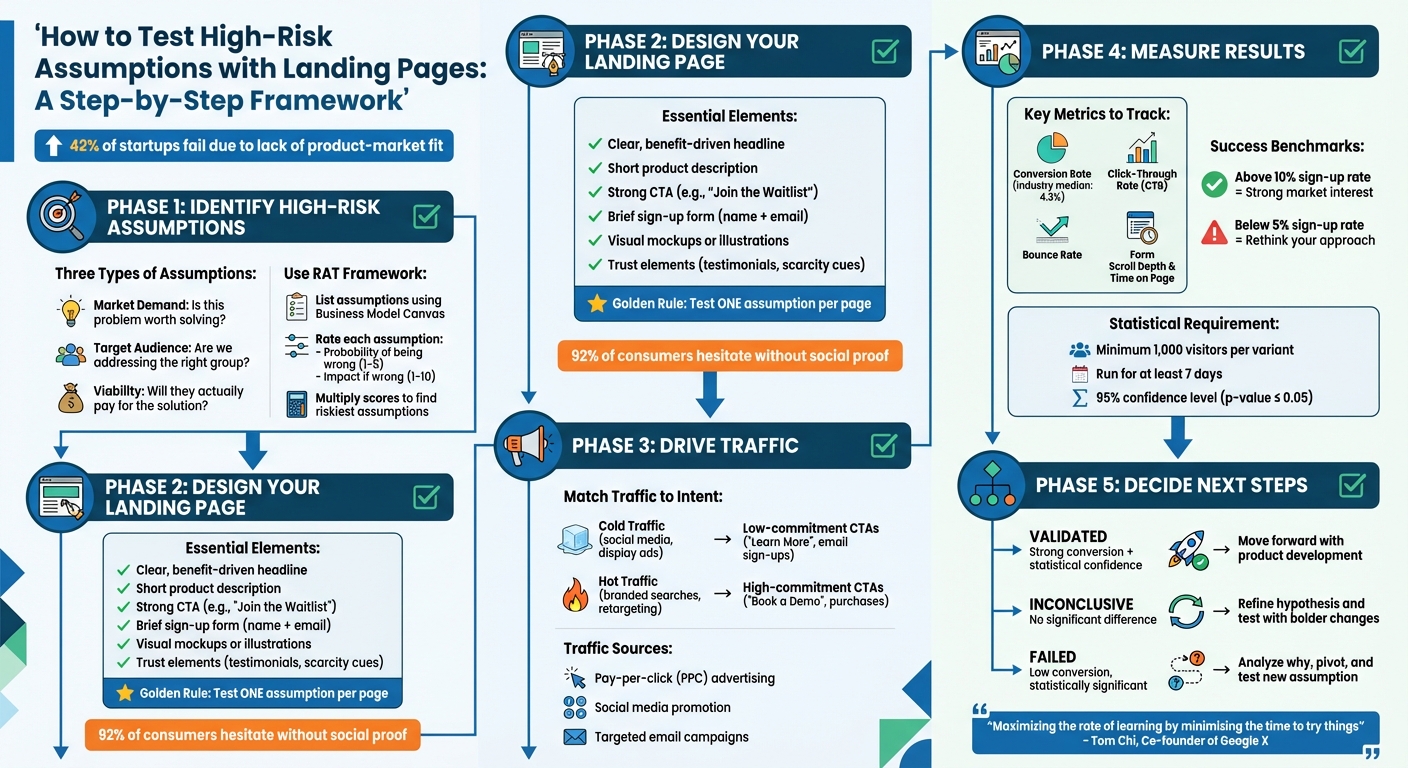
How to Test High-Risk Assumptions with Landing Pages: A Step-by-Step Framework
How to Identify High-Risk Assumptions
What High-Risk Assumptions Mean for Your Startup
High-risk assumptions are the core beliefs about your product, target audience, or business model that - if incorrect - could cause your entire business to fail. These aren’t minor details; they’re the bedrock of your startup.
Think of it like a Jenga tower: pull out one critical block, and the whole thing comes crashing down. That’s why 42% of startups fail due to a lack of product-market fit - founders often tackle problems that don’t actually exist.
These high-risk assumptions generally fall into three main areas:
- Market Demand: Is this problem worth solving?
- Target Audience: Are we addressing the right group of people?
- Viability: Will they actually pay for the solution?
Take Juicero as a cautionary example. The company developed a $400 internet-connected juicer, only to discover that users could squeeze the juice packets by hand - rendering the product unnecessary and invalidating their core assumption.
To avoid similar pitfalls, you can use the Riskiest Assumption Test (RAT) framework to identify and address the assumptions that pose the greatest threat to your startup.
Applying the Riskiest Assumption Test Framework
The Riskiest Assumption Test (RAT) framework is designed to uncover and prioritize the most critical weaknesses in your business idea. Unlike building a Minimum Viable Product (MVP) to showcase strengths, RAT focuses on testing vulnerabilities early through simple, small-scale experiments.
Start by listing out your assumptions using tools like the Business Model Canvas. Cover key areas such as your customer segments, value proposition, and revenue streams. Then, rank each assumption on two scales:
- Probability of being wrong (rated 1–5)
- Impact on your business if wrong (rated 1–10)
Multiply these scores to identify your riskiest assumptions - the ones that demand immediate attention.
For example, Joel Gascoigne, founder of Buffer, tested his riskiest assumption - whether people would pay for a social media scheduling tool - using a simple two-page landing site. Over seven weeks, he secured 120 email signups, validating both demand and pricing before building the product. Rik Ingram, a startup founder, summed it up perfectly:
"Instead of building an MVP, identify your riskiest assumption and test it. Replacing your MVP with a RAT will save you a lot of pain."
Finally, define clear success criteria upfront (e.g., "100 signups from 500 visitors"). This prevents biased interpretations of the results and ensures you’re making decisions based on solid data. By following this "learn-test-build" approach, you can validate your assumptions before committing to full-scale development.
How to Design Landing Pages That Test Assumptions
Test One Assumption per Landing Page
Every landing page should focus on just one assumption. Trying to test multiple variables at once can muddy your results .
For instance, imagine you're testing both your value proposition and pricing on the same page. If the conversion rate is low, how will you know if the issue is with the perceived benefit or the price? By isolating a single variable - like tweaking the headline while keeping everything else the same - you can pinpoint exactly what drives results .
This method mirrors the scientific approach: start with a control (your original page), create a variant with one change, and split your audience randomly between the two versions to ensure fair comparisons. Ryan McHugh, Director of CRO at NP Digital, highlights this principle:
One of the biggest mistakes site owners make when building landing pages is not having a clear, single focus for the page. Landing pages should have one primary objective, whether it's capturing email addresses, getting sign-ups, or making a sale.
What to Include on Your Test Landing Page
Your test landing page should have only the essential elements needed to validate your assumption without overwhelming visitors. Start with a clear, benefit-driven headline that directly addresses the problem your product solves. Avoid vague buzzwords or overly technical language. For example, instead of saying "Revolutionary technology", opt for something straightforward like "We’ll pick you up, wherever you are" .
Follow this with a short product description that explains your value proposition. Add a clear call-to-action (CTA) button with action-oriented wording like "Get Early Access" or "Join the Waitlist", rather than generic terms like "Submit" . Make sure the CTA stands out visually by using a contrasting color. Keep your sign-up form brief - a name and email are usually enough. Adding extra fields can lower your conversion rate .
If your product isn’t ready yet, use visuals like high-quality mockups or concept illustrations to show what you’re building . To further ease doubts, include trust-building elements such as testimonials or scarcity cues like "Limited spots for beta testing." This is critical because 92% of consumers hesitate to buy when no social proof is available.
With these components in place, let’s explore a real-world example of how this strategy can validate market demand.
Example: Testing Market Demand with Email Sign-Ups
One simple way to test market demand is by tracking how many visitors are willing to share their email for early access or updates. A sign-up rate above 10% often signals strong market interest, while rates below 5% may indicate the need to adjust your value proposition.
Take the example of Forextrading.com, a sister site of Saxo Bank. Conversion expert Michael Aagaard tested a PPC landing page for a currency-trading platform. He replaced a generic stock photo with a screenshot of the actual platform and updated the headline to focus on specific benefits: free access, no risk, and a $100,000 demo account. This more targeted approach boosted sign-ups by 99.4% and cut the cost-per-conversion by 48.2%.
When targeting cold traffic from social media, a low-commitment CTA like an email sign-up often works best. On the other hand, hot traffic from branded searches might be ready for a "Book a Demo" button. Start with the simplest ask that validates your assumption, and once you’ve confirmed interest, you can experiment with higher-commitment CTAs. This approach is a core component of fake door testing, where you measure intent before building the full feature.
Creating Landing Pages with LaunchSignal
Getting Started with LaunchSignal Templates
Once you’ve nailed down your landing page design, LaunchSignal makes it easy to bring your ideas to life. In fact, you can create and publish a validation landing page in under 30 minutes - no coding or design expertise required. The platform offers templates tailored to different campaign goals, like "Lead Squeeze" for collecting email addresses, "Coming Soon" for building pre-launch buzz, and "Sales" for simulating purchase behavior. These templates provide a straightforward starting point, depending on the assumption you’re testing.
Each template comes equipped with the essentials: a benefit-focused headline, a short product description, and a clear call-to-action. Using the visual editor, you can tweak text, images, and form fields to align with your unique value proposition. LaunchSignal also includes tools to capture user interest effectively. For example, email sign-ups act as a quick way to gauge initial interest, while questionnaires help you dig deeper into user needs before investing in product development. For testing purchase intent, the fake checkout feature mimics a real buying process but ends with a "coming soon" message. This allows you to see if users are ready to spend money - arguably the strongest indicator of interest. Once your page is live, it’s time to track how well it performs.
Tracking Results with LaunchSignal Analytics
Validating your assumptions hinges on tracking performance, and LaunchSignal’s analytics dashboard does just that. After your page goes live, the dashboard monitors key metrics like sign-up rates (a rate of 10% or more typically indicates strong demand), bounce rates (a high bounce rate might mean your page isn’t effectively communicating its value), and questionnaire responses, which provide insights into why users are or aren’t converting. As Paul Park, a Content Writer at Unbounce, explains:
Testing is about moving beyond educated guesses to uncovering the actual impact of your choices, ensuring that your vision for the landing page aligns with reality.
LaunchSignal also allows you to compare multiple landing pages side-by-side, making it easy to test different value propositions or features against each other. To ensure your results are reliable, aim for at least 1,000 visitors per variant and let your tests run for at least 7 days to account for weekly behavior patterns. The platform highlights versions that reach a 95% confidence level, giving you statistically sound insights. This data-driven method eliminates guesswork, showing you exactly which assumptions hold up when put to the test with real users.
sbb-itb-9a9c51d
Getting Traffic and Measuring Performance
How to Drive Traffic to Your Landing Page
Attracting visitors to your landing page starts with aligning your traffic source to the intent behind your offer. As Johnathan Dane, Founder of KlientBoost, aptly explains:
If your CTA doesn't match your visitor's conversion intent, it doesn't matter what you split test on your landing page - it won't work.
Traffic can generally be categorized by intent, ranging from cold (low intent) to hot (high intent). Cold traffic - like display ads or social media campaigns - usually responds better to low-commitment offers such as "Learn More" or email sign-ups. On the other hand, hot traffic - coming from branded searches or retargeting - can handle higher-commitment actions like "Book a Demo".
One effective tool for driving traffic is pay-per-click (PPC) advertising, which allows you to test and refine your approach. However, success hinges on "message match", meaning your landing page headline should directly reflect the promise made in your ad. Social media promotion is another great option, especially for testing content that resonates with current trends. Meanwhile, targeted email campaigns can work wonders when personalized. A smart approach: test subject lines on a small group first, then roll out the best-performing one to your entire list.
Once the traffic starts rolling in, the next step is to measure how effectively these visitors engage with your page.
Which Metrics to Track
Metrics are your compass for understanding whether your strategies are working. Key indicators include conversion rate, click-through rate (CTR), and form submissions, which reveal if visitors are completing the actions you want. For context, the median conversion rate across industries is 4.3%. However, this varies significantly - Food and Catering averages a strong 9.8%, while Cybersecurity lags at around 2.0%.
To dig deeper into engagement, track metrics like scroll depth, time on page, and form abandonment. For example, Going (formerly Scott's Cheap Flights) demonstrated the impact of precise tracking when they tested two different CTAs: "Sign up for free" versus "Trial for free." That small tweak resulted in a 104% month-over-month increase in trial sign-ups.
Finally, analyze these metrics across various traffic sources - whether paid ads, social media, or email campaigns. This will help you determine if your assumptions hold true universally or are specific to certain segments.
What to Do with Your Test Results
How to Know If Your Assumption Is Valid
Start by analyzing your landing page data for statistical significance (p-value ≤ 0.05). This ensures your results aren't just random noise. But remember, statistical significance alone isn't enough - you also need a large enough sample size to make your conclusions reliable. If your test was cut short or lacked enough visitors, the results might not hold up.
Next, compare your findings to the metric you set beforehand. For example, if you're testing a paid product, focus on purchase rates. If you're gauging interest, look at email sign-ups. Once you confirm statistical significance, dig deeper to understand performance variations.
Break your data into segments - such as traffic source, device type, or visitor behavior. It's possible your assumption didn't work overall but performed well within a specific group. Also, watch for external factors like holiday traffic spikes or technical issues that could distort your results.
As Michael Aagaard, Senior CRO Consultant, explains:
Until you test your hypotheses, they will never be more than hypotheses. You need reliable data to prove or disprove the validity.
Your Next Move: Iterate, Pivot, or Build
Once you've reviewed your data, it's time to decide your next step. If your assumption is validated with strong conversion rates and statistical confidence, you're ready to move forward. Begin product development with the assurance that you've significantly reduced risk. However, stay proactive - keep testing new ideas as you grow. If you need inspiration, you can use a landing page idea generator to find fresh concepts.
If your results are inconclusive - where there's no statistically significant difference between variations - it’s not the end of the road. Refine your hypothesis and try again, perhaps with a bolder change. For instance, a minor headline tweak might not have been enough; you may need to test a completely new value proposition.
If your assumption fails, don't just stop there. Dive into the reasons behind the failure using frameworks like PIE (Potential, Importance, Ease) or ICE (Impact, Confidence, Ease) to guide your next steps. Adjust your hypothesis and test again.
Josh Gallant, Founder of Backstage SEO, emphasizes:
A/B testing analysis focuses on uncovering the lessons learned and other findings from your test... it's about asking why something occurred.
Even when tests don't go as planned, they offer valuable insights about your audience. These lessons can prevent you from building something that doesn't address their real needs.
Conclusion
Landing pages offer a practical way to test ideas without sinking months into development or racking up high costs. Instead of relying on guesswork, you gain clear, actionable metrics - like sign-up rates and click-through rates - that show whether your concept connects with your audience.
The simplicity of landing pages is part of their appeal. All you need is a straightforward design, eye-catching visuals, and concise messaging that addresses a specific problem. Within just a few days, you can collect insights that would normally take months to uncover through traditional development methods.
By focusing on one assumption at a time, you can reduce risk. For example, a sign-up rate above 10% suggests strong interest, while a rate below 5% signals the need to tweak your value proposition. This kind of data-driven feedback helps you avoid a common pitfall - building something no one wants, which is a leading cause behind 42% of startup failures. The process not only validates ideas but also creates opportunities for ongoing learning.
As Tom Chi, Co-founder of Google X, wisely said:
Maximizing the rate of learning by minimizing the time to try things.
Even when tests don’t succeed, they reveal valuable insights about your audience, guiding your next steps.
FAQs
How can I identify the riskiest assumptions for my startup?
To pinpoint the riskiest assumptions for your startup, zero in on those that would have the greatest consequences if proven wrong. Start by asking yourself two key questions: What needs to be true for my idea to work? and What could make my idea fail if it’s incorrect? The goal is to prioritize assumptions that are both critical to your success and still uncertain.
One effective way to test these assumptions early is by using tools like landing pages. For example, a landing page can measure interest in your product by tracking user actions such as sign-ups or clicks. This kind of feedback offers valuable insights into essential assumptions, like whether there’s actual demand for your idea. Additionally, speaking directly with potential customers and running small-scale experiments can quickly confirm or challenge your beliefs.
By starting with the assumptions that carry the most weight and uncertainty, you can reduce risks, make smarter use of your resources, and set a solid foundation for your startup’s growth.
What should I include on a landing page to test high-risk assumptions effectively?
To test high-risk assumptions on a landing page effectively, it’s crucial to include elements that directly impact user behavior and decision-making. Start with a clear, attention-grabbing headline that sets the tone. Pair it with concise, persuasive copy that communicates your value proposition. Add engaging visuals - whether it’s images or videos - that resonate with your audience. And don’t forget a standout call-to-action (CTA) button that guides users toward the next step.
Other critical features include opt-in forms for gathering email addresses, social proof like customer testimonials or trust badges to build credibility, and a clean, intuitive layout that keeps visitors focused. To validate your assumptions, test specific variables like headline wording, button colors, or image choices. Use tools to track user actions, such as signups or mock purchases, to measure what resonates most. By systematically testing these elements, startups can quickly refine their approach and make informed decisions based on real user data.
How can I attract the right audience to my landing page for testing high-risk assumptions?
To bring the right audience to your landing page and test high-risk assumptions effectively, you need to zero in on your ideal customer base using targeted marketing strategies. Start by pinpointing who your audience is - what they need, what they prefer, and the challenges they face. Tools like surveys, interviews, or even experimental landing pages can provide valuable insights and help confirm their interest.
Use platforms like Facebook, Google, or LinkedIn to run targeted ads that reach users who fit your ideal profile. Tools such as LaunchSignal can also be a game-changer. They allow you to create optimized landing pages, gather real user feedback - like email sign-ups or survey responses - and analyze the data to tweak your approach. By keeping a close eye on your campaigns and making data-driven adjustments, you can ensure your landing page attracts the right visitors for meaningful tests and actionable feedback.
Start validating ideas in minutes not days
Create high-converting landing pages. Test with real users. Get purchase signals. Know what to build next.
Visit LaunchSignal