January 29th, 2026
How To Measure Emotional Impact Of Value Propositions
A five-step framework to uncover emotional drivers, collect signals, A/B test messaging, track KPIs, and refine value propositions with real customer feedback.
Warren Day
When customers make decisions, emotions often lead the way - 95% of purchases happen subconsciously. Emotional connections with your brand can drive trust, loyalty, and even forgiveness for mistakes. Here's how you can measure and improve the emotional impact of your value propositions in five steps:
- Identify Emotional Drivers: Use tools like the Value Proposition Canvas to map emotional needs, fears, and aspirations.
- Gather Emotional Signals: Surveys and questionnaires can uncover how customers feel about your brand, focusing on emotions like confidence, anxiety, or relief.
- A/B Test Emotional Variants: Experiment with emotional messaging to see what resonates most and boosts conversions.
- Track Emotional KPIs: Metrics like conversion rate, bounce rate, and time on page reveal how well your emotional appeal works.
- Refine with Feedback: Conduct interviews, use empathy maps, and analyze social sentiment to understand emotional connections and areas for improvement.
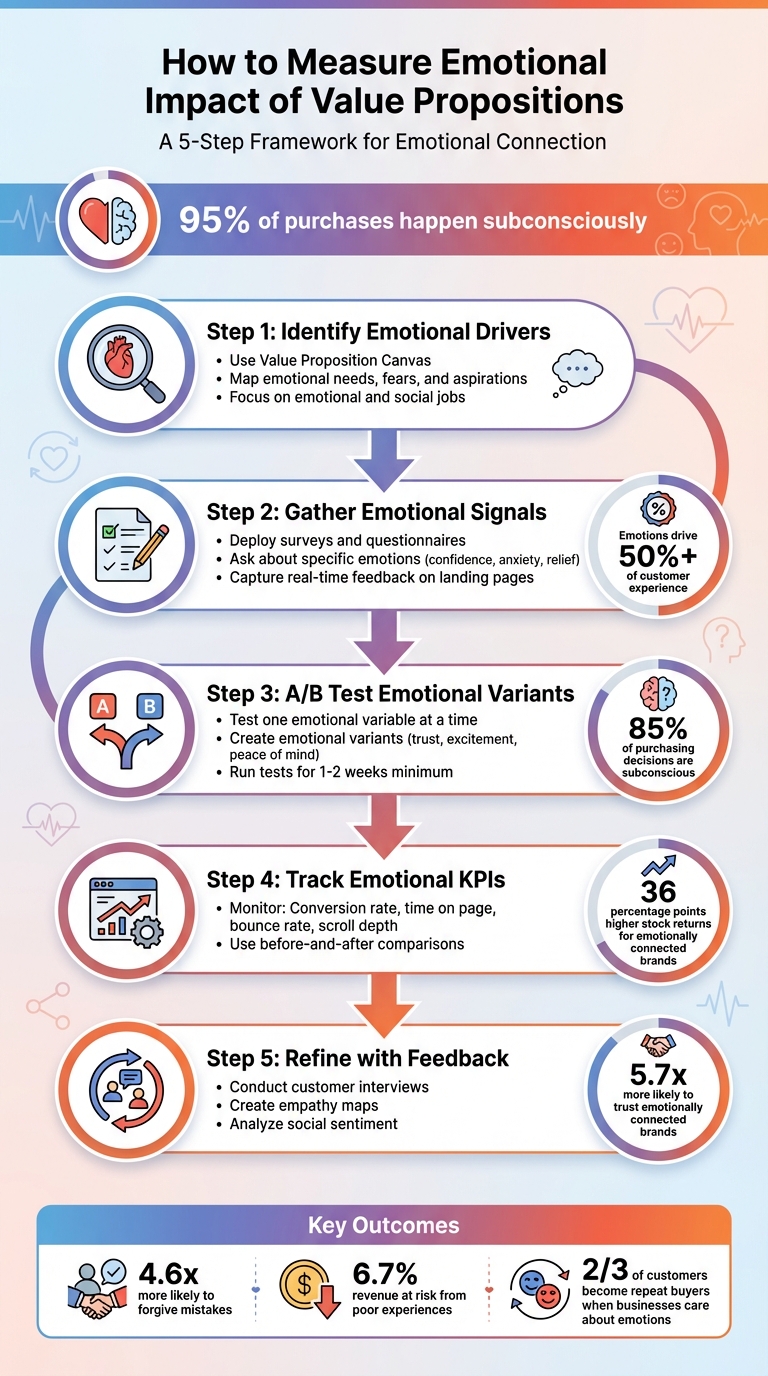
5-Step Process to Measure Emotional Impact of Value Propositions
Step 1: Identify Emotional Jobs, Pains, and Gains
Understanding the emotional side of your customers' decisions is key to creating a strong connection with them. Start by uncovering the emotions, fears, and dreams that shape their choices. The Value Proposition Canvas is a great tool to help map these emotional factors effectively.
Using the Value Proposition Canvas
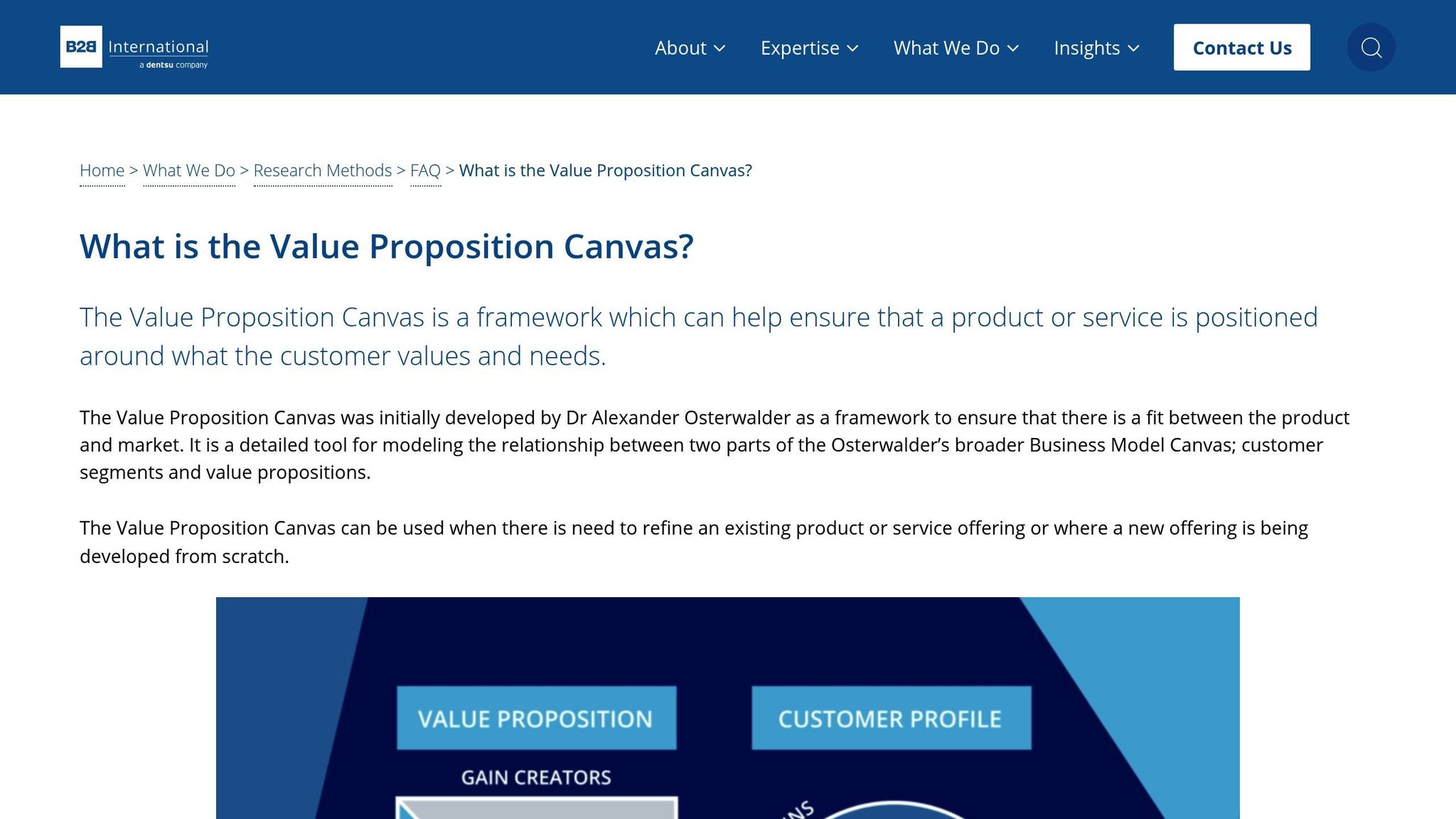
The Value Proposition Canvas (VPC) is a framework designed to align your offerings with what customers truly need - beyond just functional solutions. Start with the Customer Profile (the circle) to focus on their real needs instead of jumping straight to solutions.
Here’s how it breaks down:
- Emotional jobs reflect how customers want to feel - whether it’s secure, fulfilled, or inspired by beauty.
- Social jobs reveal how customers want others to see them - like gaining recognition, appearing fashionable, or projecting power.
"The real game-changers are often the social and emotional jobs. These are the hidden drivers that can truly set your innovation apart".
To get to the heart of these motivations, engage customers in meaningful conversations. Use techniques like the "Why" method to dig deeper. For instance, a parent driving their child to school may say they need to be on time, but the deeper emotional driver might be their desire to feel like a reliable provider.
Visual aids can help capture these insights. Map out pains (negative factors) and gains (aspirations) to better understand customer priorities. Ask targeted questions like, "What keeps you up at night?" or "What social consequences do you worry about?". These steps will help you identify the emotional aspects that matter most.
Prioritizing Emotional Needs
Once you’ve mapped out pains and gains, it’s time to rank them by intensity, frequency, and relevance. Emotional and social frustrations often carry more weight than purely functional ones, so focus on those first.
Zero in on the top three pain points or opportunities that have the greatest emotional impact.
"Great Value Propositions rarely address all customer PAINS and GAINS. They address a few really well!"
To further refine your understanding, try tools like the "Buy-A-Feature" game. Give customers a limited budget to "buy" the features they care about most. This approach reveals which emotional needs truly drive their decisions.
Step 2: Collect Emotional Signals Through Surveys and Questionnaires
Once you've identified your customers' emotional needs, the next step is to dig deeper into how they actually feel about your value proposition. Surveys and questionnaires are excellent tools for capturing these emotional cues. While numerical data tells you what's happening, qualitative surveys uncover the why by tapping into the emotions driving customer decisions.
It's worth noting that emotions drive over 50% of customer experience and loyalty.
Crafting Surveys That Tap Into Emotions
The secret to gathering meaningful emotional feedback lies in asking the right kind of questions. Instead of sticking to generic satisfaction queries like "How satisfied are you?", focus on specific emotions tied to your brand. Ask about feelings like confidence, peace of mind, or even anxiety to get a clearer picture of how customers perceive you.
Here are a few techniques to make your surveys more emotionally insightful:
- Scenario-based questions: Put customers in realistic situations to evoke genuine reactions. For instance, instead of asking, "Do you like our checkout process?", try, "Imagine you're rushing to complete a purchase and the app crashes. What’s your immediate reaction?" This type of question gets to the heart of their emotional experience.
- Photo-elicitation: Show customers neutral, relatable images and ask, "What does this remind you of when you think about our service?" Images can trigger emotions and memories faster than words, uncovering unmet needs.
- Mini-dialogue prompts: Ask customers to write a short conversation between themselves and your support team. This can highlight frustrations or expectations they might not express directly.
To keep the data quality high, limit open-ended questions to 6–8 well-thought-out prompts. Use action-oriented language like "describe", "walk me through", or "tell us about" to encourage detailed responses rather than one-word answers.
| Question Type | Purpose | Example |
|---|---|---|
| Specific Emotion | Measure emotional impact | "How much does our service make you feel 'confident' about your decision?" |
| Scenario Probe | Capture instinctive reactions | "If you couldn't track your order, what would be your first thought?" |
| Mini-Dialogue | Highlight hidden pain points | "Write a brief conversation between you and our support team about a recent issue." |
| Photo-Elicitation | Surface unmet needs | "What does this image remind you of when using our product?" |
Using Landing Pages for Instant Feedback
The best time to gather emotional feedback is when customers are actively interacting with your value proposition. Embedding surveys directly on your landing pages allows you to capture fresh, real-time sentiment. Tools like LaunchSignal's questionnaire features make it easy to integrate surveys into your pages and gather insights immediately after user interactions.
Timing is critical - capture feedback while the emotional response is still raw, rather than days later when details fade. This approach not only provides clearer insights but also helps identify which emotional triggers are resonating with your audience.
In addition to survey responses, watch for behavioral signals that hint at customer emotions. For example, rage-clicking can indicate frustration, while backtracking might signal confusion. These non-verbal cues can be just as revealing as direct answers.
One global fintech provider combined survey data with behavioral signals to reduce churn. By tracking patterns like increased support tickets and delayed payments, they built a model that flagged frustration. When four out of six warning signs appeared, the system triggered personalized outreach, improving customer retention.
Interpreting Open-Ended Feedback
After collecting responses, the next step is analyzing them to uncover emotional trends. Qualitative data is rich but requires careful processing. Normalize shorthand and symbols to ensure consistency during analysis.
Look for recurring emotional themes. Are customers frequently mentioning words like "frustrated", "relieved", or "anxious"? These patterns reveal the emotional impact of your value proposition. Tools like the Circumplex Model can help you map emotions along dimensions like valence (positive vs. negative) and arousal (intensity vs. calm), making it easier to label specific emotional states.
For example, a global healthcare provider used "love" as its core emotional metric, defining it as "loyalty beyond reason." Customers were asked to categorize the brand as "loved, friend, acquaintance, or dislike." This exercise revealed attributes that made the brand "loved", which they then incorporated into their overall experience design.
"Customers may not remember what the quality of your product was, but they will always remember how their customer experience made them feel." - Bruce Temkin, CX Expert
Pay special attention to negative emotions, as they often point to areas for improvement. Since 2017, positive emotions like happiness and relief have dropped by 9 percentage points, while negative emotions like confusion and anger have risen. Addressing these frustrations can help you refine your value proposition and remove emotional barriers.
Step 3: A/B Test Emotional Variants of Your Value Propositions
It’s time to turn emotional insights into actionable strategies. Using the feedback gathered from surveys, A/B testing allows you to experiment with emotional variants of your value propositions. This lets you see which emotions resonate most and ultimately drive conversions. Considering that 85% of purchasing decisions are made subconsciously, testing emotional triggers can help you connect with the hidden motivators behind customer behavior.
When running these tests, focus on one emotional variable at a time. Changing multiple elements - like the headline, hero image, and call-to-action - at once makes it impossible to pinpoint which adjustment caused the impact. Start by defining the emotion you aim to evoke, whether it’s trust, excitement, convenience, or peace of mind, and create variations centered on that single feeling.
Creating Emotional Variants
The key is translating product features into emotional benefits. For instance, instead of saying "fast delivery", you could frame it as "peace of mind knowing it arrives on time".
Structure your tests with a clear hypothesis: "If we change the [Element] to evoke [Emotion], then [Metric] will increase by [X]%". For example, "If we adjust the headline to build trust, then conversion rates will improve by 15%." This method keeps your testing focused and measurable.
You can also test emotional triggers across various page elements. A headline might emphasize urgency, curiosity, or social proof. For a call-to-action button, verbs like "Join" (fostering belonging) or "Discover" (sparking curiosity) can evoke different responses. Even subtle word differences - like "Get Started" versus "Secure Your Spot" - can shift how users feel.
Before diving into full-scale tests, run a quick qualitative review with a small group of users. This ensures your emotional variant delivers the intended feeling. After all, there’s no point testing a "trust" headline if it doesn’t actually make users feel more secure.
Using LaunchSignal Analytics for A/B Testing
LaunchSignal's analytics dashboard simplifies the process of comparing emotional appeals. You can create multiple validation pages, each designed to evoke a specific emotion, and track which one leads to more email sign-ups, questionnaire completions, or even simulated checkout attempts.
With built-in analytics, you can monitor visitor behavior in real time without needing extra tools. Compare conversion rates across emotional variants to identify the one that connects best with your audience. LaunchSignal’s Lifetime plan supports up to three active validation pages, allowing you to test a control version against two emotional variants simultaneously.
Run your tests for 1–2 weeks to account for daily traffic variations and ensure statistical accuracy. Most tests need at least 1,000 visits to confirm a conversion increase of 6.3% or more. For smaller changes, like a 2% improvement, you’ll need over 10,000 visits to trust the results.
Tracking Key Metrics During A/B Tests
While conversion rate is the primary indicator of success, other metrics can provide deeper insights into how well your emotional appeal is working. For instance:
- Time on page: Longer durations suggest users find your content emotionally engaging.
- Scroll depth: Shows how far users navigate, indicating where your emotional narrative might lose momentum.
- Bounce rate: A high bounce rate could mean your emotional hook isn’t grabbing attention.
- Form start rate: Tracks whether your emotional appeal is compelling enough to prompt action.
| Metric | Insights It Provides |
|---|---|
| Conversion Rate | Measures how effectively the emotional appeal drives action |
| Time on Page | Indicates user engagement and emotional resonance |
| Scroll Depth | Reveals how well the emotional narrative holds interest |
| Bounce Rate | Shows whether the initial emotional hook is effective |
| Form Start Rate | Reflects how strong the emotional appeal is in prompting action |
"The best webpages/landing pages aren't focused on products and features - but on the people and their feelings." - Kacyn Goranson
Don’t expect every test to succeed. Only 12% of design changes show positive results, which is why consistent testing is so important. Instead of focusing on minor tweaks, prioritize testing macro variants - major shifts in your value proposition. These larger changes can boost conversions by 50–300%, while small adjustments often have minimal impact.
If one emotional variant outperforms the others, make it your new baseline and continue testing against it. This iterative process helps you refine your understanding of what truly drives your customers’ decisions, setting the stage for deeper engagement with key performance metrics.
sbb-itb-9a9c51d
Step 4: Measure Emotional Engagement with Quantitative KPIs
After analyzing A/B test results, the next step is to validate your adjustments by measuring emotional engagement through quantitative KPIs. These metrics help translate emotional responses into measurable outcomes, offering a clear picture of how your audience reacts and engages.
Businesses that master emotional connections consistently outperform their competitors, achieving 36 percentage points higher stock returns compared to their peers. To gauge emotional engagement and identify areas of confusion, focus on metrics like conversion rate, time on page, scroll depth, bounce rate, and form start rate.
Key Metrics to Monitor
The conversion rate is your primary indicator - it reflects whether your emotional appeal successfully motivated action, whether that's signing up for emails, requesting demos, or making purchases. Behavioral signals such as rage-clicking, backtracking, or typing in all caps can also reveal frustration or confusion.
If users spend a long time on a page but fail to convert, this could signal confusion rather than engagement. Other metrics, like click-through rate (CTR), show whether your emotional hook inspires further action, while the form start rate measures whether users feel encouraged to begin the conversion process.
High emotional engagement can lead to impressive results. For instance, a Net Promoter Score (NPS) of 73 compared to 7 correlates with 4.6× greater forgiveness of mistakes and reduced customer service costs.
"Emotion predicts customer loyalty better than success or effort across every metric we measure, including trust, NPS, and repurchase intent."
- Isabelle Zdatny and Talia Quaadgras, Qualtrics XM Institute
Using Before-and-After Comparisons
Start by establishing a one-week baseline for metrics like conversion rate, bounce rate, and time on page. After implementing changes, compare these metrics to the baseline, ensuring you calculate uplift only when achieving 95% statistical confidence.
For example, in June 2021, MECLABS Institute conducted an A/B test for a B2B market solutions provider. The control page used a generic pitch: "Register Today To Get Your 500 Free Leads!" The revised page, led by Daniel Burstein, emphasized credibility by showcasing the work of 600 researchers conducting 26 million verification calls. This emotionally compelling approach boosted total leads captured by 201%.
Segment your data by device type, traffic source, and visitor status. For instance, while 83% of visits come from mobile devices, desktop users tend to convert 8% better. Similarly, email traffic boasts a 19.3% average conversion rate, outperforming paid social (12%) and paid search (10.9%).
These quantitative insights provide a solid foundation for refining your value proposition and enhancing emotional engagement further.
Step 5: Refine Value Propositions with Qualitative Feedback
After analyzing quantitative data in Step 4, it's time to dig deeper into the why behind the numbers. While metrics tell you what’s happening, qualitative feedback uncovers the emotional drivers behind those results. This step involves customer interviews, empathy maps, and social media analysis to reveal the emotional connections - or disconnections - your value propositions create. These insights go beyond the surface, helping you understand what truly resonates with your audience.
Conducting Customer Interviews
Customer interviews are a goldmine for emotional insights. Start by setting clear goals, choosing a diverse group of participants, and asking open-ended questions in a comfortable setting. Focus on emotions like confidence, gratitude, or even anxiety rather than generic satisfaction. The Peak-End Rule can guide your questions - ask customers about the most intense moments ("peaks") and how the interaction ended ("ends"). These moments often shape how they remember and feel about your brand.
Virtual video interviews add another layer of depth. Observing body language, tone, and behavior alongside verbal responses can help you pick up on unspoken cues. But remember, the goal is to capture insights naturally - don’t disrupt the flow of the conversation.
"Numbers don't tell the whole story. They can show you what's happening, but not why it's happening... Without the customer's own words, you're just guessing." - Kyo Zapanta, Content Lead, Thematic
Creating Empathy Maps
Empathy maps are a visual way to organize what customers say, think, do, and feel. They’re especially useful for aligning your value proposition with customers' specific needs, frustrations, and desires. For instance, if customers express a need for speed but also worry about security, your value proposition should address both simultaneously.
Keep these maps updated as customer expectations evolve. Use insights from interviews, surveys, and behavioral data to refine each quadrant. This process helps you identify where your value proposition connects emotionally - and where it falls short.
Observing Social Media Sentiment
Social media is a treasure trove of unfiltered customer feedback. People often share their thoughts more honestly in digital conversations than they do in formal surveys. By monitoring these discussions, especially "unaddressed mentions" where your brand isn’t directly tagged, you can uncover emotional drivers that might otherwise go unnoticed.
Natural Language Understanding (NLU) tools can help interpret complex cues like sarcasm or frustration. Track shifts in sentiment, such as spikes in negative mentions after a product update or price change. Filtering by platform - whether it’s X, Reddit, or LinkedIn - can also reveal how different audience segments engage with your value propositions.
The stakes are high: businesses risk losing 6.7% of their revenue globally - about $3.1 trillion - due to poor customer experiences. On the flip side, two-thirds of consumers are likely to become repeat customers if they feel a business genuinely cares about their emotional state. Combining interviews, empathy maps, and social sentiment analysis provides a comprehensive view of how your value proposition impacts customers emotionally - and where it needs fine-tuning next.
Conclusion
Summary of the 5-Step Process
Measuring the emotional impact of your value proposition isn’t a one-and-done task - it’s an ongoing cycle. Start by identifying emotional needs using the Value Proposition Canvas. Then, gather emotional signals through surveys on landing pages, test emotional variations with A/B testing, track engagement using KPIs, and refine your approach with qualitative feedback from interviews, empathy maps, and social media sentiment.
Why does this matter? Customers who feel emotionally connected to a brand are 5.7 times more likely to trust it and 4.6 times more likely to forgive mistakes. Brands that prioritize emotional connections outperform their competitors by a staggering 36 percentage points in stock returns. However, the persistent "emotion gap" shows that many companies still struggle to measure and improve emotional resonance.
"The human brain processes emotions much faster than rational thought, with 95% of decisions occurring below conscious awareness." - Isabelle Zdatny and Talia Quaadgras, Qualtrics
And here’s a key insight: 85% of purchasing decisions happen subconsciously. By addressing core emotional drivers like security, status, or relief, you can ensure your value proposition connects on a deeper level before customers even begin rational evaluation.
Next Steps
Now that you understand the five-step process, it’s time to take action. Start by auditing your value proposition to see if it aligns with your customers’ emotional needs. Use tools like LaunchSignal’s questionnaires and analytics to conduct an emotional A/B test on your landing page. Remember, it’s not just about tweaking visuals - test complete emotional hypotheses to create meaningful change. For example, if your brand promises "peace of mind", focus on measuring emotions like relief and confidence instead of broad satisfaction.
Leverage the Peak-End Rule to amplify the most intense emotional moments and ensure positive final interactions. These moments stick with customers and shape long-term loyalty more than any average experience score ever could. Share your findings with sales, customer success, and product teams to maintain emotional consistency across every touchpoint. Finally, as markets change and customer preferences shift, revisit your value proposition regularly - what works today may not resonate tomorrow.
FAQs
How can I understand the emotional factors that drive my customers' decisions?
To tap into the emotions that influence your customers’ decisions, start by pinpointing the feelings your brand wants to evoke - think trust, excitement, or a sense of belonging. These emotional triggers should align seamlessly with your brand’s core values and connect with what matters most to your audience. For example, a luxury brand might center its messaging around exclusivity, while a brand focused on families might highlight warmth and dependability.
From there, dive into customer insights. Analyze feedback, run surveys, or use tools designed to track emotional responses during customer interactions with your brand. Look for emotions like joy, relief, or excitement - these can provide clues about what truly motivates your audience. Use this information to fine-tune your value proposition, helping you build deeper emotional connections and foster more meaningful engagement with your customers.
How can I measure the emotional impact of my value propositions on customers?
To understand how your value propositions resonate emotionally, start by using surveys aimed at capturing customer feelings. Include questions that explore their emotional connection to your product or service. Tools like Likert scales can help quantify these emotions, while open-ended questions allow customers to express their thoughts in their own words, providing deeper insights.
Another approach involves observing customer behavior during usability tests or live interactions. Watching how users react in real-time can uncover emotional responses you might otherwise miss. Pair these observations with analytics tools that track user engagement and feedback to get a fuller picture of customer sentiment.
By combining structured surveys, behavioral observations, and data-driven analytics, you'll gain a clearer understanding of how your audience feels about your offerings - and where there’s room for improvement.
How can I use A/B testing to find emotional triggers that boost conversions?
When it comes to improving conversions, tapping into emotional triggers can be a game-changer. Start by crafting variations that aim to spark specific feelings - like joy, trust, or a sense of belonging. Instead of just tweaking surface details, focus on testing ideas that genuinely evoke these emotions and gauge how they resonate with your audience.
To dig deeper, use tools or strategies to segment your audience based on their responses. This lets you analyze which emotional triggers are driving the most engagement and, ultimately, conversions. By experimenting with these variations and studying the results, you can uncover the emotional cues that truly connect with your customers and lead to better outcomes.
Start validating ideas in minutes not days
Create high-converting landing pages. Test with real users. Get purchase signals. Know what to build next.
Visit LaunchSignal