June 6th, 2026
5 Ways To Turn Negative Feedback Into Product Ideas
Use customer complaints as a roadmap: find patterns, prioritize with 70-20-10, co-design solutions with users, and validate ideas with MVPs and tests.
Warren Day
Negative feedback isn’t just criticism - it’s a resource for improving your product. Customers often point out issues, missing features, or usability problems, giving you a guide to better serve them. But how do you turn those complaints into actionable product ideas? Here’s what you need to know:
- Identify Patterns: Group similar complaints to spot recurring themes.
- Focus on Product Gaps: Connect feedback to missing features or usability issues.
- Prioritize with a Plan: Use the 70-20-10 model to address critical fixes first, then enhancements, and finally new ideas.
- Collaborate with Customers: Involve users in testing solutions through interviews, beta tests, and usability studies.
- Test Before Building: Validate ideas with MVPs, landing pages, or surveys to ensure demand.
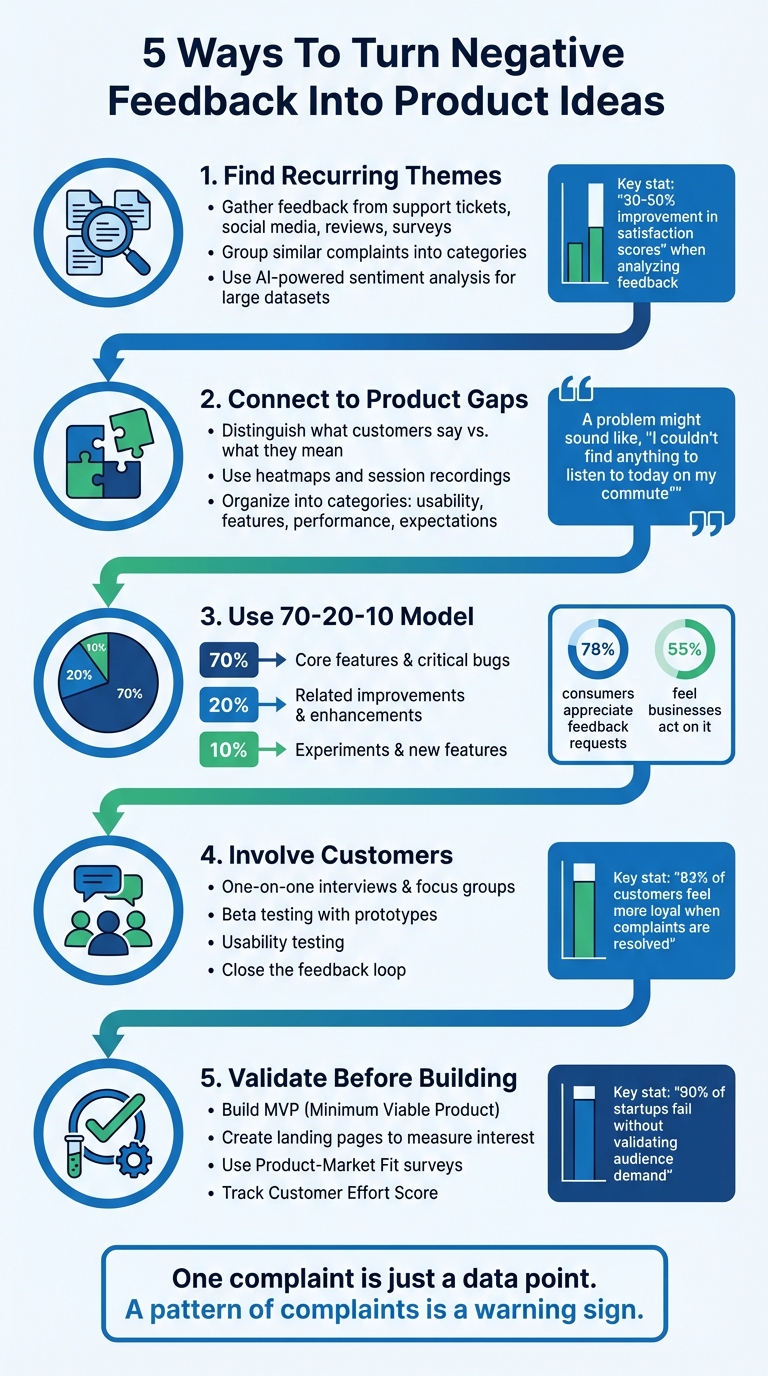
5-Step Framework for Turning Negative Feedback Into Product Ideas
1. Find Recurring Themes in Customer Complaints
Start by gathering feedback from various sources like support tickets, social media, app reviews, and surveys. Consolidating this information into a single system creates a "one-stop shop" for identifying patterns. This approach helps you avoid viewing each complaint as an isolated issue and instead reveals broader trends.
Once your data is centralized, the next step is to organize it. Group similar complaints into categories such as usability challenges, missing features, performance issues, or pricing concerns. Once you've identified a potential solution, you can validate a product idea quickly to ensure it resonates with your audience. Use tags with specific keywords - like "checkout flow" or "mobile app speed" - to pinpoint the areas of your product that are causing the most frustration. For larger datasets, AI-powered sentiment analysis can be a game-changer, helping you quickly identify and flag negative feedback.
But don’t stop at surface-level observations. Dig deeper to uncover the root causes behind recurring complaints. For example, if users frequently mention a slow app, investigate whether the issue stems from inefficient workflows or confusing navigation. As Chisel Labs wisely puts it:
"One complaint is just a data point. A pattern of complaints is a warning sign".
Businesses that actively analyze customer feedback often see satisfaction scores improve by 30–50%. That’s a clear incentive to take customer concerns seriously and act on them.
sbb-itb-9a9c51d
2. Connect Customer Problems to Missing Product Features
Once you’ve identified recurring customer complaints, it’s time to focus on the specific product gaps they reveal. The key here is to turn those complaints into actionable opportunities for improvement.
It’s important to distinguish between what customers say and what they actually mean. For example, if users complain about slow app performance, the real issue might be confusing navigation rather than technical speed. Product Manager Anna Schmunk captures this concept perfectly:
"A problem might sound like, 'I couldn't find anything to listen to today on my commute.' ... The first one might lead to an opportunity that sounds like, 'Help people discover content for their commute.'"
To ensure you're addressing the right issues, back up customer feedback with behavioral data like heatmaps and session recordings. These tools can uncover hidden problems - like features that marketing promotes heavily but users barely interact with. These "silent gaps" often point to a disconnect between what’s being advertised and what customers actually need.
Organize the feedback into categories such as usability, features, performance, and expectations. This approach helps teams prioritize and address the most pressing issues efficiently. Plus, it ensures that the right teams are assigned to tackle specific problems.
Bridging the gap between customer complaints and product improvements not only enhances the user experience but also builds trust. And don’t forget - when you make changes based on customer input, let them know you’ve listened. It can go a long way in strengthening your relationship with them.
3. Use the 70-20-10 Model to Prioritize Changes
Once you’ve identified recurring issues, it’s time to prioritize them, and the 70-20-10 model can help you do just that. This framework turns customer complaints into a manageable action plan, especially when negative feedback starts stacking up and the pressure feels overwhelming. It provides a clear way to determine what needs immediate attention and what can wait.
Here’s the breakdown: 70% of your resources should go toward core features - fixing critical bugs and addressing issues that directly affect user experience and sales. 20% should be allocated to related improvements, focusing on enhancing existing features that users already interact with but could benefit from some fine-tuning. Lastly, 10% is reserved for experiments, like new, ambitious features that require more development time and aim to meet unmet customer needs. This method not only helps your team focus but also sets realistic expectations with stakeholders.
This approach also prevents what Diony McPherson, Co-founder of Paperform, describes as creating a "Frankenstein's monster" - a product overloaded with random fixes and features that lack a cohesive vision.
The 70-20-10 model is also a great tool for managing stakeholder expectations. For instance, when someone suggests a new feature, such as a concept from a landing page idea generator, you can explain that it falls into the 10% experimental category, while stability issues are being prioritized first. Transparency here is essential. A survey shows that while 78% of U.S. consumers appreciate companies that actively seek feedback, only 55% feel businesses actually act on it. By clearly communicating your priorities and reasoning, you can build trust - even if not every suggestion makes it into the final product.
4. Involve Customers in Creating Solutions
Once you’ve decided which problems to address, don’t work in isolation. Bringing customers into the process lowers the chance of creating features nobody wants. When customers help shape the solution, you’re confirming your assumptions before committing engineering resources. Plus, 83% of customers say they feel more loyal to brands that actively respond to and resolve their complaints. This means involving them can turn a frustrated user into a loyal supporter.
Start by using one-on-one interviews or focus groups to dig into the "why" behind negative feedback. Surveys can tell you what users don’t like, but conversations uncover the deeper reasons. For instance, if users complain about a confusing checkout process, an interview might reveal that the real issue isn’t the layout but unclear shipping costs. Understanding this kind of nuance helps you avoid fixing the wrong problem.
Another effective approach is beta testing. Share a prototype or early version of your solution with a small group of engaged customers and observe how they interact with it. This helps identify usability issues and major flaws before a full launch. Similarly, usability testing allows you to watch customers navigate your product in real time. Often, they’ll struggle with tasks they wouldn’t think to mention in a survey. These methods let you validate your solution with real users before rolling it out broadly.
Lastly, make sure to close the feedback loop. Let customers know what changes were made based on their input. Whether through in-app messages, emails, or changelogs, a simple “We heard you, and here’s what we fixed” goes a long way. This kind of transparency shows customers their feedback matters, building trust and encouraging them to keep sharing their thoughts. Involving customers this way not only improves your product but also strengthens your relationship with them.
5. Validate Product Ideas Before Building Them
Once you’ve gathered customer feedback, resist the urge to dive straight into development. Here’s why: nearly 90% of startups fail in their first year, often because they launch products without confirming if their audience actually wants them. Testing your idea on a smaller scale first can save you a lot of time, money, and frustration. As Kinga Edwards, Customer Experience Expert at Survicate, advises:
"Confirm your idea's potential before heavy investment."
Start with a Minimum Viable Product (MVP) that directly addresses your audience's biggest pain point. An MVP allows you to test the waters, offer value to early users, and gather feedback - all without the cost of building a fully developed product. Incorporate alpha and beta testing to spot bugs and usability issues early on. This process not only validates demand but also turns critical feedback into opportunities for improvement.
Another effective way to validate your idea is by using landing pages to measure interest. Tools like LaunchSignal make this easy with pre-designed templates that help you capture user interest through email sign-ups, surveys, or even fake checkouts. You can also track user behavior, like where they hover or hesitate to click, to better understand engagement. This data gives you a clear picture of whether there’s enough demand to justify moving forward.
Pay close attention to metrics during this stage. For instance, Product-Market Fit surveys can be incredibly insightful. If a significant number of respondents say they’d be "very disappointed" if they couldn’t use your product, you’re likely onto something. Additionally, tools that measure Customer Effort Score can help you identify if your solution feels too complicated for early adopters.
It’s worth noting that only about 55% of U.S. consumers believe businesses actually act on the feedback they receive. By validating your product ideas, you not only reduce the risk of failure but also show your audience that their input truly matters. This builds trust and loyalty while turning customer critiques into actionable insights.
Conclusion
Negative feedback isn't just criticism - it's an opportunity to uncover strengths and chart a path for growth. When you approach customer complaints as part of a system rather than isolated incidents, you strengthen relationships and open the door to long-term success. The companies that thrive are often the ones that truly listen to their customers and take meaningful action based on their input.
Here's the reality: while 78% of U.S. customers prefer businesses that actively seek feedback, only 55% feel those businesses do anything with it. That gap presents a huge opportunity. When you actively show customers that their feedback drives real change, you can turn dissatisfied users into loyal advocates. Tim Jordan from Cars.com sums it up perfectly:
"When feedback leads to real change and you share that change, it transforms feedback from a checkbox into a relationship builder."
The process is straightforward: collect complaints, identify recurring themes, prioritize based on impact, involve customers in the development process, and validate ideas early. This approach not only transforms criticism into actionable strategies but also shows your audience that their opinions truly matter. Even if you can't act on every request, being transparent about your decisions builds far more trust than staying silent ever could.
Think of every complaint as free market research. Customers are essentially handing you a roadmap of where your product can improve and what they genuinely need - insights that many successful companies have used to their advantage.
Treat negative feedback as a treasure trove of business intelligence. Your customers are telling you exactly how to make things better. The next step? Listen and act. Tools like LaunchSignal (https://launchsignal.io) can help you turn feedback into tested, actionable plans, bringing the entire process full circle - from feedback to innovation.
FAQs
How can I spot trends in customer feedback to improve my product?
To spot trends in customer feedback, start by collecting input from various channels like surveys, support tickets, social media, and interviews. Pay attention to recurring themes, whether it's frequent complaints about a specific feature or repeated requests for new functionality. Grouping feedback into categories - such as feature suggestions, bug reports, or usability issues - can help you track patterns more effectively over time.
Visual tools like charts or heatmaps can make it easier to identify trends within large datasets. For instance, if a significant number of users report trouble with the same feature, it clearly marks an area needing attention. Regularly reviewing and organizing this feedback allows you to prioritize updates that align with user needs, transforming challenges into opportunities for product improvement.
What is the 70-20-10 model, and how can it help prioritize product changes?
The 70-20-10 model offers a practical way to prioritize learning and improvement by dividing efforts across three areas: 70% on hands-on experiences, 20% on social learning through collaboration or coaching, and 10% on formal training. The focus here is on learning by doing and gaining insights through real-world application, rather than depending solely on structured methods.
In product development, this model shifts the emphasis toward active user engagement and ongoing feedback rather than relying on one-off surveys or formalized input. By observing real user behavior and maintaining continuous interaction, teams can uncover actionable insights that lead to meaningful updates and align closely with customer needs. This approach not only optimizes resource use but also nurtures a culture of continuous learning and improvement.
Why should you involve customers when developing new products?
Involving customers in product development is a smart way to ensure your product meets the actual needs and preferences of your users. By paying attention to their feedback, you can uncover pain points, pinpoint desired features, and identify areas that need improvement. This insight helps you build solutions that genuinely connect with your audience.
When customers see their input shaping the product, it builds trust and loyalty - they feel heard and appreciated. Plus, keeping an open feedback loop means you can continuously fine-tune and adjust your product over time, improving your chances of staying competitive and achieving a strong fit in the market.
Start validating ideas in minutes not days
Create high-converting landing pages. Test with real users. Get purchase signals. Know what to build next.
Visit LaunchSignal