January 12th, 2026
SEO Basics for Startup Landing Pages
Use SEO-driven landing pages to validate startup ideas — target intent-focused long-tail keywords, optimize speed and mobile, and track real conversions.
Warren Day
SEO is a cost-effective way for startups to drive traffic and validate product ideas. Unlike paid ads, it leverages organic search to attract high-intent visitors. Here’s what you need to know:
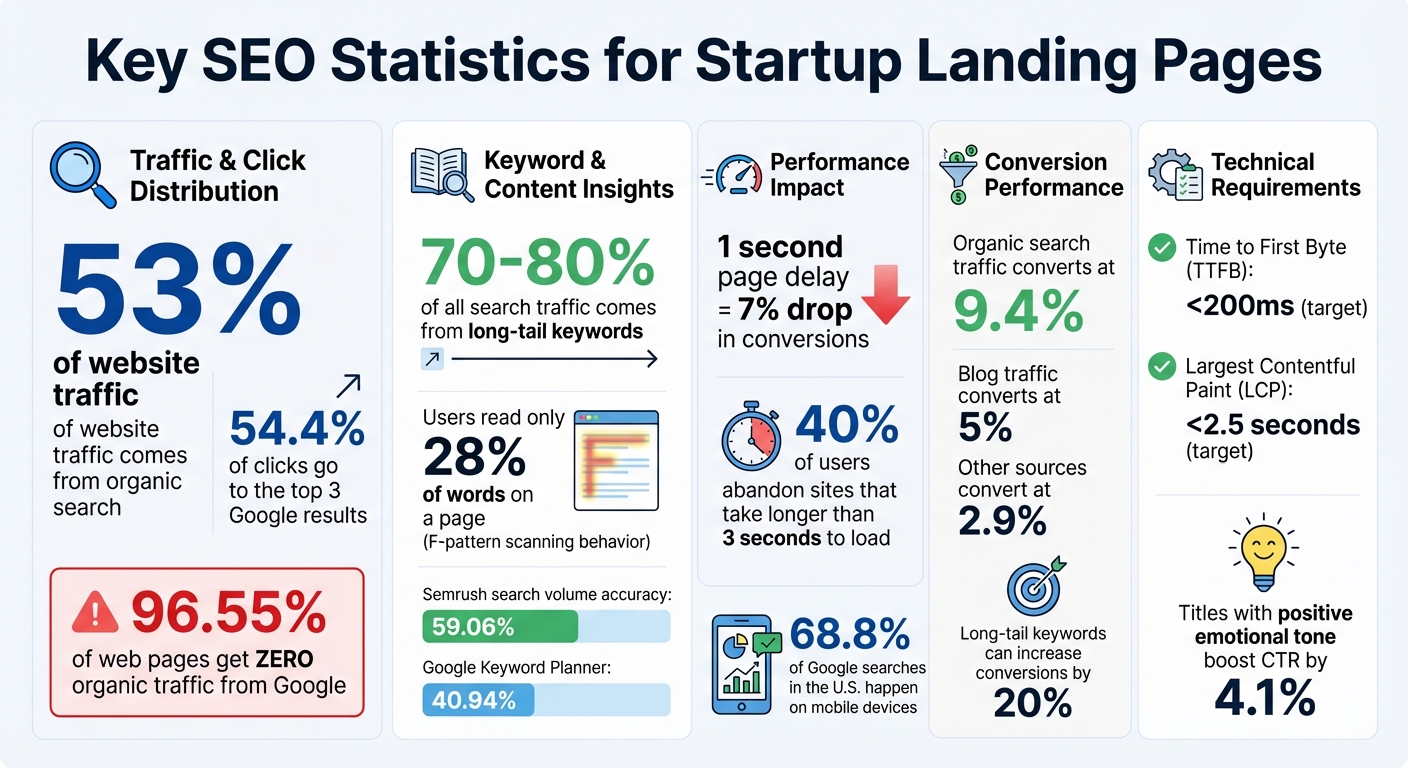
- Organic Search Dominates: 53% of website traffic comes from organic search, with the top three Google results capturing 54.4% of clicks.
- Validate Ideas with SEO: Target high-intent keywords to attract users actively seeking solutions. Use tools like email sign-ups or surveys to measure interest.
- Optimize Your Pages: Focus on fast-loading, mobile-friendly pages with clear headlines, structured content, and proper keyword placement.
- Track Performance: Use tools like Google Analytics and Search Console to monitor impressions, clicks, and conversions.
Platforms like LaunchSignal simplify creating SEO-friendly landing pages, helping startups focus on testing ideas without technical challenges. SEO isn’t just about traffic - it’s about building a steady, scalable growth channel.
Key SEO Statistics for Startup Landing Pages
Keyword Research for Startup Landing Pages
Understanding Search Intent for Early-Stage Startups
Figuring out what searchers are looking for is a key step in keyword research. Google divides search intent into four categories: informational (seeking knowledge), commercial investigation (comparing options), transactional (ready to buy or sign up), and navigational (looking for a specific brand). For validation landing pages, focus on commercial and transactional keywords. For example, someone searching "how to validate a product idea" is likely gathering information, while a search like "best landing page builders" suggests they’re actively comparing solutions and closer to making a decision.
A quick way to gauge search intent? Look at the top search results. If most of them are blog posts, the search intent is probably informational. But if the results include product pages or landing pages, that’s a strong indicator of an intent to act. As Nick Eubanks from NickEubanks.com explains:
"Without this consideration... an SEO could spend hoards of time, energy, and dollars investing in ranking for terms that will not deliver traffic".
Before committing to a keyword, search for it yourself. If landing pages already appear in the results, it’s a good sign the keyword matches your goals. This step ensures you’re aligning with the right intent and sets you up to identify effective long-tail keywords. If you're still in the early stages, using a landing page idea generator can help spark concepts worth testing.
Finding Keywords with High Validation Potential
Once you’ve nailed down search intent, it’s time to dig into long-tail keywords. These are highly specific, multi-word phrases like "SaaS landing page template for AI startups." While they might have lower search volumes, they often convert better because they attract searchers who know exactly what they need. In fact, long-tail keywords account for roughly 70% to 80% of all search traffic.
Start with basic terms related to your product - your "core keywords" - and expand them using free tools. Google Keyword Planner is a great resource for this, providing insights directly from Google Ads, including bid estimates that hint at the keyword's commercial value. The "People Also Ask" section on Google can also reveal specific questions your audience is asking. Additionally, Google Search Console can highlight keywords where you’re already ranking on page two, offering opportunities to make small improvements for better results.
For startups on a budget, even free versions of tools like Semrush can be helpful. Semrush provides 10 searches per day, and in 2020, it was found to have a search volume accuracy of 59.06%, compared to Google Keyword Planner’s 40.94%. This makes it a solid option for uncovering overlooked keyword opportunities.
Creating Targeted Keyword Sets for Landing Pages
With search intent and long-tail keywords in hand, the next step is organizing them into focused keyword sets for your landing pages. Group related keywords together and build each landing page around one primary keyword (used in the URL and H1 tag). Then, add secondary keywords in subheadings and sprinkle in supporting phrases to address specific questions.
For example, in April 2020, Asana’s landing page for "task management" attracted an estimated 13,500 organic visits per month by targeting related transactional keywords like "online project management" and "project management tool" all on the same page. Similarly, Toggl’s page for "free online calendar planner" earned approximately 5,700 monthly visits by including contextual keywords such as "plan recurring tasks" and "calendar management".
When deciding which keywords to prioritize, consider three key factors: monthly search volume (how many people are searching), keyword difficulty (the level of competition), and organic click-through rate (how likely users are to click, considering SERP features like ads). As Brian Dean from Backlinko puts it:
"I would rather have 100 readers that convert at 10% than 10,000 readers that convert 0.01%".
Focus on keywords that are within your reach to rank for and that attract visitors who are ready to take action. This approach ensures your landing pages are not just driving traffic but also generating meaningful results.
sbb-itb-9a9c51d
On-Page Optimization for Startup Landing Pages
Structuring Landing Pages for SEO and User Experience
A well-designed landing page caters to both search engines and your visitors. Start with a single H1 tag that includes your primary keyword - this helps Google and your audience immediately understand the page's purpose. Use H2 through H6 tags to organize the rest of the content in a logical hierarchy, almost like a table of contents. This makes the page easier to scan for users and crawl for search engines.
Your headline and main call-to-action (CTA) should be placed above the fold so visitors can see them without scrolling. Break the content into clear sections using descriptive subheadings, short paragraphs, and bullet points. This improves readability and helps search engines grasp the main points of your page. Incorporate internal links with relevant keywords to guide users to additional content and distribute ranking authority. And don’t forget: your page must be mobile-friendly. A responsive design not only improves user experience but also lays the groundwork for optimizing key HTML elements.
Optimizing Core HTML Elements
The title tag is one of the most important SEO factors. Keep it concise - between 50 and 60 characters - and place your primary keyword at the beginning. End the title with your brand name to reinforce identity (e.g., "SaaS Landing Page Builder | LaunchSignal"). Since search engines typically display only the first 50–60 characters, positioning your keyword early is critical.
Meta descriptions, while not a direct ranking factor, play a big role in attracting clicks. Write a 155–160 character summary that includes your primary keyword and a clear call-to-action. Google often highlights keywords that match the user’s search query, and studies show that titles with a positive emotional tone can boost click-through rates by 4.1%.
Your URL should be short, descriptive, and include your target keyword. Use hyphens to separate words, keep everything lowercase, and avoid unnecessary characters (e.g., "launchsignal.io/landing-page-templates"). For images, compress files to improve loading speed and add descriptive alt text under 125 characters that naturally includes keywords. This not only improves accessibility but also boosts visibility in image search results.
| Element | Best Practice | Why It Matters |
|---|---|---|
| Title Tag | 50–60 characters; keyword at the front | Key ranking signal and clear headline for SERPs |
| Meta Description | 155–160 characters; includes a clear CTA | Encourages clicks from search results |
| URL Slug | Short; uses hyphens; lowercase | Easy to read, share, and crawl |
| Alt Text | Under 125 characters; descriptive | Improves accessibility and ranks images in search |
Once these technical elements are in place, follow landing page best practices to write concise, benefit-oriented content.
Writing Lean, SEO-Friendly Content
Include your primary keyword within the first 100–150 words of your copy to establish relevance right away. As Google Search Central notes:
"The most basic signal that information is relevant is when content contains the same keywords as your search query."
Write content that emphasizes benefits - how your product solves problems - rather than just listing features. Keep sentences short and paragraphs easy to digest. Research shows that users only read about 28% of the words on a page and tend to scan in an "F-pattern". To make your content more scannable, use bold text, subheadings, and plenty of white space.
For startups targeting U.S. audiences, stick to U.S. English spelling (e.g., "optimization" instead of "optimisation") and display prices in USD (e.g., $99). These small details build trust and relevance for local users. Avoid stuffing your content with keywords, as it can lead to penalties and frustrate readers. Instead, focus on delivering real value that outshines what’s already ranking on the first page.
Technical SEO and Performance Best Practices
Improving Page Speed and Mobile Experience
Page speed isn’t just about convenience - it directly affects your search rankings and conversions. A delay of just one second can result in a 7% drop in conversions, and 40% of users will leave a site if it takes longer than three seconds to load. With 68.8% of Google searches in the U.S. happening on mobile devices, optimizing for mobile performance is a must.
To boost your page speed, start by compressing files over 150 bytes (CSS, HTML, and JavaScript) using Gzip, and clean up your code with tools like CSSNano or UglifyJS. Switch to WebP format for images to reduce file sizes, enable lazy loading so images load only when needed, and use browser caching with "expires" headers to speed up repeat visits.
Your Time to First Byte (TTFB) should be less than 200 milliseconds. If it’s slower, address server issues or upgrade your hosting plan. Adding a Content Delivery Network (CDN) can also help by distributing content across multiple servers, making it quicker for users to access.
Keep an eye on Core Web Vitals. For example, the Largest Contentful Paint (LCP) should load in under 2.5 seconds. Use tools like Google PageSpeed Insights or Semrush Site Audit to monitor these metrics and ensure your site also meets acceptable standards for First Input Delay (FID) and Cumulative Layout Shift (CLS).
For mobile optimization, responsive web design is key - it ensures your site looks great on any screen size. Make sure text is large enough (at least 16-point font) to avoid forcing users to zoom in. Reduce render-blocking JavaScript by setting non-essential scripts to "async" or "defer".
As Moz explains:
"A slow page speed means that search engines can crawl fewer pages using their allocated crawl budget, and this could negatively affect your indexation."
Once your site is fast and mobile-friendly, the next step is ensuring it’s properly indexed.
Ensuring Indexing and Crawlability
If search engines can’t find your pages, they can’t rank them. Start by configuring your robots.txt file to guide crawlers - block low-value pages like login screens, thank-you pages, or internal search filters. Create an XML sitemap and submit it to Google Search Console and Bing Webmaster Tools to help search engines discover your content.
Use rel="canonical" tags to indicate the preferred version of a URL, which helps prevent duplicate content issues and consolidates ranking signals. Keep your site’s structure simple - important pages should be no more than three or four clicks away from the homepage. Regularly check for 404 errors, broken links, and redirect chains (keep redirects to fewer than 3–5 hops) to avoid losing crawler efficiency.
For staging or test pages, use robots directives or password protection to keep them out of search engine indexes and avoid duplicate content problems. If your site relies on JavaScript, use the URL Inspection tool in Google Search Console to confirm that Googlebot can render your pages correctly.
Surprisingly, 91% of web pages get zero traffic from Google, often due to simple crawlability and indexing oversights.
Building Trust with Privacy and Security
Beyond performance and structure, security plays a big role in building trust with users and search engines. HTTPS is a confirmed ranking factor. Secure your entire site with an SSL certificate and ensure secure pages don’t link to insecure (HTTP) resources to avoid "mixed content" issues. This is especially important for pages collecting sensitive information like payment details or email addresses.
Provide clear privacy notices explaining how you handle visitor data. If your audience is in the U.S., make sure you comply with relevant privacy laws and include easy-to-find links to your privacy policy. Use encrypted form handling to protect submissions, which not only improves security but also reassures users, increasing conversion rates.
For example, platforms like LaunchSignal simplify this process. They offer SEO-friendly templates with built-in HTTPS and privacy compliance, along with automatic page speed and mobile optimization. This ensures your landing pages meet search engine requirements while helping you validate product ideas efficiently.
Measuring SEO Success for Idea Validation
Setting Up Analytics and Tracking Tools
Using tools like Google Analytics 4 (GA4) and Google Search Console (GSC) is key to understanding organic traffic and validating your product ideas. GA4's Acquisition reports (filtered by Organic Search) allow you to see how users find your site, while GSC provides data on search impressions, clicks, and average rankings. Submitting your XML sitemap to GSC ensures Google indexes your pages effectively. To measure success, set up GA4 conversion events like email signups, waitlists, or demo requests, which help you calculate conversion rates.
For a more streamlined approach, platforms like LaunchSignal integrate with GA4 and GSC, consolidating analytics into one dashboard. With LaunchSignal, you can track metrics like email signups, questionnaire responses, and even simulated checkout completions. This makes it easier to compare the performance of different landing pages, giving you actionable insights to validate your ideas.
Key SEO Metrics for Startups
When measuring SEO success, focus on metrics that directly reflect user interest and engagement with your product. For instance:
- Search impressions help you gauge the potential interest in your product.
- Click-through rate (CTR) shows how effectively your headlines and value propositions attract clicks.
- Average engagement time in GA4 highlights whether visitors find your content engaging - it tracks active user interaction rather than passive time spent.
- Organic conversions are perhaps the most telling metric, reflecting user actions like signups or purchases. For example, one startup found that organic search traffic converted at 9.4%, outperforming blog traffic (5%) and other sources (2.9%).
Here’s a quick reference table:
| Metric | What It Measures | Primary Tool |
|---|---|---|
| Search Impressions | Potential audience reach | Google Search Console |
| Click-Through Rate | Effectiveness of headlines and metadata | Google Search Console |
| Average Engagement Time | Visitor engagement and content value | Google Analytics 4 |
| Organic Conversions | Evidence of user interest | Google Analytics 4 |
| Core Web Vitals | Technical performance affecting rankings | PageSpeed Insights |
Using Data to Improve Landing Pages
Data from these tools isn’t just for tracking - it’s for refining. For example, if GSC shows high impressions but a low CTR, it might be time to tweak your meta title and description to better match search intent. Similarly, if scroll depth tracking reveals users aren’t reaching your primary call-to-action, consider moving your key value proposition higher on the page.
The Search Queries report in GSC is another goldmine. It shows the exact phrases people use to find your page. Groove's CEO shared that targeting long-tail keywords increased conversions by 20%, with organic search traffic converting at an impressive 9.4%. Regularly reviewing this data - ideally on a quarterly basis - can help you address issues like declining keyword rankings or reduced traffic. Keep in mind that the top three search results account for 54.4% of all clicks, so maintaining or improving your average position is crucial.
To keep your content competitive, update it with fresh statistics, adjust it to better align with search intent, and refine your calls-to-action. These ongoing, data-driven adjustments can significantly enhance your landing page’s performance over time.
Conclusion
To master SEO for your startup landing page, focus on three key areas: keyword research, on-page optimization, and performance tracking. Keyword research helps you discover what your audience is searching for, with long-tail keywords often being the quickest way to rank, especially when competing against larger, established brands. On-page optimization ensures your content aligns with both search engines and users - think strategically placing keywords in your H1 tag and the first 100 words, and structuring your page to match search intent. Meanwhile, performance tracking turns guesswork into actionable insights, helping you understand visitor behavior and improve conversions.
Here’s a staggering stat: 96.55% of web pages get zero organic traffic from Google. That means the difference between being invisible and standing out often lies in nailing these basics. It’s a powerful reminder of the importance of a smart, well-executed SEO strategy.
"Good keywords are worth nothing if we don't smartly incorporate them into our on-page strategy. In fact, our keyword research informs and guides almost every aspect of our on-page SEO strategy." - Moz
These strategies are particularly vital for startups looking to validate their product ideas. If you’re juggling multiple concepts, LaunchSignal can simplify your SEO efforts. It offers templates that are mobile-responsive, fast-loading, and technically optimized, so you can focus on testing your ideas. Plus, its integrated analytics dashboard pulls data from all your landing pages, making it easy to see which ideas are driving organic traffic and converting visitors into actionable signals. By combining strong technical SEO with data-driven insights, startups can quickly validate ideas and fuel meaningful growth.
FAQs
How can startups use SEO to test demand for their product ideas?
Startups can use SEO-optimized landing pages to measure interest in their product ideas by focusing on specific keywords their audience might search for. These pages can act as a testing ground, where organic traffic and engagement metrics - like email sign-ups or form submissions - reveal how much demand exists.
By monitoring conversions and user behavior on these pages, startups can uncover whether their product idea connects with their target audience. This method offers a data-driven way to make smarter decisions and reduce potential risks along the way.
What are long-tail keywords, and why should startups use them?
Long-tail keywords are precise, multi-word phrases - typically three words or more - that people use when they know exactly what they're looking for or are ready to make a decision. For instance, instead of searching for something broad like "shoes", a person might type in "comfortable running shoes for women."
For startups, these keywords are a game-changer. Why? They come with less competition, making it easier to secure higher rankings in search results. Even better, they attract highly specific visitors who are more likely to take action, whether that's making a purchase, signing up, or engaging with your content. By zeroing in on long-tail keywords, startups can generate meaningful traffic and grow their online presence - all without needing a hefty budget.
How can on-page optimization improve the performance of a startup landing page?
On-page optimization fine-tunes your landing page to make it friendlier for both search engines and users. By weaving in relevant keywords, crafting compelling title tags and meta descriptions, speeding up page load times, and delivering clear, high-quality content, you can improve how your page ranks in search results.
Better rankings mean more targeted visitors - people genuinely interested in what you offer. These strategies not only help your page climb search rankings but also enhance the overall user experience, which can lead to higher engagement and, ultimately, more conversions for your startup.
Start validating ideas in minutes not days
Create high-converting landing pages. Test with real users. Get purchase signals. Know what to build next.
Visit LaunchSignal