January 5th, 2026
7 Ways to Avoid Feature Bloat in MVPs
Seven practical strategies to prevent feature bloat in MVPs: prioritize core functionality, validate with users, use MoSCoW/RICE, run agile sprints, and focus on usability.
Warren Day
Want to launch a successful MVP without wasting time or money? Here’s the key: focus only on the features that solve one main problem for your users. Adding too much too soon leads to delays, confusion, and wasted resources. Start lean, validate ideas, and build only what matters.
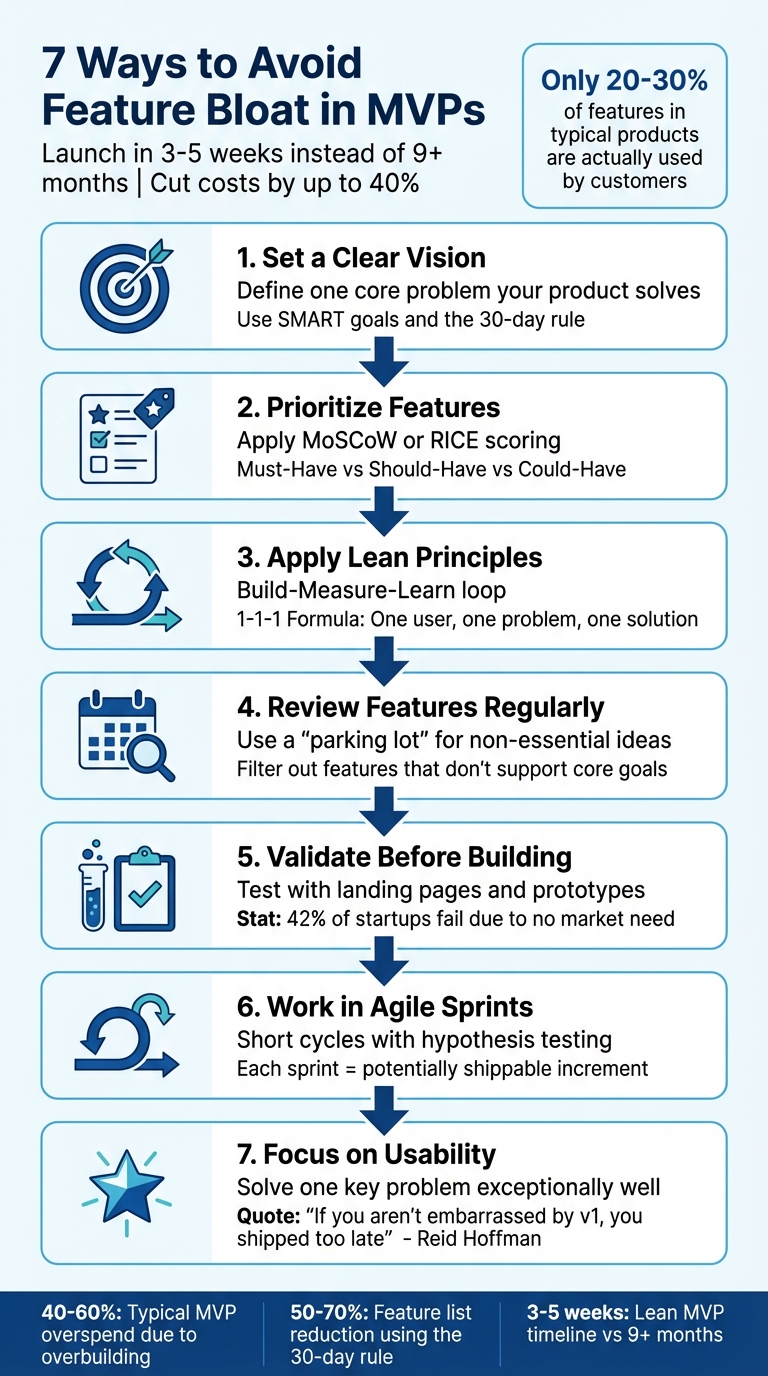
Here’s how to avoid feature bloat in 7 steps:
- Set a Clear Vision: Define one core problem your product solves and stick to it.
- Prioritize Features: Use methods like MoSCoW or RICE scoring to decide what’s essential.
- Apply Lean Principles: Focus on solving one problem for one user type with one simple solution.
- Review Features Regularly: Use a "parking lot" for non-essential ideas to avoid distractions.
- Validate Before Building: Test ideas with tools like landing pages and prototypes before coding.
- Work in Agile Sprints: Develop in short cycles and only add features that prove your hypothesis.
- Focus on Usability: Solve one key problem well instead of trying to do everything.
Pro Tip: Follow the “30-day rule” - if a feature isn’t critical in the next 30 days, it can wait. This approach saves time, cuts costs by up to 40%, and helps you launch in as little as 3–5 weeks instead of 9+ months.
Keep your MVP simple, test assumptions early, and let user feedback guide your next steps.
7 Steps to Avoid Feature Bloat in MVPs
1. Set a Clear Product Vision and SMART Goals
Focus on Core Functionality
Every great product starts with a crystal-clear vision. Ask yourself: What single problem does this product solve? This question keeps you focused and helps you filter out unnecessary feature requests that don’t align with your core purpose. Knowing your product’s "One Core Job" makes it easier to avoid distractions and stay on track.
Here’s why focus matters: Startups often overspend by 40–60% during the MVP stage because they overbuild. Yet, only 20–30% of features in a typical product end up being used by customers. A clear vision helps you identify the "Golden Path" - the shortest and most effective route from user sign-up to that all-important "aha" moment. Everything else? It can wait. Once you’ve nailed down the primary problem your product solves, you can measure progress using SMART goals.
Alignment with MVP Goals
With a focused vision in place, SMART goals give you the framework to bring your MVP to life. These goals zero in on a single pain point, track progress with clear KPIs (like sign-up rates), ensure feasibility, and align with your budget. Plus, they keep your timeline realistic, often aiming for a 3–6 week launch window. The structure of SMART goals forces you to define what success looks like before you start coding.
A simple but powerful tool to stay lean is the "30-day rule": if a feature can wait 30 days, cut it. This rule has helped many founders slash their feature lists by 50–70% and save up to 40% on development costs. To keep everyone aligned, craft a one-sentence problem statement and define OKRs (Objectives and Key Results) that tie each feature to a measurable outcome. When your team debates adding a feature, let objective criteria guide the decision - not gut feelings. You can even use fake door testing to confirm demand for specific features before they enter the development pipeline.
sbb-itb-9a9c51d
2. Use MoSCoW Method or RICE Scoring to Prioritize Features
Focus on Core Functionality
The MoSCoW method breaks features into four categories: Must-Have, Should-Have, Could-Have, and Won't-Have. The essential question here is simple: "Can we launch without this?"
- Must-Have features are absolutely necessary for users to complete the main journey. These are non-negotiable.
- Should-Have features are important but not critical for the initial release.
- Could-Have features are nice additions but can wait.
- Won't-Have features are explicitly ruled out, at least for now.
This framework creates a shared understanding among developers, designers, and stakeholders. It eliminates endless debates about priorities and keeps everyone focused on delivering the core product.
User Validation and Feedback
RICE scoring offers a structured way to evaluate features using this formula: (Reach × Impact × Confidence) ÷ Effort.
- Reach estimates how many users a feature will impact.
- Impact measures how much it contributes to the main goal.
- Confidence reflects how certain you are about your assumptions, often backed by user data.
- Effort accounts for the time and resources needed to implement the feature.
Features with low confidence or high effort but minimal payoff can be filtered out early, saving time and resources. By focusing on high-impact, validated features, your team can avoid costly mistakes and stay on track.
Alignment with MVP Goals
Start by identifying the Must-Have features with the MoSCoW method. Then, use RICE scoring to prioritize the build order, ensuring you're balancing effort against potential impact. This layered approach ensures you're not just picking the right features but also delivering them in the most logical and effective sequence.
| Framework | Primary Purpose | Best Used For |
|---|---|---|
| MoSCoW | Categorizes features into Must-Have, Should-Have, Could-Have, and Won't-Have | Defining strict MVP boundaries under time constraints |
| RICE | Scores features based on Reach, Impact, Confidence, and Effort | Making objective decisions and aligning team priorities |
"An MVP isn't about how many features you launch - it's about whether the features you choose prove your business model." - Cabot Technology Solutions
3. Apply Lean Principles and Outcome-Based Planning
Focus on Core Functionality
Lean principles rely on the Build-Measure-Learn loop to deliver a streamlined product, gauge user reactions, and adjust accordingly. This method cuts out features that don't contribute to learning or address the primary user problem.
The 1-1-1 Formula simplifies this process: focus on one specific user type, solve one main problem, and create one straightforward solution. The most effective MVPs stick to a single clear function, avoiding the trap of becoming overly complex, like "Swiss army knife" apps that confuse users with too many options. This sharp focus not only makes the product user-friendly but also lays the groundwork for robust user validation and outcome-based planning.
User Validation and Feedback
Lean methodology emphasizes testing business assumptions to confirm the model. A great example comes from Zappos founder Nick Swinmurn. Instead of building a warehouse or inventory system in 1999, he tested whether people would buy shoes online by simply photographing shoes in local stores, posting them on a basic website, and manually purchasing and shipping them when orders came in. This approach validated the business model without any upfront inventory costs.
Start by defining a value hypothesis - the main benefit your product offers to early adopters - and test it before adding extra features. Dropbox did this effectively by releasing a simple 3-minute screencast video showing how file syncing worked. The result? Their waiting list skyrocketed from 5,000 to 75,000 signups practically overnight, proving market demand without building the full system first.
Alignment with MVP Goals
To keep development aligned with measurable outcomes, use OKRs (Objectives and Key Results). For instance, set a clear Objective like "validate signup flow" and pair it with specific Key Results such as "achieve a 30% conversion rate." This approach ensures teams focus on building features that directly support measurable goals, rather than chasing ideas that merely sound appealing.
A lean mindset also benefits from applying YAGNI (You Aren’t Gonna Need It) to avoid unnecessary additions. Before implementing any feature, ask if it’s critical to proving a key assumption. If it’s not, park it for future consideration. This discipline keeps scope creep in check, preventing the "just one more feature" mentality that can derail both timelines and budgets. This is crucial since startups often overspend by 40–60% during the MVP stage due to overbuilding.
4. Run Regular Feature Reviews and Maintain a Parking Lot
Focus on Core Functionality
Once you've prioritized features using established frameworks, regular reviews become essential to keeping your MVP focused on its main purpose. These reviews act as a checkpoint to filter out features that don't directly support the core job your product is designed to do. During these sessions, ask yourself: Does this feature align with a measurable goal? Would its absence significantly disappoint users at launch? Does it introduce unnecessary complexity?. If the answer to any of these questions is "no", the feature likely doesn't belong in your MVP.
Beyond maintaining focus, these reviews help the team avoid potential technical headaches. Features that seem simple on the surface can come with hidden costs, like requiring major infrastructure upgrades, database adjustments, or third-party integrations. These complexities can quickly inflate both timelines and budgets.
User Validation and Feedback
To handle nonessential ideas, a parking lot system (sometimes called a backlog or back burner) serves as a holding area for future consideration. This approach allows you to acknowledge stakeholder suggestions without disrupting your current development sprint. As previously mentioned, applying the 30-Day Rule can help decide whether a feature belongs in the parking lot. If the answer is yes, it’s stored there for later evaluation.
The parking lot isn’t just a dumping ground - it’s a thoughtful way to prioritize features based on real user validation. Features should only move from the parking lot to active development after being confirmed through user validation and feedback or behavior data [9, 24]. This ensures you're building based on actual demand, which is critical given that research shows only 20–30% of features in most products are actively used by customers.
Alignment with MVP Goals
During reviews, the MoSCoW framework can help categorize features into Must-Have, Should-Have, Could-Have, or Won’t-Have categories [6, 11]. The "Could-Haves" are often the biggest culprits of feature bloat - those extras that are nice to have but not essential. These should be moved to the parking lot. Equally important is maintaining a clear "Won't-Have" list, which sets firm boundaries and guards against the temptation of adding "just one more feature" [3, 6].
5. Use User Data and Validation Tools Before Building
User Validation and Feedback
Jumping into development without first validating your ideas with users can quickly lead to wasted effort and a bloated MVP. In fact, 42% of startups fail because they create products for which there’s no market need. Before writing a single line of code, take the time to test your riskiest assumptions. Will users pay for your product? Does a specific feature actually solve their problem? These are the questions you need to answer upfront.
One effective strategy for gauging interest is fake door testing. This involves creating a landing page that describes a feature and then driving traffic to it using paid ads on platforms like Facebook or Google. By measuring click-through rates, you can determine if users are genuinely interested. Tools like LaunchSignal simplify this process - they offer ready-made landing page templates with features like email capture, questionnaires, and even fake checkout flows to assess real user intent.
Using these kinds of validation tools helps you stay aligned with lean development principles, ensuring your MVP is tightly focused on what users actually need.
Focus on Core Functionality
Once you’ve validated your ideas, the next step is to test user flows with clickable prototypes using tools like Figma or Marvel. Present these prototypes to a handful of potential users (5–10 is often enough) to see if your solution effectively addresses their main problem. These sessions should go beyond simple “yes or no” feedback - conduct open-ended interviews to uncover workarounds, pain points, and challenges users face in their daily workflows.
Before committing resources to development, validate your core assumptions. A helpful guideline here is the YAGNI principle - You Aren’t Gonna Need It. This mindset encourages you to critically evaluate every feature and focus only on what truly adds value. By sticking to the essentials, you can avoid feature creep and keep your MVP lean and effective.
6. Work in Agile Sprints and Establish a Change Request Process
Focus on Core Functionality
Agile sprints are all about breaking your development process into manageable, testable chunks. By doing this, your team can focus on delivering core functionality without getting bogged down by unnecessary features. Each sprint results in a "potentially shippable product increment" that aligns with the Build-Measure-Learn loop, ensuring that every step delivers real value. For example, think of Uber: their primary focus was on perfecting the ride-booking experience before layering on extra features. This approach keeps your team focused on what matters most and avoids the trap of feature bloat.
Short, iterative cycles also help your team stay on track, focusing on tasks that truly make an impact. It’s easy to get tempted by "nice-to-have" ideas that come up in meetings, but agile sprints ensure you're prioritizing what moves the needle.
Alignment with MVP Goals
Every sprint should directly support your primary business hypothesis. To keep things streamlined, apply the 30-Day Rule: if your product could launch and function without a feature for at least 30 days, that feature should go to the backlog. This rule helps avoid unnecessary distractions during development.
To handle new ideas without disrupting your workflow, set up a clear change request process. Document every new feature idea, but don’t let it interfere with the current sprint. Every addition should be carefully evaluated: if it doesn’t directly contribute to validating your core hypothesis, it can wait. This simple process helps keep your team on budget and on schedule.
User Validation and Feedback
Building on earlier user validation practices, agile development ensures that real-world feedback plays a central role in shaping your product. Engage stakeholders and customers early and often. At the end of each sprint, hold a review session to assess progress and determine the next steps based on actual feedback. This ongoing process helps you avoid product bias - the tendency to justify features based on weak or selective data.
Every new feature should be treated as an experiment. Start by documenting the hypothesis behind it, outline what you plan to build, decide how success will be measured, and then evaluate the results. This hypothesis-driven approach ensures your team stays focused on adding features that deliver real value, rather than chasing distractions.
7. Focus on Usability and Solve One Core Problem
Focus on Core Functionality
When building your MVP, it’s crucial to excel at one thing that truly matters. This idea stems from the "One Core Job" framework - figuring out the single most important task your users expect your product to handle. Take Uber, for example. At launch, Uber’s core function was simple: book a ride. Features like ratings, fare splitting, and ride scheduling came later, keeping the initial offering straightforward and focused.
The danger of trying to do too much too soon is feature creep. Adding too many features can make your product confusing, harder to use, and stray from its original purpose. To avoid this, stick to the YAGNI Principle ("You Aren’t Gonna Need It") and cut anything that doesn’t directly validate your core assumption.
By focusing on one primary task, you can use user feedback to ensure you're meeting essential needs without unnecessary complexity.
User Validation and Feedback
Real user feedback is the key to figuring out whether your product solves a critical problem or just adds fluff. Think of features as either "painkillers" or "vitamins". Painkillers address core problems users face - they’re indispensable. Vitamins, on the other hand, are nice-to-haves that often lead to feature bloat.
A large chunk of startup failures can be traced back to solving non-critical problems or creating products that lack usability. Before you start building, validate your idea with actual users. Tools like LaunchSignal (https://launchsignal.io) make this process easier by letting you test your concept with landing pages, questionnaires, and email signups vs. fake checkouts to see which validates better. This allows you to collect real behavioral data without writing a single line of code. Pay attention to what users do - track metrics like activation rates, retention, and time-to-value to ensure your product hits the mark.
Alignment with MVP Goals
Once you’ve nailed your core functionality, align every design and development decision with your MVP’s measurable goals.
A helpful rule of thumb is the 1-1-1 Formula: one target user, one core problem, and one straightforward solution. This approach keeps your MVP lean and prevents you from trying to build something for "everyone", which often leads to a product that solves no problem well. Use simple, native design components and proven UX patterns to make sure users can accomplish tasks quickly and easily.
As Reid Hoffman, LinkedIn’s founder, famously said:
"If you aren't embarrassed by the first version of your product, you shipped too late."
Overbuilding is an expensive mistake. Startups often overspend by 40% to 60% during the MVP stage because they try to include too much too soon. Stay focused on solving the real problem, and let user feedback guide your next steps. This focus will ensure your MVP stays lean, usable, and effective.
Conclusion
Creating a successful MVP isn’t about packing in every feature you can think of - it’s about zeroing in on the core functionality. By sticking to these seven strategies, you can avoid feature overload and develop a streamlined product that effectively tests your idea.
This method has been the backbone of successful MVPs like Instagram, Facebook, and Uber. These companies started with a single core feature, collected user feedback, and refined their products based on real-world needs. As Eric Ries famously said:
"Your MVP is the version of a product that allows you to collect the maximum amount of validated learning with the least effort".
It’s this mindset that separates startups that grow sustainably from those that waste resources on unnecessary bells and whistles.
Before diving into development, validate your assumptions. Tools like LaunchSignal make it easier to test concepts using landing pages and user feedback, without committing to full-scale development. This approach can shrink your timeline from nine months to just 3–5 weeks and cut costs by as much as 40% [9, 11].
FAQs
What is feature bloat, and how does it impact an MVP?
Feature bloat, or feature creep, occurs when a product is packed with extra features that stray from its primary purpose. For a Minimum Viable Product (MVP), this means adding bells and whistles that don’t contribute to testing the central idea.
When an MVP gets bogged down with unnecessary features, it can lead to delayed launches, higher costs, and a scattered focus. Instead of honing in on the product's main value, teams may lose sight of what they’re trying to validate. On top of that, users might find the product overly complicated or confusing, making it harder to gather actionable feedback. This defeats the whole point of an MVP - learning quickly and efficiently.
The key to avoiding feature bloat is sticking to the basics and focusing on validating the main concept before diving into full-scale development. Tools like LaunchSignal can help with this by enabling founders to create landing pages, gather user feedback, and analyze data. This approach ensures that only the most important features make the cut.
How can I use the MoSCoW method to prioritize features for my MVP?
The MoSCoW method is a straightforward approach to prioritizing features by sorting them into four groups: Must-have, Should-have, Could-have, and Won’t-have (for now). Start by clearly defining the primary problem your MVP is designed to address and the key outcomes you aim to achieve. Then, work with your team to assign each feature idea to one of these categories.
- Must-have features are absolutely necessary for the MVP to function and deliver its core value.
- Should-have features improve usability or efficiency but can be implemented later.
- Could-have features are optional extras that are not critical for the initial version.
- Won’t-have features are intentionally set aside to keep the MVP focused and manageable.
After categorizing, take a close look at the Must-have list to ensure it fits within your available time, budget, and resources. If the list is still too extensive, you can use a scoring model like RICE (Reach, Impact, Confidence, Effort) to prioritize these features based on their value. Throughout the development process, revisit and refine your priorities based on user feedback to ensure your MVP remains streamlined and effective.
Why is it important to validate your idea before building an MVP?
Validating your idea before diving into building an MVP is a smart move. It ensures you're addressing a problem people actually care about and saves you from spending time and money on features that might not resonate with users. Instead, you can zero in on the core solution that truly matters.
Gathering early feedback is key. Whether it's through landing page sign-ups, surveys, or even testing mock checkouts, these methods help you identify the features that show real promise. This way, you can avoid unnecessary extras and build an MVP that’s closely aligned with what users need.
Tools like LaunchSignal simplify this process. With features such as customizable landing pages, user feedback collection, and analytics to test multiple ideas, you can gather actionable insights. This helps you refine your MVP and boosts your chances of launching something that connects with your audience.
Start validating ideas in minutes not days
Create high-converting landing pages. Test with real users. Get purchase signals. Know what to build next.
Visit LaunchSignal