February 9th, 2026
How to Measure Lead Quality in Email Signups
Measure email signup quality with engagement, website behavior, and lead scoring to prioritize MQLs, improve conversions, and reduce wasted effort.
Warren Day
Not all email signups are worth your time. While every signup can feel like a win, the real value lies in identifying leads that are likely to convert into paying customers. Here's the bottom line: quality beats quantity. High-quality leads save resources, convert faster, and deliver higher lifetime value.
Key Takeaways:
- What defines lead quality? It’s how well a lead matches your target customer profile and shows purchase intent, like visiting high-value pages (e.g., pricing) or downloading resources.
- Why focus on quality? Low-quality leads waste time and money. For example, 25% of lead generation budgets are lost to fraud, and sales teams spend 60% of their time on unqualified prospects.
- How to measure lead quality: Use metrics like email engagement (click-through rates, read times), website behavior (pricing page visits, downloads), and lead scoring systems that combine "Fit" and "Intent."
- Improve lead quality: Simplify signup forms, tailor offers to user intent, and use tools like data enrichment to qualify leads without overwhelming them with questions.
Start by tracking the right metrics, aligning sales and marketing teams, and focusing on leads that show real potential. The result? Better conversions, less wasted effort, and more revenue.
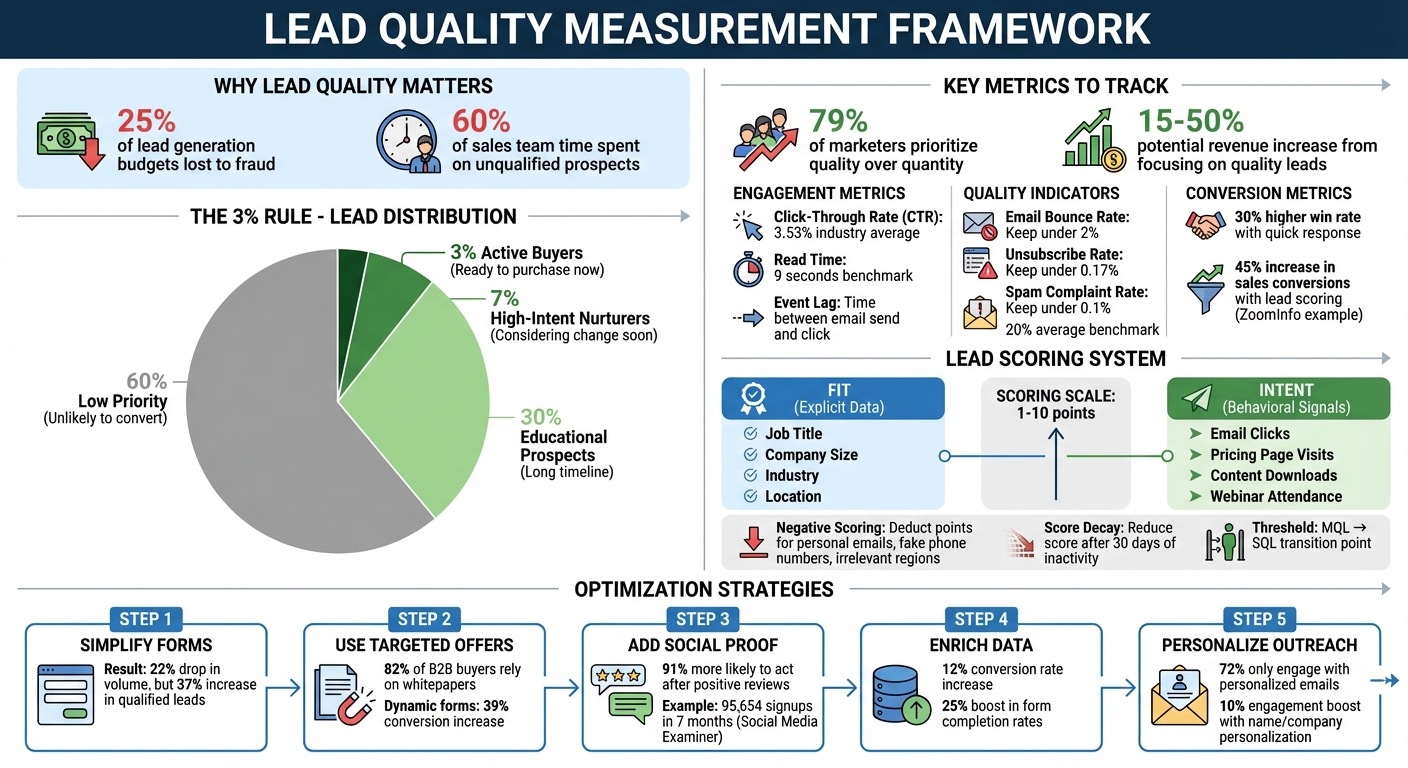
Lead Quality Measurement Framework: Metrics, Scoring, and Optimization Process
Key Metrics to Evaluate Lead Quality
Capturing email signups is just the beginning. The real challenge lies in identifying which leads are worth pursuing. By tracking the right metrics, you can distinguish genuine prospects from casual browsers or bots. Here's what to pay attention to.
Engagement Metrics
Email engagement is a strong indicator of interest. Metrics like click-through rate (CTR) - with an industry average of 3.53% - and click-to-open rate (CTOR) provide valuable insights. While CTR measures overall link clicks, CTOR focuses on clicks relative to opens, helping you filter out accidental opens. Since Apple's Mail Privacy Protection has made open rates less reliable, shift your focus to more actionable signals like clicks, website visits, and read times. For example, a read time benchmark of around 9 seconds can indicate content relevance.
"High engagement may indicate a customer with high brand loyalty, who maybe should be targeted in an upcoming loyalty offer." - Dillon Baker, Senior Product Marketing Manager, Salesforce
Website behavior is equally telling. High-quality leads often move from emails to high-intent pages, such as pricing or demo request pages designed with landing page best practices. Content downloads - like whitepapers or product flyers - are another sign of deeper interest. Additionally, consider tracking event lag, which measures the time between sending an email and a recipient's click. Shorter lag times generally signal higher urgency.
To make sense of these behaviors, implement a scoring system that combines both fit and intent.
Lead Scoring Systems
Lead scoring assigns numerical values to prospects based on their attributes and actions. The most effective systems use two dimensions: "Fit" (how well a lead matches your ideal customer profile) and "Intent" (their demonstrated interest and readiness to buy).
For "Fit", use explicit data like job title, company size, and industry. For "Intent", focus on behavioral signals such as email clicks, webinar attendance, and visits to high-value pages like pricing. Negative scoring is equally important - deduct points for behaviors like using personal email addresses for B2B signups or submitting fake phone numbers like 999-999-9999. A simple 1-10 scoring scale works well, and decay scores over time; for instance, reduce a lead's score after 30 days of inactivity to keep sales teams focused on active prospects.
Set a clear threshold to transition leads from Marketing Qualified Lead (MQL) to Sales Qualified Lead (SQL). Companies like ZoomInfo have seen a 45% increase in sales conversions after implementing lead scoring systems. By letting scores decay over time, you ensure your team prioritizes leads who are actively engaged.
While lead scoring is essential, conversion metrics ultimately reveal how these signals translate into revenue, as we'll explore next.
Trial Conversion and Churn Rates
Analyze how quickly leads convert into sales and compare conversion rates across different channels. A channel with a 10% conversion rate is clearly delivering better-quality leads than one at 1%, even if the cost per lead is higher. For products offering free trials, track metrics like revenue per lead and average order value (AOV) to pinpoint the most profitable sources.
Free trial signups themselves are strong buying signals, often qualifying someone as an MQL. Pay close attention to what happens next - organizations that respond quickly to leads see a 30% higher win rate, so speed is critical.
Customer lifetime value (CLV) is the ultimate measure of lead quality. High-quality leads turn into loyal customers who stick around, while low-quality leads tend to churn within the first few months. Keep in mind that only about 3% of leads are ready to buy immediately, while the remaining 97% need nurturing. With sales teams spending roughly 60% of their time on low-quality leads, fine-tuning your approach to identify that 3% can significantly boost your bottom line.
sbb-itb-9a9c51d
How to Design Signup Forms That Attract Quality Leads
Your signup form isn’t just a way to collect contact information - it’s a tool for identifying leads who are genuinely interested in what you offer. A well-designed form strikes the perfect balance between ease of use and strategic qualification, ensuring you attract serious prospects without creating unnecessary friction.
Keep Forms Simple
Streamline your form fields. Here's an example: In April 2025, Arham Khan, Founder and CEO of Pixated, added a "Company Size" dropdown to a B2B software client's lead form. What happened? Lead volume dropped by 22%, but the percentage of qualified leads shot up by 37%.
"For a B2B software client, we added a simple 'Company Size' drop-down. Lead volume decreased by 22%, but qualified prospects jumped 37%. Their sales team celebrated the change." - Arham Khan, Founder and CEO, Pixated
Ask only for the essentials. Replace open-ended text fields with dropdown menus or button selections to reduce decision fatigue and make it easier to process responses. For longer forms, include a progress bar so users know how close they are to completing it. And don’t underestimate the power of a good button - swap out generic "Submit" text for something action-oriented, like "Get My Free Guide" or "Sign Me Up".
Use Targeted Offers
The simplicity of your form matters, but so does the offer itself. Tailor your offers to match where your leads are in their decision-making process. For example, a checklist or blog post will appeal to those in the early stages of research, while a product demo or free trial will attract prospects who are closer to making a purchase. If you're targeting B2B buyers, keep in mind that 82% rely heavily on whitepapers when evaluating options.
Callum Gracie from Otto Media shared an example of using dynamic forms for an e-learning client. When users repeatedly visited the pricing page without signing up, the form asked, "What's stopping you from signing up?" and offered multiple-choice answers. This personalized touch boosted conversions by 39%.
"When we applied this tactic to an e-learning client, conversions increased by 39% because leads felt like we were addressing their specific concerns, not just pushing them into a sales funnel." - Callum Gracie, Digital Marketing Agency Owner, Otto Media
Keep your form length proportional to the offer’s value. For a simple checklist, an email address might be all you need. But for something like a consultation request, asking for more details - like name, phone number, and budget - makes sense.
Add Social Proof
Trust matters when asking for personal information. Did you know 91% of consumers are more likely to take action after reading positive reviews? Use testimonials, registrant counts, or logos from well-known media outlets near your signup button to build credibility. Adding links to your privacy policy and security certifications near the submission button can also reassure users and encourage them to provide accurate information.
Michael Stelzner, founder of Social Media Examiner, grew his email list by over 95,654 names in just seven months using targeted capture forms with exit-intent technology. Similarly, Marie Forleo’s B-School uses its 14-year track record and a base of 80,000 students to drive waitlist signups. These numbers aren’t just for show - they demonstrate real value in the offer.
If you’re looking for tools to make this process easier, platforms like LaunchSignal provide customizable landing page templates and integrated email capture tools that can help you implement these strategies seamlessly.
Segmentation and Personalization for Better Lead Management
Once you've collected emails using effective signup forms, the next step is to refine your approach by segmenting and personalizing your leads. This ensures your efforts are focused on the most promising prospects, saving time and resources. If you're still in the early stages, using a landing page idea generator can help you design high-converting pages. While signup forms lay the groundwork, segmentation and personalization turn those initial contacts into real opportunities.
How to Segment Leads
Divide your leads into three main categories to streamline your strategy. Use demographic or firmographic details - like age and location for B2C, or industry, company size, and job title for B2B - to create meaningful segments. Pay attention to behavioral cues, such as email open rates, link clicks, and visits to high-priority pages like pricing pages. Additionally, consider the lead source, as referrals and organic traffic often yield better results than cold traffic.
Here’s a helpful framework to guide your segmentation:
- Active buyers (3%): These leads are ready to act and require immediate follow-up.
- High-intent nurturers (7%): These prospects are considering a change soon and benefit from targeted nurturing.
- Educational prospects (30%): These leads have longer timelines and respond well to educational content.
- Low priority (60%): These individuals are unlikely to convert and should be deprioritized.
Known as the "3% Rule", this approach helps avoid wasting time on leads that are unlikely to convert. Sales teams often spend up to 60% of their time on low-quality leads, which this strategy aims to minimize.
To refine your efforts further, implement negative scoring. Exclude leads that don’t align with your goals, such as those using personal email addresses or located in irrelevant regions. This ensures your pipeline remains focused on high-potential prospects.
With clear segments in place, you can enhance your targeting by enriching your lead data.
Enrich Lead Data
Segmentation becomes even more powerful when paired with enriched data. While asking for too much information upfront can reduce form completions, you still need enough details to qualify leads effectively. Data enrichment tools solve this issue by automatically adding firmographic information - like job titles, company revenue, and industry - after a lead signs up. This approach has been shown to increase conversion rates by up to 12%, and reducing form fields while enriching data in the background can boost completion rates by as much as 25%.
Platforms like Clearbit, ZoomInfo, and Apollo.io can gather additional details from various sources and sync them directly to your CRM. Many of these tools use "waterfall enrichment", meaning they check multiple data providers (up to eight) until they find accurate information. This allows you to keep your signup forms simple - just a name and email address - while still building detailed lead profiles for segmentation and scoring.
For B2B campaigns, technographic data is particularly valuable. Knowing what software or tools a lead's company uses enables you to craft highly specific messaging. For example, if a prospect uses a competitor's product, you can highlight the advantages of switching to your solution. Just ensure your enrichment tools comply with GDPR and CCPA regulations to avoid legal complications.
Personalize Your Outreach
Once you’ve segmented and enriched your leads, it’s time to tailor your messaging to each group. Generic email blasts won’t cut it - customization is key. For active buyers in the top 3%, prioritize immediate, personalized follow-ups with demos and pricing information. The 7% of leads preparing for change should receive semi-automated nurturing content, like comparison guides and decision-making resources. Meanwhile, the 30% with non-urgent needs can be engaged with fully automated educational emails about industry trends and solutions.
"A successful approach to lead scoring will involve automation to make sure that contacts are getting routed to the right people, that they're getting nurtured with the right content, and they're getting served the most custom experience that you can possibly serve them." - Ryan Durling, Inbound Consultant, HubSpot
Behavioral triggers can further enhance your outreach. For instance, if a lead downloads a pricing guide or abandons a cart, you can send a targeted email addressing that specific action. Personalize your emails with details like first names and company names - this "piping" technique has been shown to boost engagement rates by around 10%. It’s worth noting that 72% of people only engage with marketing emails tailored to their specific interests.
Balance Signup Volume with Conversion Quality
Having a high number of signups might seem like a win, but it doesn’t always translate into success. If those signups don’t convert, they can drain your budget, clutter up your CRM, and waste your sales team’s time. In fact, 79% of marketers say their main goal is generating quality leads. Metrics like email open rates, click-through rates, and trial conversions can help you separate genuinely interested leads from those who just signed up for a freebie. And here’s the kicker: even when signups increase, conversion rates often stay stagnant. That’s why it’s critical to spot early signs of low-quality leads and address them.
Spot Low-Quality Signups
Low-quality signups tend to leave behind clear warning signs. Start by checking your email bounce rate - anything over 2% could mean you’re collecting invalid addresses, whether from bots or simple typos. Similarly, if your unsubscribe rate tops 0.17% or your spam complaint rate goes above 0.1%, it’s a red flag that your emails aren’t delivering value.
Engagement metrics offer even more insight. With the average email open rate sitting at about 20%, anything below that benchmark suggests your audience isn’t interested in what you’re offering. Leads that fail to move beyond the initial signup - those who don’t book meetings, start trials, or progress from Marketing Qualified Lead (MQL) to Sales Qualified Lead (SQL) - are another sign of poor quality. And here’s a sobering stat: 60% of a salesperson’s time is wasted on leads that are unlikely to convert. Filtering these out early can save a lot of effort.
Financial metrics also tell a story. If your Cost of Customer Acquisition (CAC) is climbing while your Average Lead Value (ALV) or Subscriber Lifetime Value (SLV) stays flat, you’re spending more to acquire leads that aren’t delivering value. A low contact rate can also indicate invalid data or leads that simply aren’t engaging. Once you’ve identified these low-quality signups, it’s time to focus on making your funnel more efficient.
Improve Funnel Efficiency
After spotting low-engagement signups, the next step is to fine-tune your funnel. Start by adopting lead scoring with the BANT framework (Budget, Authority, Need, Timeframe) to prioritize leads based on their likelihood to buy. Set a minimum score threshold before passing leads to sales, and use negative scoring to weed out red flags, like visits to your career page or leads outside your service area.
Email automation can help nurture high-quality leads while filtering out unresponsive ones. Behavioral triggers, for instance, can move engaged prospects further along the funnel while sidelining those who aren’t active.
Leverage an analytics dashboard to track lead-to-sale velocity. This metric shows how quickly leads from different sources convert. High-quality leads typically move through your funnel faster and require fewer touchpoints. For example, if you’re using tools like LaunchSignal to validate product ideas, its built-in analytics can help you identify which landing pages are attracting leads that actively engage with your questionnaires or fake checkout flows. These early indicators can highlight genuine interest before you invest more resources in outreach.
Lastly, ensure your sales and marketing teams are aligned on what makes a lead qualified. Regular feedback loops between the two teams can help marketing attract better-fit profiles while sales focuses on prospects with real potential. This alignment addresses a common issue: 43% of sales professionals report needing higher-quality leads from marketing. When both teams are on the same page, it’s a win for your revenue goals.
Conclusion
Measuring lead quality in email signups isn’t just about numbers - it’s about attracting the right people who are likely to convert into paying customers. Chasing low-quality leads can drain resources, while prioritizing quality can increase revenue by as much as 15% to 50%.
To make this happen, ensure your sales and marketing teams are on the same page about what defines a "qualified" lead. Misalignment here can lead to inefficiencies, so take the time to agree on clear definitions. Tools like lead scoring systems - such as BANT - help rank prospects objectively, while negative scoring can weed out leads that show early signs of disinterest or poor fit.
Focus on metrics that truly matter. Instead of obsessing over vanity metrics like the sheer number of signups, track engagement rates, lead-to-sale velocity, and conversion rates. This approach ensures your team spends their time on prospects who are genuinely ready to make a purchase.
For startups, it’s crucial to start with the basics. Define your Ideal Customer Profile (ICP) based on your best current customers. Use simple lead scoring techniques and adopt real-time validation to filter out bad data as it comes in. As your business grows, you can expand into more advanced tools like predictive analytics and behavioral tracking. The goal is to create a scalable system that keeps your team focused on high-quality prospects ready to take the next step.
FAQs
What are the best metrics to evaluate the quality of leads from email signups?
To determine the quality of leads from email signups, it’s important to focus on three main aspects:
- Demographic fit: Consider how closely the lead matches your ideal audience. This includes factors like their industry, job title, or the size of their company.
- Engagement behavior: Pay attention to how they interact with your emails. Are they opening messages, clicking on links, or completing forms? These actions reveal their level of interest.
- Lead scoring: Implement a scoring system to evaluate leads based on their relevance, interest, and how prepared they are to take the next step.
Monitoring these elements helps you identify the most promising leads and make smarter decisions to drive your business forward.
How can I ensure high-quality leads from email signups without losing signups?
To enhance lead quality while keeping signup numbers steady, focus on smart filtering and leveraging behavioral insights. Start by simplifying the signup process - ask only for basic details like an email address and validate it in real-time to ensure accuracy. For additional information, use progressive profiling, where optional questions are introduced after the initial signup. This approach minimizes friction while gradually collecting more data. Subtle qualification techniques, such as short quizzes or simulated checkout experiences, can also help identify genuinely interested prospects without turning them away.
Tracking user behavior is another key strategy. Pay attention to actions like the number of page visits, time spent on critical pages, and clicks on high-value CTAs (such as pricing or demo links). Use this data to develop a straightforward lead-scoring model that helps you focus on the most promising leads. To keep signups flowing, implement bot detection tools and flag disposable email domains to filter out low-quality entries. By combining smarter data collection, gentle qualification steps, and behavior-based scoring, you can improve lead quality without sacrificing the volume of signups.
What are the best ways to design signup forms that attract high-quality leads?
To create signup forms that attract high-quality leads, focus on keeping things simple and relevant. Stick to the basics - ask for only the most essential information, like the user's name, business email, and one or two qualifying details (e.g., company size or specific needs). Overloading forms with too many fields can turn users away or lead to low-intent signups. Instead, collect the critical details upfront and use progressive profiling to gather more information gradually over time.
Write clear, benefit-focused copy paired with a strong, actionable call-to-action (CTA). For example, "Get Your Free Guide" sets expectations and appeals directly to users who are ready to engage. Including trust signals, such as privacy disclaimers or real-time email validation, can also help minimize fake or low-quality entries. Don’t forget mobile users - ensure your form is responsive, easy to navigate with touch, and quick to complete.
Tools like LaunchSignal can simplify this process. With pre-designed templates and built-in email capture features, you can quickly create, test, and refine your forms. These tools make it easier to ensure the leads you collect meet your quality standards.
Start validating ideas in minutes not days
Create high-converting landing pages. Test with real users. Get purchase signals. Know what to build next.
Visit LaunchSignal