May 18th, 2026
Reducing CAC: 7 Proven Strategies
Seven tactics to cut Customer Acquisition Cost: target profitable segments, use SEO, optimize funnels, referrals, retention, automation, and landing page tests.
Warren Day
Reducing your Customer Acquisition Cost (CAC) is key to improving profitability and sustaining growth. CAC is calculated by dividing total sales and marketing expenses by the number of new customers. If your lifetime value (LTV) to CAC ratio is below 3:1, you’re likely spending too much to acquire customers. Here are seven practical strategies to lower your CAC effectively:
- Target profitable customer segments: Focus your marketing on high-value audiences using Ideal Customer Profiles (ICP) and lead scoring systems.
- Leverage SEO and content marketing: Organic traffic reduces dependency on costly paid ads and increases conversions over time.
- Optimize your sales funnel: Fix leaks like cart abandonment and slow-loading pages to improve conversions without additional spending.
- Introduce referral programs: Reward existing customers for bringing in new ones, cutting acquisition costs by up to 15%.
- Retain current customers: Loyal customers cost less to keep and often spend more over time.
- Automate marketing tasks: Use tools to streamline repetitive tasks, reduce labor costs, and reclaim lost revenue.
- Test and improve landing pages: Small tweaks can double conversion rates, slashing your CAC in half.
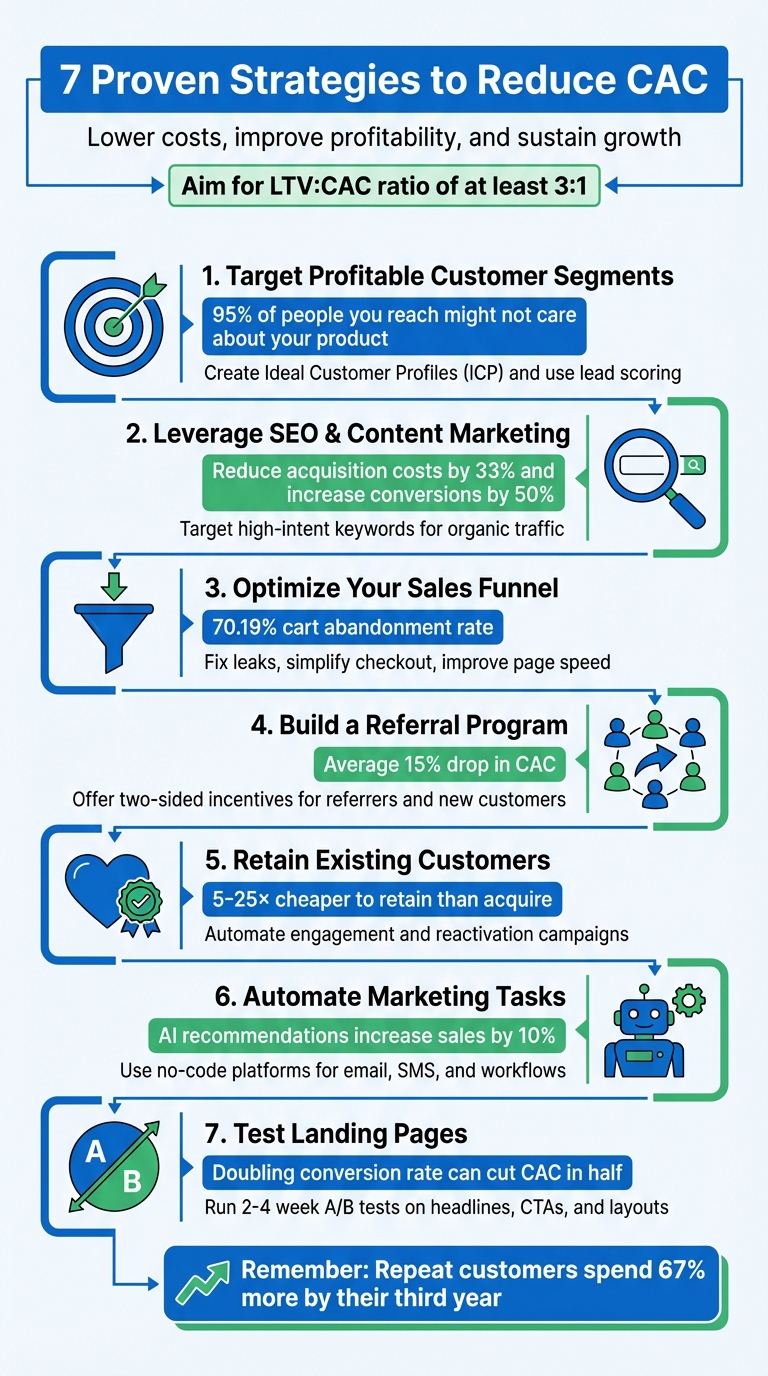
7 Proven Strategies to Reduce Customer Acquisition Cost (CAC)
1. Focus on Your Most Profitable Customer Segments
Not all customers are created equal, and spreading your marketing dollars too thin can be a costly mistake. In fact, up to 95% of the people you reach might not even care about your product or service. That’s a lot of wasted effort and budget.
Instead, hone in on the customers who matter most by creating an Ideal Customer Profile (ICP) based on real data. Take Gauri Manglik, CEO and co-founder of Instrumentl, as an example. Her company initially relied on generic trade show lists, which led to poor-quality leads and a high customer acquisition cost (CAC). By shifting to targeted content syndication and referral programs aimed at specific customer segments, they dramatically reduced their CAC.
Once you’ve identified your target segments, make sure you’re reaching the right people within those groups. Vi Trang, Growth Marketing Lead at Rex Software, emphasizes the importance of targeting decision-makers:
"A common mistake is assuming the decision-maker is always the highest-ranking person... researching your audience pays off because you'll know exactly who to target. That means you're not wasting budget and resources on the wrong leads".
To further refine your efforts, implement lead scoring systems. This allows you to prioritize high-value prospects for your sales team while automating follow-ups for lower-quality leads. NoticeNinja took this strategy a step further by introducing high-touch onboarding for their software clients. With features like monthly newsletters and live training sessions, they boosted client retention by over 60% in just two years.
Lastly, analyze your CAC for each marketing channel to pinpoint which segments are the most cost-effective to acquire. Double down on what works and focus on customer groups with strong retention potential. Why? Because repeat customers tend to spend 67% more by their third year. That’s where the real growth lies.
2. Use SEO and Content Marketing
Cost-effectiveness
When it comes to long-term value, SEO and content marketing stand out as some of the most budget-friendly strategies. Unlike paid ads, which charge you for every single click, organic traffic comes with zero ongoing costs once you've secured strong rankings. For example, LeadSquared generates around $100,500 worth of organic traffic every month - traffic that would otherwise require a hefty pay-per-click budget.
The upfront costs? Mostly tied to creating and optimizing content. But here's the kicker: targeted content can reduce acquisition costs by 33% while increasing conversion rates by 50%. That means you're not just saving money - you’re making your marketing dollars work harder. Lower costs and higher conversions? It’s a win-win that directly impacts your customer acquisition cost (CAC).
Impact on CAC reduction
Content marketing also helps cut your reliance on costly paid campaigns. By crafting content that directly addresses buyer concerns, you’re smoothing out the sales process. Sales reps armed with the right content to tackle objections see close rates soar to 64%.
The secret sauce lies in targeting high-intent keywords - search terms that signal potential buyers are ready to take action. Elisa Montanari, an expert in SEO and CRO, sums it up perfectly:
"SEO drives users to the website, and CRO converts them into high-quality leads. One way to increase high-quality leads without increasing acquisition costs is to increase your conversion rate".
Ease of implementation
While SEO and content marketing don’t deliver instant results, they’re straightforward to implement with consistent effort. Regularly publishing quality content is essential, and it can take a few months to see measurable outcomes. Technical aspects like keyword research, on-page optimization, and page speed also play a major role. Even a one-second delay in load time can slash conversion rates by 7%.
Potential for scalability
This is where SEO truly outshines other strategies. A single, well-optimized blog post can keep driving traffic and leads for years, steadily lowering your average acquisition costs over time. Unlike paid ads, which stop working the moment your budget dries up, SEO creates lasting digital assets that deliver ongoing returns. For instance, one organic article pulling in 30,000 clicks per month can generate traffic value equal to $12,000 in Google Ads spending. That’s the kind of scalability that turns good strategies into great ones.
3. Improve Your Sales Funnel Conversion Rates
Making the Most of Your Budget
Fine-tuning your sales funnel is a smart way to stretch your marketing dollars. By focusing on improving the performance of the traffic you already have, you can boost conversions without spending more, which directly cuts down your Customer Acquisition Cost (CAC).
Take Or & Zon, for instance. By honing in on conversion rate optimization and building trust through genuine customer testimonials, they managed to reduce their CAC from $40 to $32 - a 20% drop. This kind of approach not only saves money but also encourages a deeper dive into your funnel's performance.
Cutting CAC by Fixing Leaks
Every time a visitor exits your funnel prematurely, it's a missed opportunity. With a 70.19% cart abandonment rate and more than half of visitors leaving due to slow-loading pages, there’s a lot of room for improvement. Tackling these weak spots can make a noticeable dent in your CAC.
For example, Poko Lorente, a fashion brand, introduced AI-driven personalized product recommendations and saw a 14.29% conversion rate, adding $49,000 in products to carts in just 28 days. Similarly, Caraway leveraged Shop Campaigns to focus on high-intent shoppers, generating over $1 million in revenue and achieving 16x growth in Shop app orders in 2023. The key? They identified and fixed friction points that were deterring customers.
"Simplifying forms can reduce friction, increase conversion rates, and make it easier for customers to complete them, eventually lowering acquisition costs."
- Luo Baishun, CEO and Co-founder of HeyForm
Simple Fixes, Big Results
You don’t need a complete overhaul to see improvements. Start by identifying where your funnel is losing visitors. Tools like Google Analytics or MixPanel can help you map out the customer journey and locate the stages with the most drop-offs. For deeper insights, heatmaps and session recordings from platforms like Hotjar or Crazy Egg can reveal user behavior and sticking points.
Often, the solutions are surprisingly simple:
- Enable guest checkout (forcing account creation is a major turn-off).
- Reduce the number of form fields.
- Show shipping costs upfront.
- Add trust badges near your "Buy" button.
"A complicated checkout is like having a salesperson who actively tries to talk customers out of buying. Simplify the process, and you'll see an immediate impact on your bottom line."
- Hugo Arias-Benamou, LanderMagic
These straightforward fixes can seamlessly integrate into broader strategies to lower CAC.
Scaling for the Future
Once your funnel is optimized, the benefits don’t just stop - they grow. Improvements compound over time, driving down CAC further and freeing up more budget to attract additional traffic. For example, Shop Pay can boost conversion rates by up to 50% compared to standard guest checkouts, and its presence alone can deliver a 5% lift in lower-funnel conversions. As your traffic increases, so do these benefits.
What’s great about funnel optimization is the snowball effect. Better conversion rates lower CAC, giving you more resources to bring in traffic, which then moves through your streamlined funnel to generate even more customers. It’s a cycle that keeps building momentum.
4. Build a Referral Program
Once your funnel is running smoothly, adding a referral program can be a game-changer for cutting customer acquisition costs (CAC). Why? Because it taps into something incredibly powerful: customer trust.
Why It Works Without Breaking the Bank
Referral programs are all about paying for results. You reward customers only when they bring in new business. That means no wasted dollars on ads that might flop - you’re putting your money where it counts: proven performance.
The stats don’t lie. Acquiring customers through paid ads costs 23% more than getting them through referrals. It’s a smart way to leverage your existing customer base without hiring more staff or pouring extra cash into ads. Take PayPal, for instance. Early on, they offered a "$10 for you, $10 for a friend" deal. This strategy helped them cut their overall CAC by 10% while driving 7–10% of new customers daily.
How Referrals Slash CAC
Referrals work because trust works. 90% of consumers trust personal recommendations over any other type of advertising. And when someone is referred by a friend, they’re 4 times more likely to buy. That trust translates into better results: referral leads convert at rates 3–5 times higher than leads from other channels.
Dropbox nailed this with their "give storage, get storage" program, which drove a jaw-dropping 3,900% growth rate. Tesla also leaned into referrals in Q2 2019, with over 30% of its new car sales coming from their program, which offered perks like free Supercharger use. On average, businesses using referral programs see a 15% drop in CAC.
"Referral programs increase the likelihood that referred customers will become paying customers by using the social influence and trust that current customers hold."
- Sunil Mehta, Author and Marketing Expert
Easy to Set Up, Easy to Use
You don’t need a massive tech overhaul to launch a referral program. Tools like ReferralCandy and Referral Rocket make it simple. They handle tracking, rewards, and CRM integration for you. The key is to make it effortless for your customers. Use one-click sharing links and pre-written messages to remove any guesswork for the referrers.
The best results come from two-sided incentives - reward both the person referring and the new customer. This approach motivates participation and ensures both sides feel valued. Target your happiest customers, as they’re more likely to bring in high-quality leads who stick around.
Built for Growth
Here’s the beauty of referral programs: they create viral loops. Every new customer becomes a potential referrer, sparking a chain reaction of growth without a matching rise in spending. Unlike paid ads, which need constant funding to keep traffic flowing, referrals build a self-sustaining cycle.
And it gets better over time. Referred customers tend to stick around longer, with a 16–25% higher lifetime value and a 37% higher retention rate compared to customers from other channels. Businesses that embrace referral campaigns have seen 86% revenue growth over just two years.
It’s a win-win strategy that doesn’t just lower CAC - it sets your business up for sustainable, long-term growth.
sbb-itb-9a9c51d
5. Keep Your Existing Customers
After fine-tuning your strategies for bringing in new customers, shifting your focus to keeping the ones you already have can significantly lower your customer acquisition costs (CAC).
Why Retention Is Cost-Effective
Did you know it’s 5–25× cheaper to retain a customer than to acquire a new one? From 2013 to 2022, the cost of acquiring new customers skyrocketed by 222%, jumping from $13 to $29. By emphasizing retention strategies - like using email, SMS, and fostering community engagement - you can avoid the high costs of paid ads or cold outreach.
Take NoticeNinja, for example. CEO Amanda Reineke introduced a high-touch onboarding process that included monthly newsletters, live training sessions, and an engaged user community. The result? A 60% boost in client retention between 2022 and 2024. It’s proof that increasing revenue doesn’t always mean spending more on acquiring new customers.
How Retention Affects CAC
When customers stick around, their lifetime value (LTV) increases, making the money you spent to acquire them stretch much further. Plus, loyal customers often become your biggest cheerleaders, spreading the word about your brand without costing you a dime.
A great example is fashion retailer Pierre Cardin. By focusing their ad spend on high-intent customers using predictive segmentation, they slashed their CAC by an impressive 67.95%.
"Retention transforms customers into brand evangelists, significantly boosting long-term value."
- Eli Weiss, Senior Director of CX and Retention, Jones Road Beauty
Simple Ways to Get Started
Retention strategies don’t have to be complicated. Small automations - like sending replenishment reminders or offering personalized product recommendations - can go a long way in encouraging repeat purchases. By analyzing customer data to find pivotal moments (like posting three listings in 30 days), you can create automated campaigns that keep customers engaged.
Reactivating customers who’ve gone quiet is another low-cost strategy. For instance, you can target those who haven’t made a purchase in 6–12 months with tailored emails or exclusive discounts. Since these customers already know and trust your brand, re-engagement efforts are far cheaper than acquiring someone entirely new.
Scalability of Retention Strategies
Retention efforts don’t just pay off - they snowball over time. Repeat customers spend 67% more in their third year than they do in their first six months. And while they may only make up 21% of your customer base, they often contribute nearly half of your total revenue. Starbucks’ rewards program is a perfect example: members spend three times more than non-members.
By driving more revenue through upselling and cross-selling to existing customers, you can reduce your dependence on expensive paid channels. In fact, increasing customer retention by just 5% can boost profits by 25% to 95%.
Investing in retention isn’t just about cutting costs - it’s about building a foundation for long-term growth.
6. Automate Your Marketing Tasks
When it comes to lowering Customer Acquisition Costs (CAC), automating marketing tasks can deliver quick and sustainable results. By handing off repetitive tasks to software, you not only save on labor costs but also free up resources to focus on owned channels like email and SMS. These channels are often far more budget-friendly than paid ads. This approach not only trims operational expenses but also sets the stage for further CAC reductions.
Cost-effectiveness
Automation is a game-changer for cutting costs. It replaces the need for large teams with streamlined workflows. Instead of hiring more staff to manage expanding campaigns, you can rely on automation tools to scale efficiently. For instance, automated bidding strategies in paid search, such as Target CPA, help control costs and avoid overspending on low-performing traffic. Additionally, AI-powered product recommendations can drive up sales by as much as 10% and increase average order value by 33% - all without adding to your team.
"Marketing automation also lowers customer acquisition costs by reducing the number of staff you need to run your marketing campaigns." - GetResponse
Impact on CAC Reduction
Automation also helps plug the leaks in your sales funnel. For example, automated recovery emails can reclaim revenue from abandoned carts, which is a common issue in e-commerce. AI-driven product recommendations further enhance this by increasing click-through rates by up to 70%, turning casual browsers into paying customers more effectively than generic campaigns.
Take Duradry, a deodorant brand, as an example. Over seven months in 2024, they used Shopify Collabs to automate a creator program with 250 influencers. This strategy cut their CAC by 29% and brought in $50,000 in affiliate sales. Similarly, Poko Lorente, a fashion brand, leveraged AI-powered product recommendations through GetResponse in 2024. Over just 28 days, they achieved a 14.29% conversion rate and added $49,000 in monthly cart value.
Ease of Implementation
The good news? You don’t need a team of developers to get started. No-code platforms make automation accessible even for small teams. Many tools integrate seamlessly with major e-commerce platforms like Shopify and WooCommerce, allowing you to track customer behavior and set up automated workflows without technical expertise. Simple automations, such as abandoned cart emails, welcome sequences, or post-purchase reminders, can deliver a high return on investment.
Potential for Scalability
One of the best parts about automation is how easily it scales. Once in place, automated systems work around the clock, acting like tireless sales reps that grow with your business. They allow you to deliver personalized customer experiences at scale without requiring additional effort. For example, cookware brand Caraway demonstrated this in 2023 by using Shopify's Shop Campaigns with automated targeting. By setting a fixed CAC and paying only for successful sales, they generated over $1 million in revenue and saw 16x growth in Shop app orders.
"Workflows reduce the need for large teams to handle repetitive tasks manually. This translates directly into lower customer acquisition costs and higher ROI from marketing spend." - Copy.ai
7. Test Landing Pages with LaunchSignal
Before you invest more heavily in ads, it’s smart to evaluate what happens after someone clicks. A landing page that converts at 2% instead of 1% can slash your customer acquisition cost (CAC) in half. That’s where testing becomes crucial, and LaunchSignal is designed specifically for this purpose. It complements earlier strategies by ensuring every ad click delivers maximum value.
Cost-Effectiveness
Testing your landing pages is a smarter, long-term strategy compared to endlessly increasing your ad budget. Instead of paying for fleeting attention on third-party platforms, you’re improving your own website - an asset you control. LaunchSignal makes this process accessible with a one-time cost of $99 for lifetime access. This includes up to 3 active validation pages and 10,000 monthly page views. With pre-built templates, you can quickly set up tests that collect user feedback through email forms, surveys, or even simulated checkouts. This affordable approach helps lower CAC by boosting your landing page’s conversion rates.
Impact on CAC Reduction
Optimizing your landing page can significantly reduce CAC. For example, improving conversions from 20 to 30 customers on an $800 ad spend lowers your CAC from $40 to $26.67. Testing highlights where visitors drop off and identifies which messages resonate most. Simple tweaks - like aligning your ad copy with your landing page content - can eliminate confusion and instantly improve conversions. Given that 53% of visitors leave if a page takes longer than 3 seconds to load and the average cart abandonment rate is 70.19%, even minor adjustments can recover significant revenue. These measurable improvements make testing a must before scaling your ad campaigns.
Ease of Implementation
You don’t need technical expertise to start testing. LaunchSignal’s platform simplifies the process, enabling you to set up A/B tests in minutes. Run experiments for 2–4 weeks to collect meaningful data. Focus on landing page best practices like adjusting headlines, pricing layouts, or call-to-action buttons. Testing one element at a time ensures you know exactly what’s driving results. The built-in analytics dashboard provides clear insights, taking the guesswork out of optimization.
Potential for Scalability
Once you’ve established a testing routine, it scales seamlessly with your business. LaunchSignal allows you to test multiple product ideas simultaneously and export data for deeper analysis. As your traffic grows, the same testing framework that worked for your first 1,000 visitors will continue to deliver results for 10,000 or even 100,000. This creates a repeatable system for managing CAC effectively over the long term, rather than relying on one-off fixes.
Conclusion
Bringing down your Customer Acquisition Cost (CAC) requires a thoughtful, well-rounded approach that touches every part of your marketing and sales funnel. The seven strategies outlined earlier aim to connect with the right audience, increase conversions, and keep customers coming back.
To recap, focus on customer segments that bring the most value, utilize organic channels like SEO, fine-tune your conversion funnel, promote referrals, automate repetitive tasks, and regularly test your landing pages. Remember, acquiring new customers can cost five times more than retaining existing ones, and even a modest 5% increase in retention can lead to a profit boost of 25% to 95%. These adjustments can make a noticeable difference in your overall business efficiency.
Start by calculating your CAC - divide total marketing expenses by the number of new customers - and aim for an LTV:CAC ratio of at least 3:1.
Where you focus your efforts will depend on the biggest gaps in your funnel. Use analytics tools to map out your customer journey and pinpoint where potential customers drop off. For example, if you're driving traffic but struggling with conversions, prioritize landing page improvements and funnel tweaks. If retention is the issue, invest in customer success initiatives and referral programs. And if your paid ads aren't delivering clear results, consider reallocating resources to SEO and content marketing.
Test your strategies systematically with A/B testing over a 2–4 week period, and let the data guide your next steps. Tools like LaunchSignal can streamline your landing page testing process, making it easier to deploy and refine pages effectively. With rising digital ad costs, adopting a multi-channel acquisition approach is essential for sustainable, long-term growth.
FAQs
What’s the best way to target profitable customers and reduce CAC?
To reduce your Customer Acquisition Cost (CAC), start by zeroing in on customer segments that bring the most value. Dive into your data to identify audiences with high lifetime value (LTV) and relatively low acquisition costs. Once you’ve pinpointed these groups, you can focus your marketing efforts where they’ll make the biggest impact.
Personalization plays a big role here. Use targeted ads and custom content to connect with these high-value audiences. Tools that help you build optimized landing pages or capture user signals - like email signups or feedback - can further fine-tune your approach. These methods not only increase engagement but also cut down on wasted spending, making your campaigns more efficient.
Keep an eye on your data regularly to monitor performance and tweak your targeting as needed. A flexible, data-driven strategy helps you stay focused on reaching your most profitable customers while keeping CAC under control.
How can SEO and content marketing help reduce customer acquisition costs (CAC)?
SEO and content marketing can be game-changers when it comes to cutting down customer acquisition costs (CAC). By bringing in organic traffic to your website, they reduce your reliance on pricey paid ad campaigns. Plus, creating high-quality content helps establish trust and credibility with your audience, drawing in more qualified leads without breaking the bank.
The best part? Optimized content keeps working for you long after it's published. It continues to drive traffic and generate leads over time, all without additional spending. That makes it a smart, cost-efficient approach for long-term growth.
How can referral programs help lower customer acquisition costs?
Referral programs are a smart way to cut down on customer acquisition costs by leveraging your happiest customers as brand advocates. People naturally trust recommendations from someone they know, making this word-of-mouth strategy both effective and budget-friendly. Plus, referrals often bring in better-quality leads compared to traditional ads.
Offering incentives like discounts, rewards, or exclusive perks motivates customers to spread the word about your product or service. This creates a win-win situation: your business gains new customers while building stronger loyalty with the ones you already have - all in a scalable and cost-efficient manner.
Start validating ideas in minutes not days
Create high-converting landing pages. Test with real users. Get purchase signals. Know what to build next.
Visit LaunchSignal